

























































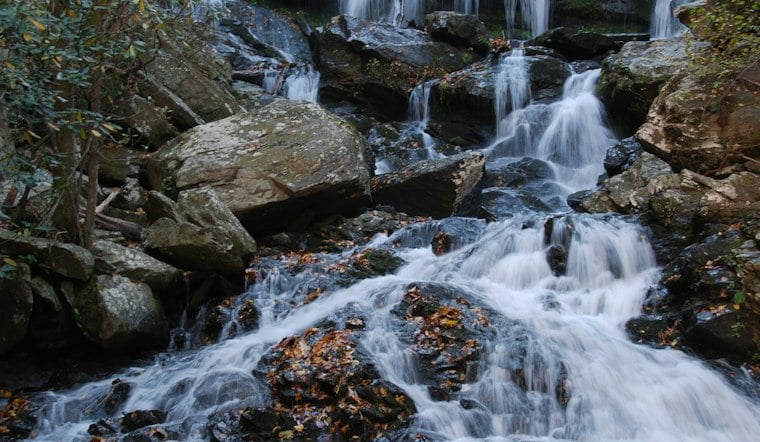
A dam that stood on the Catawba River in McDowell County for decades, generating no hydroelectric power in all that time, is officially gone. The Old Fort Finishing Dam was located just below where the Catawba River meets West Mill Creek, and its removal reconnects more than 212 miles of streams and waterways stretching from the river's headwaters down to Lake James.
Watauga Riverkeeper announced on November 13 that the main dam structure had come down after years of planning, fundraising, environmental monitoring and permitting, according to 828 News Now. The structure had already been badly damaged during Tropical Storm Helene in September 2024, leaving it in rough enough shape that it posed a hazard to people using the upper Catawba River.
With the dam gone, two state-listed species — the Seagreen Darter and the Brook Floater mussel — are now able to move into upstream habitat that had been blocked off, the news outlet's report notes. Conservation groups also expect the removal to improve flood resilience for the town of Old Fort and communities downstream, and they say it should make recreation safer along the Catawba River Blueway and the Blue Ridge Snorkel Trail.
A Long List of Partners Behind the Project
The removal effort pulled together a sizable coalition, including the Catawba Riverkeeper, MountainTrue's Watauga Riverkeeper program, the North Carolina Wildlife Resources Commission, American Rivers, Wildlands Engineering, and the National Fish and Wildlife Foundation, per the same account from 828 News Now. The work isn't entirely finished — crews still have to remove the remaining mill building structure, restore streambanks and plant native vegetation to stabilize the riverbanks.
The Catawba isn't the only western North Carolina waterway where Helene's floodwaters reshaped the conversation around aging dams. The storm also partially washed out Lake Craig Dam on Asheville's Swannanoa River, opening a passage that let native fish reach upstream habitat that had been blocked for more than a century. Wildlife researchers documented fish moving into those previously inaccessible areas above the dam, and a blog post from the North Carolina Wildlife Resources Commission found smallmouth bass and russet darters there during fish monitoring surveys — both considered positive indicators for the Swannanoa's recovery.
Momentum Building for Another Dam Removal Nearby
That accidental breach appears to have added fuel to a separate push in Buncombe County, where environmental and recreation groups have urged the Metropolitan Sewerage District to consider removing Craggy Dam on the French Broad River in Woodfin, citing fish passage, recreation and public safety benefits as reasons for taking it out, the 828 News Now report states.
Dam removal has become a recurring theme across the region's river systems over the past several years. In the Watauga River watershed, American Rivers, MountainTrue and the U.S. Fish and Wildlife Service removed Shull's Mill Dam, which combined with the 2021 removal of Ward Mill Dam downstream to create a 78-mile free-flowing corridor, according to American Rivers. The Ward Mill Dam removal alone reconnected 35 miles of habitat along the Watauga's mainstem and 140 miles of streams across the broader watershed, per Appalachian Voices.
Part of a Bigger Regional and National Push
The South Fork Catawba Sub-Basin Restoration and Protection Plan separately includes three dam-removal projects of its own, according to WUNC, which also reported that the Catawba Riverkeeper Foundation has pointed to dams as a source of blocked fish movement and reduced biodiversity. Nationally, American Rivers has set a goal of removing 30,000 dams by 2050, and 80 dams came down across the country in 2023 alone, as Carolina Public Press has reported.
Whether fish populations actually bounce back the way advocates hope remains an open scientific question. A publication from the U.S. Geological Survey notes that migratory fish are widely assumed to benefit from dam removals that restore connectivity to upstream habitat, but that few studies have actually evaluated whether that assumption holds true. For now, in McDowell County, the work ahead is more immediate: finishing the mill building removal and getting native vegetation back into the ground along the Catawba's banks.





