

























































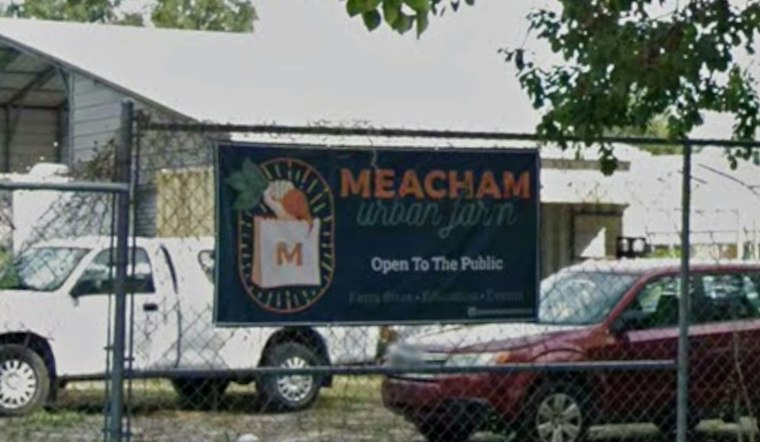
Meacham Urban Farm is opening its two acres at the northeast end of downtown Tampa for another harvest weekend, with a Saturday tasting already sold out and Sunday festival tickets still listed at $10 to $20.
The farm sits in the historic Scrub, between downtown and Ybor City, on ground that once held public housing and a school named for one of Hillsborough County's first Black women principals. Creative Loafing Tampa reported Monday that the weekend includes a tasting on Saturday, Nov. 21, from 4 to 8 p.m., and Harvest Fest on Sunday, Nov. 22.
A Weekend, Two Listings
Creative Loafing's event listing puts the Saturday tasting at Meacham Urban Farm, 1108 East Scott Street, and marks that session sold out. The same report says Sunday Harvest Fest tickets remain available for $10 to $20. A 2021 project fact sheet from Encore had listed the farm at 1134 E. Scott St. on a 2.1-acre parcel, so the street numbers in circulation do not match.
What this year's festival will actually stage is a thinner public record. Creative Loafing describes Harvest Fest as a family festival with food and activities, without a lineup. The first one, on Sunday, Oct. 1, 2023, ran from noon to 6 p.m. and, as that earlier Creative Loafing preview laid out, packed in farm tours, a pig roast with barbecue jackfruit for vegans, live music, talks, raffles, a petting zoo, games, photo stops and local vendors. Adults paid $20 in advance or $25 at the door; children under 12 got in free.
Co-owner Travis Malloy, of TrailBale Farm, said then that the point was to welcome nearby residents and get the word out about weekend store hours. That practical pitch still fits a place the Tampa Housing Authority describes as fully operational, with a public farmers market on weekend mornings that usually sells out.
Rock, Concrete And A $345,000 Start
Agricultural work on the site began in 2018, after Joe Dalessio, Kristin Beauvois of Black Finger Farm and Malloy secured $345,000 from a federal Choice Neighborhood Initiative grant to build the farm. Dalessio is a University of South Florida microbiology graduate. Nicole Dalessio, formerly Kubilins, later joined with a background in horticulture and fruit and vegetable production.
The first two months were demolition in reverse. The crew cleared rubble and pulled more than 100 tons of rock and concrete out of the ground before the rows could mean much. A $1-a-year arrangement made the land available: the 2021 Encore fact sheet says the Hillsborough County School District leased the 2.1-acre parcel to the Tampa Housing Authority under a renewable five-year lease, and the authority leased it to the farm on the same terms. Creative Loafing's account this week also describes the farm's rent as $1 a year under that renewable five-year structure. The school district had earlier taken a portion of former housing land in a swap with the authority.
The fact sheet says the farm opened in December 2020 and held a grand opening in February 2021. The Housing Authority dates completion to that same February. For 2021, the fact sheet projected 60,000 pounds of seasonal produce. That figure was a projection, not a reported harvest.
Why The Name Is Meacham
The farm carries Christina Meacham's name, and the programming for local children is how the operators say they are carrying that legacy. Tampa Magazine reports that by November 1927 she had become the first Black woman to serve as a school principal in Hillsborough County. She was a teacher and an advocate for Black teachers' rights, and a property owner with land in the Scrub and along Central Avenue.
The Scrub was the ground between downtown Tampa and Ybor City where the city's first Black neighborhood formed after the Civil War. Fred Hearns, curator of Black history at the Tampa Bay History Center, has said nearly half of Tampa's Black population lived there during the Jim Crow era, according to Creative Loafing's account.
Christina Meacham Elementary grew out of School No. 2, which became Harlem Academy. Harlem Academy was burned in targeted violence in the late 1800s. St. Peter Claver Catholic School was burned in a similar attack. Harlem Academy was rebuilt with help from local churches and residents, including Thomas McKnight, who commanded a 92-man volunteer militia known as Captain Thomas McKnight's Company in Hillsborough County.
In the early 1950s the federal government bought property around the school for public housing. By 2007, when the Tampa Housing Authority had funding to redevelop the area, Central Park Village and Meacham Elementary School were torn down. The green that is there now is a later use of that cleared land, not a restoration of the neighborhood that stood on it.
What Grows, And Who Shows Up
The Housing Authority calls Meacham a two-acre organic farm with three greenhouses, an educational facility and a farm store selling dairy, meat, vegetables and organic honey. It also says the farm offers more than 40 varieties of fruits, vegetables and herbs. The 2021 fact sheet used a similar count, more than 40 varieties of vegetables and herbs planted, with expansion still underway. Creative Loafing's 2026 report describes a tighter snapshot: 20 to 30 varieties of organic crops in the ground at any one time, among them carrots, beets, cilantro and gold potatoes, plus 100 chickens and multiple beehives. Those counts are not the same thing, and nothing in the record settles whether the difference is season, method or what got planted.
The educational side is more specific. The farm works regularly with 15 to 20 local youths, ages 2 to 15. Nicole Dalessio told Creative Loafing the farm has hosted neighborhood children alongside chef Kareen "Coco" Linton for nearly four years. Joe Dalessio has described the crew as refusing to give up. That is a founder's characterization, not a yield report.
Access at the store has a policy hook. 83 Degrees Media reported that the store accepts Fresh Access Bucks with SNAP, a program the outlet said gives families a double discount on local organic produce. The Housing Authority's weekend-morning market is the public counter where a lot of that food actually leaves the property.
The Wider Plate
Hillsborough's food numbers make a two-acre farm look both useful and small. Inside Climate News reported that more than 15 percent of county residents were food insecure in Feeding America's 2026 Map the Meal Gap, which draws on 2024 data. Hillsborough's Coalition of Community Gardens has said food insecurity is more common among non-white residents and coincides with chronic illnesses including diabetes and heart disease. County food systems specialist Monica Petrella has said each dollar spent on nutrition and physical activity reduces related spending by $5.60 over five years and $6.20 over 10 years.
Gardens around the bay have not been a sure thing. Of 12 community gardens that started in the region between 2009 and 2011, six had failed by 2015. After the Coalition of Community Gardens formed to network and support them, Inside Climate News reported, none failed over the next six years. A University of South Florida doctoral candidate's model found about 58 percent of existing Tampa Bay gardens in neighborhoods ranked highest priority, against about 40 percent that random placement would predict. Nearby, Dee Morales runs 813 Hood Garden, a set of growing spaces in East Tampa, Sulphur Springs and Ybor City, two of them in neighborhoods the federal government classifies as food deserts.
Meacham is not those gardens, and a festival ticket is not a meal program. What is on the calendar is narrower: a sold-out tasting Saturday evening at the East Scott Street farm, and Harvest Fest on Sunday with tickets still posted at $10 to $20. The chickens, hives and weekend market will still be there after the tents come down.



