

























































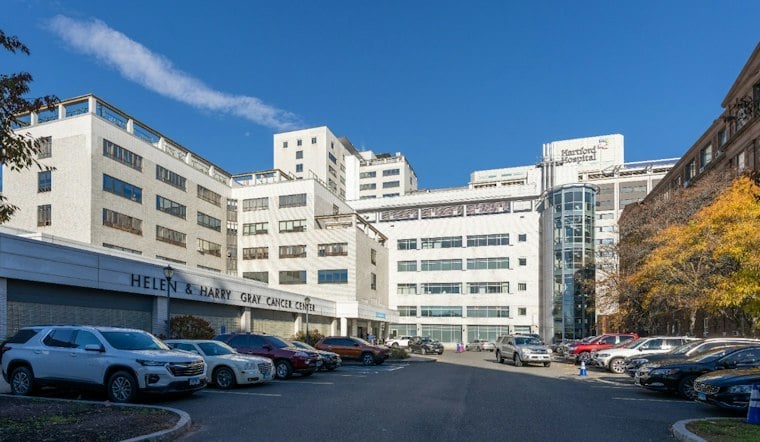
A string of strep throat infections led Sandra Binkowski, then 18 and living in Meriden, to kidney failure and congestive heart failure, the Hartford Courant reported. Fifty years after her brother donated a kidney, the organ was still functioning—a milestone her doctors described as extraordinary.
According to the Hartford Courant, Binkowski became ill in February 1976 and spent three and a half months on dialysis before her brother, Joe Binkowski, was tested as a living donor. He was the only person tested and proved to be a match. Surgeons at Hartford Hospital transplanted his kidney into 19-year-old Sandra on Nov. 9, 1976, the newspaper reported.
Fifty years later, the same kidney was still functioning. The Courant reported that Hartford Healthcare experts consider Binkowski among the longest-living kidney transplant recipients in the hospital's history. Dr. Oscar Serrano, a Hartford Healthcare transplant surgeon since 2018 and head of the National Kidney Foundation's medical advisory board, told the newspaper that 50-year survival is extremely rare.
A 50-Year Graft in Context
Binkowski's outcome far exceeds the typical spans cited by her doctors. The Courant reported that Dr. Joseph Singh, medical director of Hartford Healthcare's kidney transplant program, put a typical kidney transplant's duration at 10 to 12 years, making her graft's function roughly five times that span. Serrano told the newspaper that many transplants last 10 to 30 years, while average survival after a living-donor transplant is 15 to 20 years.
How Current Outcomes Compare
A current benchmark shows higher five-year graft survival for living-donor kidneys in both age groups reported. According to the OPTN/SRTR 2024 Annual Data Report: Kidney, among recipients aged 18–34 who received transplants in 2017–2019, five-year graft survival was 89.9% for living-donor kidneys and 82.5% for deceased-donor kidneys; among recipients aged 65 or older, it was 79.8% and 66.1%, respectively. These figures provide a modern benchmark, not a direct comparison with outcomes in the 1970s.
Singh, who has treated Binkowski for about eight years, told the Courant that having a sibling donor, following care instructions and taking medication consistently may have contributed to her outcome. He also praised her resilience and outlook. Singh said dialysis alone typically carries a three-to-five-year survival outlook, according to the newspaper.
Binkowski is not the only recipient reported to have reached the 50-year mark. In the United Kingdom, Angela Dunn received a kidney transplant on July 25, 1970; Cambridge University Hospitals reported that she was still living a healthy life with the same kidney after 50 years. Kidney Care UK says Dunn's kidney came from a deceased donor and lasted 55 years and nine months.
A Career Spent Around the Operating Room
Binkowski later built a nursing career, the Courant reported. She became a registered nurse in 1985 and spent about 20 years working in the operating room at MidState Medical Center. She then worked for 16 years at Hartford Hospital's eye surgery center before retiring in 2022.
The Courant reported that Binkowski never married or had children and has two nieces, one nephew and four great-nephews. In 2026, her team participated in the Connecticut Kidney Walk at Hubbard Park in Meriden, placing first and raising nearly $12,000, according to the newspaper.
The Daily Discipline Behind the Milestone
The Courant reported that Binkowski sees Singh once a year, has bloodwork every four months and checks with the transplant office whenever her primary doctor wants to prescribe a new medication. Her advice to other patients, as reported by the newspaper, is to keep every appointment and take medications as prescribed.
Singh told the Courant that transplant medicine has changed substantially since 1976. He said surgery now uses minimally invasive laparoscopic and robotic techniques, while newer anti-rejection medications help prevent organ rejection and avoid some of the harsher side effects associated with older immunosuppression drugs.
Serrano told the Courant that transplant outcomes have improved over the decades and that donation options now include kidney swaps and chains extending across large parts of the country, in addition to donations from family members and close friends. Hartford Hospital began its transplant program more than 50 years before the Courant's report, not long after the first kidney transplant took place in Boston in 1954. A separate report from WTNH found Hartford Hospital's Kidney Transplant Program had the best graft survival rate in the nation among 256 adult kidney programs.





