

























































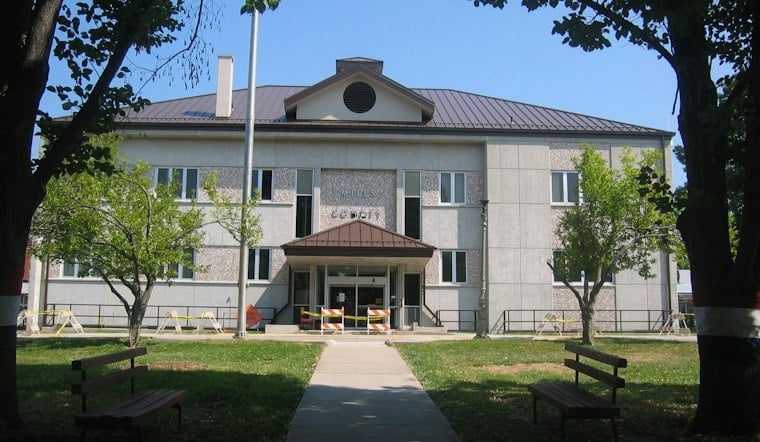
Mills County has no data centers, no pending project to build one, and currently no way to even approve one under its existing zoning code — but that didn’t stop county officials from spending part of Tuesday hashing out what rules should apply if one ever shows up. The Mills County Planning and Zoning Commission heard a presentation from a zoning consultant on whether to add data centers to the county’s zoning ordinance, with at least one resident pressing commissioners to think hard about light pollution and environmental impact before any developer comes calling.
No Project on the Table, But Officials Want Rules Ready
The meeting, held Tuesday in Mills County, Iowa, centered on a presentation about adding data centers as an allowable use under the county’s zoning ordinance, according to KETV. Mills County currently has no data center ordinance, and no data center project is proposed for the county. Planning and Zoning Consultant Matt Wyant told commissioners that under current rules, Mills County has no allowable land use for data centers and would not be able to permit such projects even if a developer wanted to build one there.
That gap is also why county supervisors separately discussed whether a formal moratorium on data centers might be necessary, a conversation that unfolded during the new business portion of a regular Tuesday morning board meeting, also with Wyant, according to KMAland. Officials concluded a moratorium likely isn’t needed, since data centers aren’t currently a listed land use under the county’s zoning ordinances in the first place — meaning any company that wanted to build one would first have to go through the county’s process to add that use to the books. Wyant noted that if supervisors did want a moratorium anyway, it would need a defined time limit and a clear purpose, such as using that window to draft specific regulations.
Resident Raises Light Pollution, Environmental Concerns
Not everyone at the table was simply talking zoning mechanics. Resident Jack Goodman told the commission that other communities have experienced problems with light pollution from data centers, and he said he personally opposes living near one. Goodman said he wants Mills County to protect its environment and everything that defines the county, and he said he hopes commission members listen closely to Mills County residents as they weigh any changes.
Wyant, for his part, laid out the other side of the ledger: data centers can bring economic development, county growth, and jobs. He also pointed to a less obvious factor shaping where these facilities might land — state legislature budget-growth constraints that, he said, may make a rural location like Mills County more appealing to a data center developer than it would otherwise be. Commissioner Christopher Weide recommended that the group study and visit existing data centers to better understand how they actually operate before writing any rules.
Why Water and Power Could Slow Any Project Anyway
Even if Mills County opened the door to data centers tomorrow, Wyant said the physical build-out wouldn’t happen overnight. Rural data center development requires a lot of water and the treatment infrastructure to handle it, he said, plus substantial power capacity — including new transmission lines — that could take years to construct, according to the same KMAland report.
That reality is playing out elsewhere in the state as more Iowa counties confront the same questions. As of October 1, ten Iowa counties already had data-center ordinances in place, and more than 40 others were in the drafting process, according to Iowa Public Radio. Separately, at least six Iowa cities and ten counties were considering policies to regulate the industry, the Business Record reported, and several local governments have enacted moratoriums ranging from three months to 18 months. At least eight Iowa counties had data-center moratoriums in place as of early July, according to Radio Iowa.
How Other Iowa Communities Have Responded
The patchwork of approaches shows up in the details. Linn County adopted a zoning ordinance requiring developers to complete a comprehensive water study and sign a water-use agreement with the county before construction, along with noise and light-pollution limits and 1,000-foot setbacks from residentially zoned property, according to Inside Climate News. Central City released a draft ordinance this week covering zoning, noise, water use, electricity demand, emergency response, and site closure, including a 65-decibel limit for combined operational noise at an industrial property’s boundary and a requirement for pre-construction noise studies, per KCRG.
Marshalltown, meanwhile, enacted a 120-day moratorium in August while city staff draft land-use and zoning regulations, the Business Record reported. Ringgold and Union counties have implemented their own temporary moratoriums, while the Council Bluffs City Council recently denied a request for a one-year moratorium, according to KMAland’s reporting.
For now, Mills County’s planning and zoning commission isn’t voting on anything yet. Commissioners plan to review the materials Wyant provided over the next month, with the next meeting set for December.




