

























































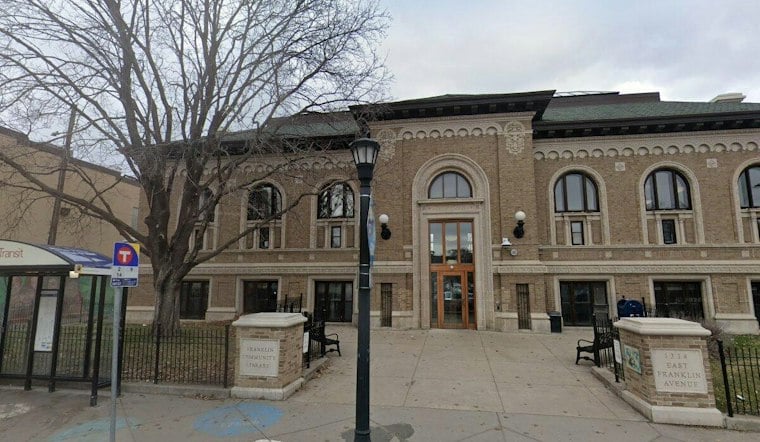
Hennepin County Library has begun the process of decommissioning Franklin Library, the 112-year-old Carnegie building that anchors south Minneapolis's American Indian Cultural Corridor and serves as one of the system's smallest yet most heavily trafficked branches. County officials plan to move library operations from the historic structure at 1314 E. Franklin Ave. to a new location, though no site or budget has been finalized.
The news, first reported by the Minnesota Star Tribune, has alarmed patrons and officials who see Franklin as a lifeline for the urban Indian community of south Minneapolis. County Commissioner Angela Conley, who represents the district where the library sits, said constituents have already reached out to her about what will happen to their access to the branch. She said the community deserves a welcoming space for all, and she wants the current library building given to the American Indian community.
Franklin Library opened in 1914, making it Minneapolis's oldest surviving Carnegie library and the first of four such buildings funded in the city through industrialist Andrew Carnegie, who bankrolled more than 1,600 libraries nationwide. Three of Minneapolis's four Carnegie libraries remain standing; the fourth, a Carnegie building that once served Northeast Minneapolis, was demolished in 1970 and replaced by the current Northeast Library.
A Cramped Building Serving an Outsized Role
Hennepin County administrators have decided that keeping the existing Franklin building is not an option, according to the Star Tribune's reporting. A request for proposals circulated by the county states that previous analysis already ruled out renovating and reusing the current structure. The building needs significant maintenance, including a roof replacement, and officials say it cannot realistically be expanded because it is hemmed in by neighbors the county does not want to displace — including an apartment building and offices belonging to multiple Indian tribes.
The branch's limitations go beyond its walls. Scott Duimstra said the cramped basement hallway gets packed with dozens of people on the days a harm-reduction nonprofit holds services there, straining the library's ability to deliver its own programs. He said some families simply avoid the branch because of the limited space. A roughly $1 million round of interior modifications in 2019 did not resolve those larger problems, per the same reporting — patrons still feel underserved by what the small building can offer.
Despite the constraints, Franklin remains in constant demand. The branch has dozens of public computers that stay in near-continuous use, and longtime patron Tony Gatz said he visits five days a week. Gatz said he had not heard anyone mention plans to decommission the building before the news broke. Myron Thingvold said people who rely on the library simply for warmth would be shocked to learn the county intends to discontinue it.
Security Incident Still Fresh for Patrons
The push to relocate comes about 19 months after a volatile confrontation at the branch rattled the community. Security contractors from Black Knight Protection Agency handcuffed a patron to a fence and pepper-sprayed a crowd that had gathered during a March 25 altercation, according to the Star Tribune. County officials said there had been 12 public complaints about Black Knight since the firm's $2 million contract was approved by the County Board in 2021. That incident fueled calls from some community members to reconsider security at the branch, and it adds to the sense among regulars that Franklin's physical limitations are compounding other tensions at the library.
Mike Hogan said he was frustrated that administrators seemed to have decided to leave the historic building without any public engagement about whether it could be reused. County officials, for their part, said there is no formal process governing how a public library gets decommissioned — leaving the final call to a future vote by the Hennepin County Board of Commissioners. Under Minnesota law, the county board is charged with directing, operating and managing the county library system, according to Minnesota Statutes — though the statute's text does not spell out a specific procedure for shuttering an individual branch.
Master Plan Flagged Franklin for Replacement
The push to relocate traces back to a 10-year master plan Hennepin County published before November 2024 covering the needs of its 41 libraries. That plan recommended replacing and relocating Franklin to a larger facility. Aaron Albertson said library staff had discussed needing more space for years, but the idea had not been put into motion until now. County administrators are finalizing a contract with architectural and public-engagement firms to help determine both the services and the location for a future library.
Officials have acknowledged that finding a suitable alternate site within the Franklin corridor will be both a priority and a challenge. A future Franklin replacement project would be budgeted into the county's capital improvement program only after a study identifies an alternative location and estimates a cost, according to the county's own framework. Franklin's constituency has the county's highest racial and economic disparities among its full-service libraries, a factor Conley and others have pointed to in pressing for a thoughtful relocation rather than a quiet closure.
Franklin's history runs deep. It replaced the earlier Phillips Library in 1914 to serve the neighborhood of the same name, according to Hennepin County Library, and it carries both National Register of Historic Places listing and local historic designation from the Minneapolis Heritage Preservation Commission. The library established its American Indian collection in the 1960s, after the county relocated its Scandinavian collection downtown to free up space, as detailed by the Twin Cities Daily Planet. It became part of Hennepin County Library in 2008 when the Minneapolis Public Library system merged with the county, and despite its modest footprint it has often posted some of the Minneapolis Public Library system's highest circulation numbers.
How Other Historic Branches Have Fared
Paul Mellblom said Franklin is a marquee historic building that contributes to the street life of Franklin Avenue, underscoring what's at stake if the county moves forward with a full replacement rather than a renovation. Other historic branches in the system took a different path: Sumner Library in Near North and Hosmer Library in Powderhorn both received additions over the years to remain functional rather than being replaced outright. Hosmer's yearlong, $4.4 million renovation preserved a large skylight and original wood windows while expanding its children's and teen areas, according to the Star Tribune's earlier coverage. Sumner's refurbishment, completed with LSE Architects, preserved original wood millwork and shelving at the community's request, per Finance & Commerce.
The scale of Franklin's eventual project remains unknown, but the county's ongoing Southdale Library rebuild in Edina offers a sense of what a full replacement can cost: that project, which closed the existing building on January 6, 2025, after planning that began in 2015, paused in 2020, and resumed in 2023, is expected to run around $107 million and take roughly three years to complete, per Hennepin County. Minneapolis has no laws compelling property owners to prevent historic buildings from falling into disrepair, and any major exterior changes to a protected structure like Franklin would still require municipal approval — leaving the building's ultimate fate, and the community's access to it, unresolved for now.


