

























































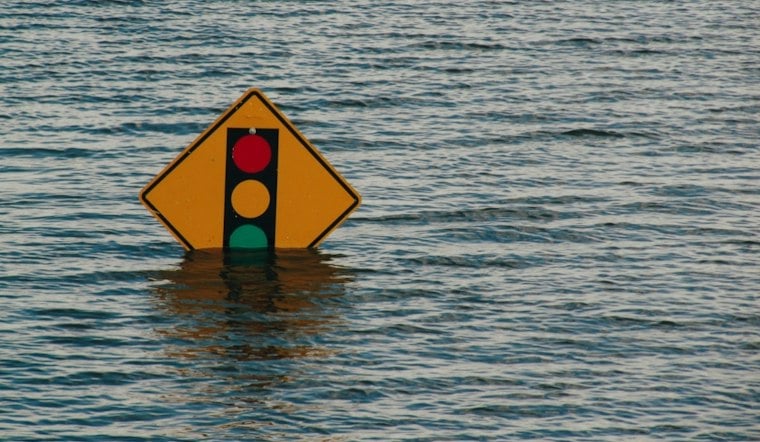
Santa Clara Valley Water marked major flood-protection improvements along Upper Llagas Creek with a ribbon-cutting on Monday, November 16, 2026. Phase 2B remains under construction and is expected to finish in 2027. The project aims to shield roughly 1,100 homes, 500 businesses and more than 1,300 acres of farmland in southern Santa Clara County from a 100-year flood. The announcement lands as multiple forecasters expect a wetter-than-average winter.
According to Santa Clara Valley Water, the Upper Llagas Creek Flood Protection Project's preferred plan calls for improvements along 13.9 miles of channel stretching from Buena Vista Avenue to Llagas Road, including a stretch of West Little Llagas Creek running through downtown Morgan Hill. Phase 2B remains under construction through spring 2027, following the ribbon-cutting celebrating major improvements.
The creek has a long history of overwhelming its banks, with flooding reported in both 2017 and 2009, as noted by The Mercury News. That same report traced the project's roots back to 1954, when the federal government first authorized a flood control fix for the area — meaning the effort predates most of the people it's meant to protect.
A Tunnel, a Creek Bed, and Years of Work
Progress on the ground has come in stages. Valley Water completed Phase 2A in August 2024, which included building a 2,300-foot-long tunnel underneath downtown Morgan Hill, according to the water district. Crews then began working along three miles of West Little Llagas Creek, from Watsonville Road north to Llagas Road, starting in April 2026, per the same agency's account.
Phase 2B, the project's final segment, covers roughly eight miles of Upper Llagas Creek and the East and West Little Llagas creeks between Highway 101 and Llagas Road, Valley Water says. The Morgan Hill Times has reported that this final phase began in October 2024 and is expected to continue through spring 2027.
Funding Fights and a Price Tag in Dispute
Money for the project has come from a patchwork of sources. The Natural Resources Conservation Service awarded $80 million in federal funding to support the final phase, Valley Water says, and the water district's board separately voted on August 13, 2024, to reallocate $42.7 million from the Upper Guadalupe River Flood Protection Project to help cover Upper Llagas Creek costs.
What the whole project actually costs depends on which account you read. The Mercury News's headline on the completion announcement put the figure at $395 million, while the same outlet reported in September 2024 that it was a $241 million undertaking with a $129 million final phase. Morgan Hill Times has described it as a $176.2 million effort led by Valley Water in partnership with the City of Morgan Hill, and a Valley Water brochure from July 2019 pegged the total cost at approximately $180 million. None of the available reporting reconciles these differing estimates.
Insurance Relief Still Pending FEMA Sign-Off
For homeowners along the creek, one of the more tangible payoffs could be their insurance bills. Valley Water says the project is expected to help residents and businesses save thousands of dollars annually on flood insurance, though that relief depends on certification from the Federal Emergency Management Agency that has not yet been confirmed.
The timing of the announcement isn't lost on anyone watching the skies. Three separate winter 2026-27 forecasts predict a wetter-than-average season for California tied to a strong El Niño, as reported by USA Today. NOAA's own winter outlook favors wetter-than-average conditions across the Southwest, including California, alongside warmer-than-average temperatures in Northern California, the outlet reported.
NOAA has cautioned that the added precipitation could bring relief to drought-stricken areas while also raising the risk of flash flooding and mudslides, according to the same USA Today report. Forecasters stress, though, that these seasonal outlooks only sketch broad patterns — they cannot pin down the timing or severity of any individual storm months in advance.



