

























































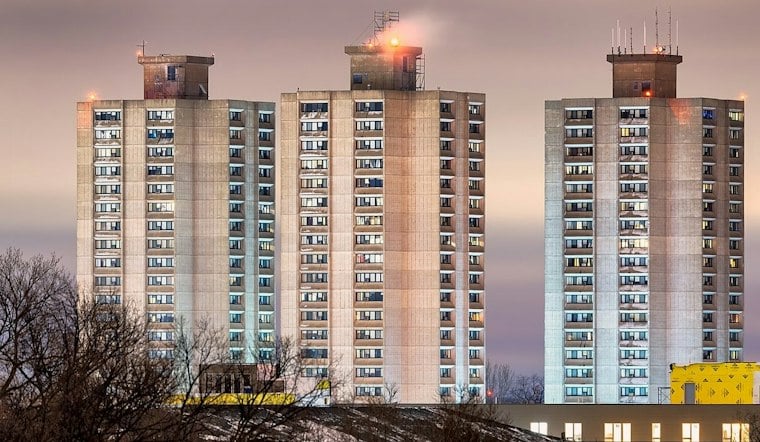
A market-rate senior housing building planned for Near North Minneapolis now totals 82 units, four more than its original 2023 approval — and got there over the objection of city staff, who wanted the project's balcony variances denied. The Minneapolis Planning Commission voted Monday to approve JADT Development's proposal for Satori Senior, attaching 10 conditions to the market-rate active adult housing project at 1823–1839 Bryant Avenue North.
Satori Senior is the second phase of the larger Satori Village development in Near North, according to Finance & Commerce. City staff had recommended denial of the proposal, citing the absence of practical difficulties in meeting zoning requirements for balcony setbacks — a standard that, under Minnesota state law, requires an applicant to establish practical difficulties before a variance can be granted. JADT had requested variances to reduce setbacks across the project, including for the balconies, and commissioners ultimately sided with the developer rather than staff's recommendation.
JADT Development, led by Tim Baylor, argued the balconies were not a cosmetic extra but a competitive necessity. “We want to make sure that we have the amenities that other market-rate senior buildings have, and that includes balconies,” Baylor said, per the same report. The design calls for Juliet balconies on the first two floors and full balconies from the third through fifth floors.
Amenities Aimed at Luring Market-Rate Renters
Baylor said he studied demand for senior housing before shaping the project, and that he wants its amenities to match competitors in the North Loop, Northeast and Robbinsdale. Beyond the balconies, the building is slated to include a fitness center, a bike room, and lounge and programming space, along with a second-floor club room opening onto an outdoor plaza. Parking plans call for 53 stalls, including three EV-ready spaces and five charging stations.
As part of its approval, the planning commission also asked for three canopy trees to help mitigate heat-island effects on the site. Baylor has tied the project to a broader argument about the neighborhood's housing stock: he said North Minneapolis gained roughly 400 housing units over the past 20 years, but that none of them were market-rate until Satori Village's first phase arrived.
A Financing Condition Tied to the First Phase
Getting to this point required clearing a federal hurdle first. The U.S. Department of Housing and Urban Development, which provided financing for JADT's development, required proof that the project's 112-unit first phase could actually be leased before the senior housing phase was allowed to proceed, the outlet reported. That first phase, built as part of a roughly $68 million apartment and commercial complex, was mostly aimed at middle-class renters, with 20% of its units reserved for renters earning up to 60% of the Twin Cities area median, according to the Star Tribune.
The senior building's scale has shifted over time in ways the available record does not fully explain. An earlier account from Twin Cities Business described “the future Satori Senior Living building” as a 60-unit project, while the proposal just approved calls for 82 units — a gap the current reporting does not address. That same earlier coverage described other pieces of the Satori Village plan, including a 112-unit Satori Boutique Apartments building that was to be 80% market-rate and a four-story, 26-unit Satori Lofts building that was to be 62% market-rate. A 2022 Star Tribune report had pegged the overall Satori Village vision at up to 220 apartments and commercial space spread across three blocks along lower West Broadway.
With the planning commission's vote forwarding the proposal, Satori Senior now moves ahead with its 10 conditions attached, adding another market-rate option to a stretch of North Minneapolis that, by Baylor's own account, went two decades without one.





