

























































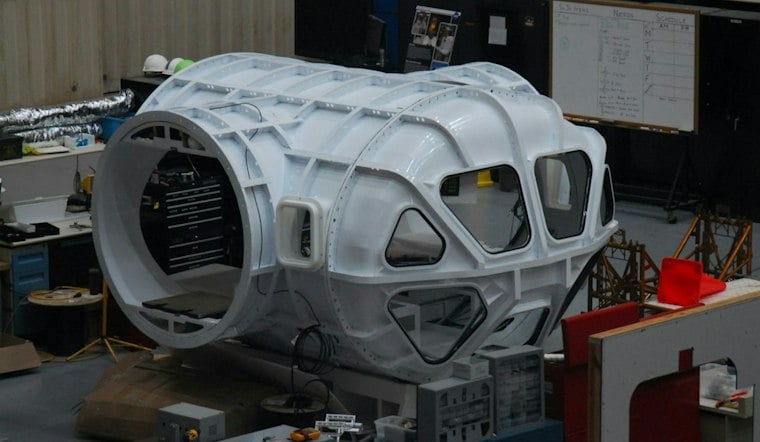
A New England-based startup called Corridian emerged from stealth Tuesday morning with $38 million in fresh seed funding to build autonomous underwater vehicles that can haul cargo, sensors, and potentially weapons without a single crew member aboard. The company says its flagship vehicle, slated to be unveiled next year, is designed to carry ISO-standard containerized payloads over long distances beneath the waves.
The round was led by Point72 Ventures, with Balerion Space Ventures, Harpoon Ventures, DCVC, and Marlinspike also participating, according to Axios, which first reported the raise. Corridian co-founder Mike Guay, a former Army field artillery officer, said the platform will carry whatever payloads customers choose — be that sensors, supplies, or weapons — though he declined to share additional vehicle specifications, including how the AUV would actually be launched.
Filling a Gap Guay Says Doesn't Exist Yet
Guay framed the pitch around a conspicuous absence in undersea logistics. He said undersea transportation currently lacks anything equivalent to railroads, surface shipping, or rockets launched into space — networks that move goods reliably across other domains. Corridian is positioning itself to fill that gap by adopting more of an aerospace manufacturing model, the same report notes, rather than trying to compete for scarce shipyard space.
That approach is deliberate: the company's manufacturing model is intended to avoid interfering with the submarine industrial base and instead lean on a broader commercial supply chain, per the same account. Corridian has lined up a trio of retired flag officers as advisers — Adm. Lisa Franchetti, Vice Adm. Jeffrey Trussler, and Rear Adm. Milton “Jamie” Sands III — lending the young company a layer of institutional credibility as it courts military customers.
Submarine Programs Running Years Behind
The timing lines up with a rough stretch for traditional U.S. shipbuilding. Many of America's highest-priority warships are behind schedule, and crewed submarine construction is years behind schedule amid limited shipyard capacity, aging infrastructure, and a shortage of skilled labor, according to Marine Technology News. The Navy pushed the planned start of its next-generation SSN(X) attack submarine program from the 2030s into the 2040s, with the first procurement slipping five years, from fiscal 2035 to fiscal 2040, during the fiscal 2025 budget process, as reported by Defense News.
The Columbia-class ballistic missile submarine, meanwhile, is projected to be delivered two years late, in 2029, the outlet's report says. A Congressional Budget Office review also flagged delays of 18 to 26 months for the submarine tender Enterprise and 12 to 16 months for the first Columbia-class boat, though that figure comes from a low-confidence snippet of the CBO's publication rather than a fully verified citation.
Existing Uncrewed Vehicles Offer a Comparison
Corridian isn't entering an empty field. Boeing's Orca, which the manufacturer describes on its own site as a first-of-type autonomous submarine built for the Navy, offers up to 6,500 nautical miles of range and a 34-foot modular payload section that can be swapped out for different missions, carrying up to 8 tons of dry payload and launching pier-side without a dedicated support vessel. Yet Defense News has reported that the Orca program had not completed and delivered any of its contracted prototypes as of its article, and Marine Technology News notes that both Orca and the Navy's Snakehead program are suffering from significant cost overruns, technical issues, and programmatic uncertainty — Snakehead having been canceled by the Navy and Congress in 2022 before being partly revived as a market-research effort.
Other players are circling the same opportunity. The Office of Naval Research is seeking rapid design, construction, and testing of an ultra-large autonomous underwater vehicle capable of long-range, high-endurance missions with large modular payloads, with an initial demonstrator called Ocean Explorer meant to prove out the concept, per the same Marine Technology News report. The Defense Innovation Unit has separately awarded prototype contracts for commercial off-the-shelf large AUVs to Kongsberg, Oceaneering, and Anduril Industries, with Anduril's Dive family of vehicles already available for Navy units to borrow for experiments or buy outright, according to Defense News.
An International Race Beneath the Surface
The competition extends well beyond U.S. borders. Mitsubishi Heavy Industries has developed a 10-meter extra-large uncrewed underwater vehicle prototype, and Canada's Cellula Robotics began sea trials in August 2023 for its hydrogen fuel cell-powered Solus-XR, which the company says can travel 5,000 kilometers and stay submerged for 45 days, according to Small Wars Journal. In May, the United States, United Kingdom, and Australia announced their first AUKUS Pillar II signature project to develop payloads and enabling systems for autonomous underwater vehicles, with initial system deliveries expected in 2027, the same outlet reported. It also noted that the industrial base needed to produce, maintain, and upgrade maritime drones at scale does not yet exist among the U.S. and its allies.
Investors Betting on an Elite Team
Stephen Rodriguez, an investor with DCVC, said he has backed more than 25 companies and regards Corridian's founders as an exceptionally serious, elite team. He said he committed to Corridian from the start because, as he put it, observable things disappear once shooting starts — a rationale that underscores the appeal of undersea platforms that are harder to detect than surface vessels or aircraft.
Corridian expects to double its workforce over the next year as it works toward unveiling its flagship vehicle in 2027. The article was authored by Colin Demarest for Axios's technology section.





