

























































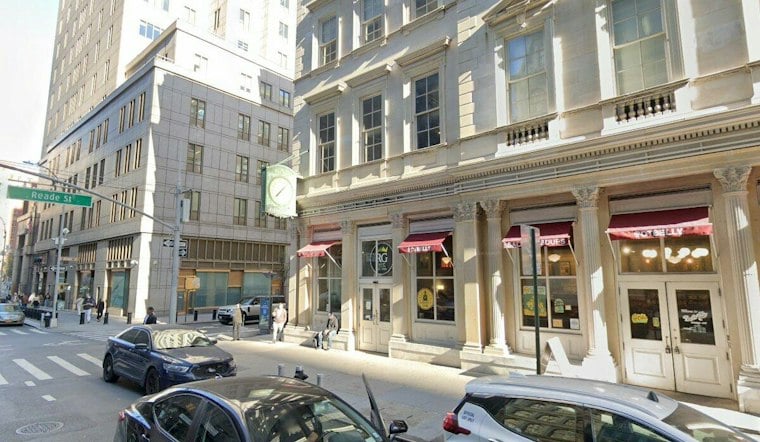
Two new sidewalk shed prototypes went up outside the New York City Department of Buildings headquarters at 280 Broadway in Civic Center, Manhattan, marking the first appearance of either design on a city sidewalk. The Baseline Shed and the Speed Shed, both designed by the architecture firm PAU, were unveiled on October 19 as part of a broader push to overhaul the scaffolding structures that have long lined New York streets.
According to New York YIMBY, PAU developed the two structures with structural partner LERA Consulting Structural Engineers, alongside collaborators Tang Studio Architect, Langan, RWDI, Fisher Marantz Stone, and Dharam Consulting. Both designs lean on sloped roofs that eliminate the need for a parapet, let in more natural light, and are meant to discourage people from climbing onto the structures, per the same outlet. The angled roofline is also intended to improve sightlines to the buildings and storefronts that sheds typically obscure.
Two Very Different Jobs for Two New Sheds
The Baseline Shed is built for the long haul, available in heavy- and light-duty configurations with a transparent polycarbonate roof that filters daylight onto the sidewalk below while still providing overhead protection, the outlet's report notes. The Speed Shed takes the opposite approach: it is a lightweight, mobile structure meant for rapid deployment during short-term work and emergency repairs, swapping solid decking for protective netting.
What makes the Speed Shed stand out is its detachable wheels, which allow crews to reposition it as construction needs shift, the article notes. PAU also designed a Wide Baseline Shed aimed at larger, longer-term projects on broad sidewalks and major thoroughfares, using widely spaced columns meant to cut down on obstructions and keep pedestrian traffic moving.
A Standardized Kit Behind the Design
Underpinning all the shapes is a standardized, modular kit of parts with adjustable aluminum framing, which PAU developed to simplify installation, maintenance, and reuse as site conditions change, per the same account. The firm's designs also incorporate a drainage gutter and a concealed flat scaffolding plane tucked behind the roof slope.
The prototypes are the latest fruit of the city's Get Sheds Down initiative, which selected teams led by PAU and Arup back in February 2024 to reimagine the ubiquitous structures. Those teams produced six designs in total, three from each firm, first unveiled in November 2025. Arup's Flex Shed and Rigid Shed prototypes got their own 30-day test run in front of 280 Broadway in June, before PAU's turn outside the same building, according to 6sqft. Arup's Flex and Rigid designs were later named among TIME magazine's Best Inventions of 2026, the YIMBY report adds.
Rulemaking Underway as Shed Counts Shift
The Department of Buildings is advancing the rulemaking process that would make all six designs available throughout the five boroughs. The six designs are owned by the city of New York and can be freely reproduced, per the same reporting.
City officials have been touting progress on reducing the sheer number of sheds citywide. On October 19, Mayor Zohran Mamdani and the DOB reported that sidewalk sheds across the five boroughs had declined by approximately 1,200 since January, a drop of more than 15 percent. As of this past Tuesday, November 3, the city had 6,822 active sidewalk sheds, which have been in place for an average of 568 days and span a combined 1,624,990 linear feet, according to DOB figures cited by 6sqft.
A separate figure from a March NYC Mayor's Office release put the citywide decline in sidewalk sheds at 17 percent, though that announcement did not specify the measurement period behind the number. The two figures are not presented as directly comparable, since they appear to track different dates. Still, between the new prototypes at 280 Broadway and the ongoing push to thin out the city's shed count, the scaffolding that has defined so many New York sidewalks for years may be entering a visibly different era.




