

























































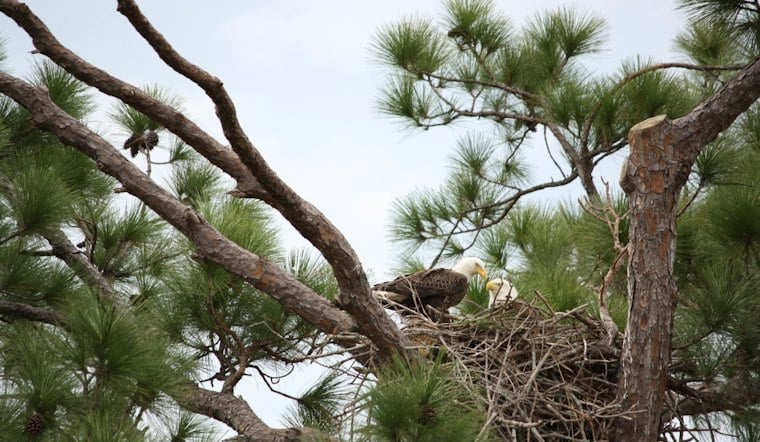
Nine bald eagle nests are under watch across Sanibel, Captiva and North Captiva as the islands' annual nesting season gets underway, with volunteers reporting no eggs yet but plenty of activity, including one pair caught moving in on an osprey's old home.
According to the Sanibel-Captiva Conservation Foundation, volunteers are monitoring five nests on Sanibel, three on Captiva and one on North Captiva. As of the foundation's early November update, none of the pairs had laid eggs. One of the Captiva pairs, however, had been spotted modifying an osprey nest on Sanibel, a sign that nest-building season is in full swing even if egg-laying hasn't started.
Per the Captiva Sanibel news site, the current nesting season began in October, though some island eagles have returned as early as August in recent years. The Florida Fish and Wildlife Conservation Commission defines the official bald eagle nesting season as running from October 1 through May 15, and notes that eagles typically begin building nests or gathering nesting materials in late September or early October.
A Record Season To Beat
The stakes for eagle watchers this year are tied to last season's numbers. The nests SCCF volunteers monitored fledged 13 eaglets during the 2025-2026 season, a record high. Captiva Sanibel reported that the 2024-2025 season “fledged 10 nests.” The foundation's report called that 13-eaglet count a record, and the station WGCU reported that the foundation hopes the mark gets topped again this time around.
Bald eagles tend to return to the same nesting territory year after year and often reuse the same nest, which is part of why volunteers can track individual pairs across seasons. If a pair's first clutch fails early in the season, they may renest, and eaglets from a renest can still fledge as late as June or July, meaning eagle activity can stretch well beyond the official nesting-season window.
When Eagles and Ospreys Collide
The Captiva pair's interest in an osprey nest on Sanibel points to a recurring dynamic between the two raptor species. Ospreys and eagles commonly steal each other's nests, and both species are territorial and return to the same nesting area each season. Florida's bald eagle nesting season begins earlier than osprey nesting season, which can give eagles an opening to move into a nest before the osprey pair returns to try to reclaim it.
Bald eagles also maintain what are known as satellite nests, and may move between nests within their own territory. According to the Florida Fish and Wildlife Conservation Commission, a single eagle territory averages about 1.5 nests and can include anywhere from one to five. It remains uncertain where the Captiva pair eyeing the Sanibel osprey nest will ultimately lay its eggs this season.
Protections and a Decade of Tracking
Bald eagles remain protected under both the Bald and Golden Eagle Protection Act and the Migratory Bird Treaty Act, according to SCCF, and disturbing nesting eagles can violate both federal laws. Captiva Sanibel reports that any disturbance of nesting eagles should be reported to the appropriate authorities.
The Sanibel-Captiva Conservation Foundation has monitored nesting eagles on Sanibel since 2016, though some of the pairs being tracked may have nested in the area for years before that monitoring began — the so-called Dairy Queen eagle pair has reportedly been observed on Sanibel since 2002. Eight volunteer monitors currently watch the nests across Sanibel, Captiva and North Captiva, entering their observations into EagleWatch, a database created by Audubon that tracks eagle nesting across Florida and allows researchers to follow changes in the state's nesting eagle populations over time.
Young eagles typically don't reach breeding age until four or five years old, according to WGCU. For now, islanders are left watching nests, and an osprey's old home, for the season's first signs of eggs.





