

























































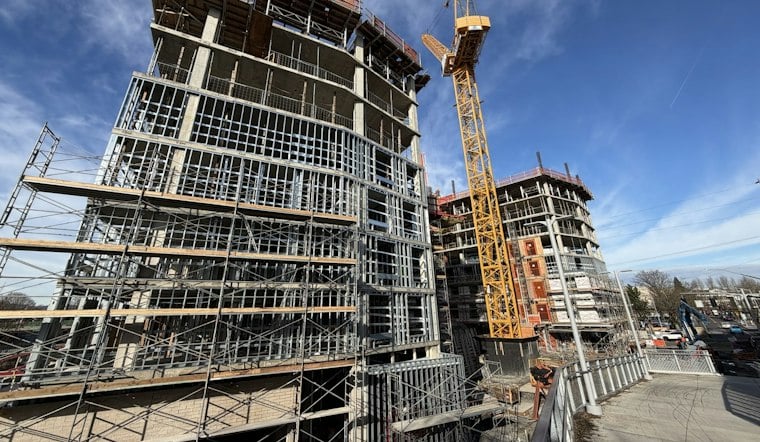
A stalled North Portland apartment building that once budgeted its units at $361,000 apiece will now cost nearly $1 million each to finish, after the Oregon Housing Stability Council voted on Oct. 2 to pour an additional $30 million into the project. The vote brought the total cost of the 57-unit Monarca development to $56.2 million — an average of $985,513 per apartment — even as two council members refused to support it.
The council approved the extra funding despite abstentions from Ed McNamara, a retired Portland affordable housing developer, and Javier Mena, the affordable housing manager for the city of Beaverton, according to the Oregon Journalism Project. Three other council members voiced concerns about the project's price tag but voted to fund it, while three voted to fund it without objection; council member Mary Ferrell was absent from the vote. Monarca, located at 1220 N Jessup St. in North Portland, sits in an eight-story building that will rent its apartments to households earning 60% or less of the area median income.
A Project That Stalled at the Halfway Mark
Monarca was formerly known as Minnesota Place, and construction on the project began four years before the council's latest vote. It was initially budgeted at $26 million, or $361,000 per unit, but work stopped in 2024 when the building was only half complete. The Oregon Bureau of Labor and Industries determined that Minnesota Place LLC had to pay prevailing union wages, which are significantly higher than nonunion wages, while general contractor Lorentz Bruun Co. had bid the project based on nonunion pay.
Court records indicate the prevailing-wage decision was not conveyed to Lorentz Bruun until midway through construction, and the resulting communication breakdown caused a multimillion-dollar shortfall. Minnesota Place LLC asked BOLI to reconsider its decision, and BOLI denied the request. The developer then asked Oregon Housing and Community Services to fund the gap between prevailing and nonunion wages, and the state denied that request as well. The project became the subject of two lawsuits in Multnomah County Circuit Court involving BOLI, Minnesota Place LLC, Lorentz Bruun and its subcontractors, and the building has stood unfinished and vacant while the parties litigated for two years.
Daniel Young, who owns a home across the street from Monarca, said living near the stalled construction had been nightmarish. Mark Miller, a spokesman for Oregon Housing and Community Services, disputed the idea that the building sat vacant simply because the state declined to cover the wage difference, saying the prevailing-wage issue was just one of many problems with the project. Miller said the alternative to funding the completion was walking away from the state's existing investment and leaving the building unfinished, and OHCS officials expect litigation over the stalled project to settle soon, which is a condition of Hacienda finishing the work.
Hacienda Steps In, Fewer but Bigger Units
In 2025, Oregon Housing and Community Services decided to move forward with the project and selected Hacienda Community Development Corporation, a Latino-led nonprofit in Portland, to finish it. Hacienda reconfigured the building's space and reduced the apartment count from 72 to 57 in order to provide more two- and three-bedroom units. That redesign brought the total project cost to $56.2 million.
Javier Mena said the project would not receive funding if it were submitted under today's costs, telling colleagues, “there's no way we would fund it.” He separately said Monarca was overpriced and worried that approving the additional money would effectively bail out a project the state might be better off abandoning. Ed McNamara said Monarca was extraordinarily expensive and, per a meeting recording cited by the Oregon Journalism Project, noted that its total construction costs ran three times what the state is putting into other projects.
Wider Scrutiny of State Housing Costs
Monarca's price tag is landing amid broader questions about how Oregon spends its housing dollars. Several affordable housing developers have said BOLI broadened its interpretation of which projects are subject to prevailing-wage requirements, and critics argue those rulings drive up project costs while yielding less housing overall. Developers have urged Gov. Tina Kotek and the Democratic legislative supermajorities to address the effects of BOLI's rulings.
Separately, housing projects funded by Oregon Housing and Community Services averaged $318 per square foot in hard construction costs last year — 31% above the agency's own benchmark, according to Willamette Week. The agency met its benchmark as recently as 2022 but has missed it by a wide margin in each of the past three years. Costs vary widely by project: a 72-unit McMinnville development was budgeted at $413.12 per square foot in hard construction costs, while a 168-unit Corvallis project came in at just $172.80 per square foot, the outlet reported.
Some experts estimate that prevailing-wage requirements alone add 10% to 20% to the cost of housing, which can reduce the number of units a state's limited funds can build, according to separate Oregon Journalism Project reporting. That reporting also detailed how Related Northwest scrapped a proposed 143-unit affordable housing project in Wilsonville entirely after BOLI's April 2024 determination that its LIFT funding and commercial uses made the whole project subject to prevailing wages. In Lorentz Bruun's own court filings, the contractor argued that Oregon law exempts affordable housing from prevailing-wage requirements and alleged that BOLI, under elected Labor Commissioner Christina Stephenson, misinterpreted the law; BOLI has said in court and to the Oregon Journalism Project that it interprets the law as written, and it disagreed with Lorentz Bruun's interpretation.
What the Numbers Mean for North Portland
The scale of the spending comes into sharper focus against the local housing market. North Portland had a median single-family home sale price of $481,000 this year, meaning the state could have purchased 116 detached North Portland homes for less than it ultimately spent on the 57 Monarca apartments. Oregon has significant control over these costs because the state finances the projects directly.
Oregon Housing and Community Services oversees state funding for low-income housing with a biennial budget of $3.7 billion, employing more than 450 people who primarily finance affordable housing construction and renovation through forgivable loans, tax credits, grants and federal funds. Axios Portland reports the agency expects to build or renovate nearly 8,000 affordable homes during the current two-year budget cycle, and state housing officials have said construction costs vary based on location, building design and other requirements — adding that strict cost limits could end up excluding worthwhile projects, according to Axios Portland.
Kotek, who won reelection as governor, has said her second term would focus on making key services, especially housing, more available and affordable. She appointed the nine-member Oregon Housing Stability Council to oversee billions of dollars in state housing funds, and her spokesman, Lucas Bezerra, said she plans to work with OHCS in the coming year to examine the costs of funded projects and prioritize greater housing-production impact from state dollars.



