

























































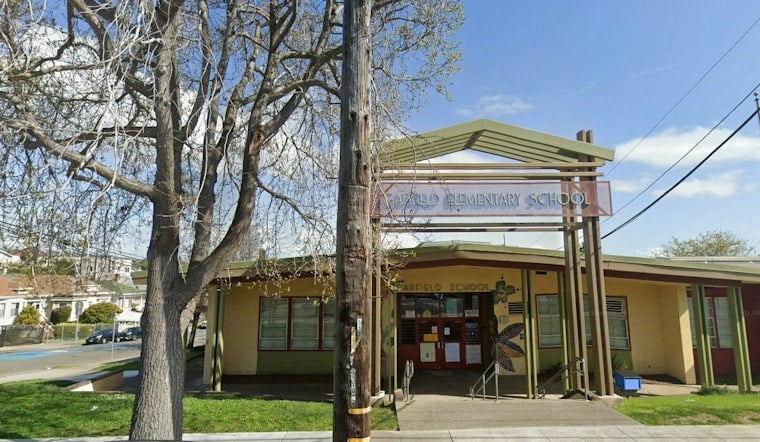
Oakland's City Council voted on Nov. 10 to sell 0.6 acres of Garfield Park in East Oakland to the Oakland Unified School District for $597,500, with the money earmarked for the city's general fund. The field, tucked behind Garfield Elementary School, has sat largely off-limits to the public for years, available only by registration to groups that reserve it in advance.
The city says the sale price reflects the midpoint between Oakland's and OUSD's separate appraisals of the land. OUSD wants the parcel to fold into its $104.5 million rebuild of Garfield Elementary, a project funded through voter-approved bonds, according to Oakland North, which first reported the Life Enrichment Committee's vote to advance the proposal in late October. The outlet reported that an assistant capital improvement project coordinator with Oakland Parks said the sale proceeds would land in the city's general fund.
OUSD's Board of Education voted in March to scrap its original plan to modernize the existing Garfield Elementary building in favor of constructing a larger school from scratch, according to the Oakland Unified School District. The new building will have 29 classrooms serving grades PK through 5. The district's plans call for new play areas, and community partnerships would use the adjacent field to expand student access.
A Field That's Been Locked Up for Years
The field's recent history is thin. A city report found that the charter school Bay Area Technology School was the only official user of Garfield Field, reserving it for a single three-month stretch, per the report Oakland North reviewed. The field was previously used for girls' softball, Babe Ruth baseball and fall recreation programs, according to reporting from The Mercury News, and more recently it has been used by a nearby charter school's boys' and girls' soccer teams.
Seth Feldman, principal of Bay Area Technology School — located one block from Garfield Field — told the Mercury News he had not been notified about the park sale. He said he hoped his school could work with OUSD to keep using the field going forward.
Under the proposed agreement, OUSD will provide field access to qualified community organizations, Oakland city staff said. Those groups would need to reserve a minimum of eight to 10 hours per week through the district's reservation system and pay its standard fees, per the city's terms as described to the Mercury News. OUSD has said it plans to fold Garfield Park into its broader renovation once it takes ownership, with the project expected to include a new turf field open to the public.
Timeline for the Rebuild
Construction on the renovation project is expected to begin in 2027, with students scheduled to move into the new school building in August 2029. The existing campus would then be demolished and site improvements completed in 2029, according to the agenda report cited by the Mercury News.
Echoes of the Coliseum Saga
Oakland's instinct to plug budget gaps with one-time asset sales has a rocky recent history. Then-Mayor Sheng Thao planned in 2024 to sell the city's 50 percent interest in the Coliseum property to help close that year's budget deficit, a plan financial experts criticized at the time as short-sighted. The City Council went on to pass a $2 billion mid-cycle budget built around anticipated Coliseum proceeds that officials said were necessary to erase more than $100 million of the deficit, according to ABC7 News. At the time, Oakland's own administration acknowledged there was still no written purchase and sale agreement for the anticipated $105 million deal, even as the budget leaned on it. Anti Police-Terror Project deputy director James Burch warned then that the one-time cash injection would not solve the city's long-term budgetary concerns, while council president Nikki Fortunato Bas said the structural deficit had been decades in the making.
The Coliseum deal then fell apart in stages. The buyer, AASEG, paid its $5 million deposit but missed the first $10 million installment when it came due on Sept. 23, 2024, according to Oaklandside. The missing payments never arrived, forcing Oakland to enact what the outlet described as brutal budget cuts that December. By May 2025, the city scrapped the original payment plan entirely, postponing the sale until Alameda County completed a separate transaction with AASEG, the same Oaklandside investigation found.
Oakland officials later moved to dismantle the formal link between the Coliseum sale and the city's operating budget following Thao's 2024 recall. The deal was eventually restructured again: by July 2026, the plan called for the city to hand over ownership of the entire complex immediately, with stadium payments arriving in later years, the Mercury News reported. The council ultimately approved a reworked $125 million sale of its remaining 50 percent stake to AASEG and its affiliate, Oakland Acquisition Company — a $110 million lump sum plus 6 percent of future annual gross ticket sales from the redeveloped complex, passing 6-1, according to the Post News Group. That 6 percent ticket-sales cut was designated as an ongoing revenue stream for the city's General Purpose Fund, rather than a one-time payout.



