

























































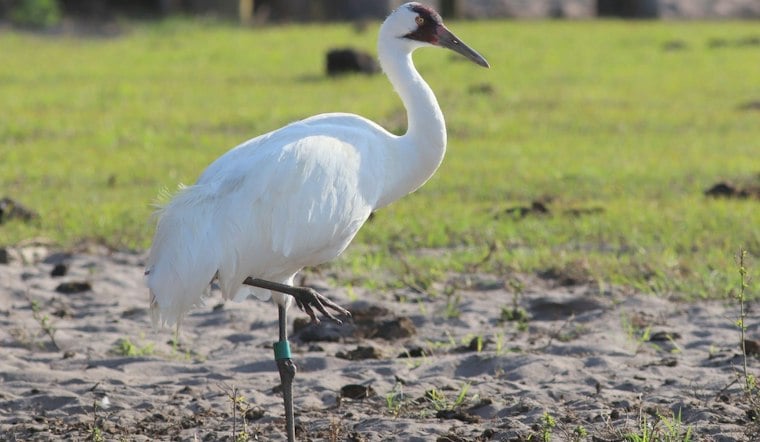
Oklahoma wildlife officials are asking hunters, bird watchers and anyone else out in the field this fall to keep an eye out for one of North America's rarest birds. The whooping crane, a federally endangered species that stands nearly 5 feet tall, is moving through the state right now on its annual migration, and officials want every sighting reported.
The Oklahoma Department of Wildlife Conservation is asking people who spot a whooping crane to report it. Its whooping crane field guide provides a way to submit sightings and upload photos. The request was also reported by The Journal Record.
Whooping cranes follow the Central Flyway between nesting grounds in Canada and wintering grounds on the Texas coast. The route is roughly 2,500 miles and may take nearly two months, with wetlands and grain fields serving as stopover sites, according to The Journal Record's reporting. At nearly 5 feet tall, with a wingspan of about 90 inches, the cranes are North America's tallest bird.
Where To Look In Oklahoma
The department's field guide says Oklahoma sightings are most common from mid-October through November, in an area generally east of Guymon and west of Interstate 35. A crane may stay at a stopover for only one to three days before moving on.
The Journal Record reports regular stopovers at Salt Plains National Wildlife Refuge near Jet, Tom Steed Reservoir near Snyder, and Hackberry Flat Wildlife Management Area near Frederick. Salt Plains is also designated critical habitat for whooping cranes, according to the wildlife department's field guide.
A Fragile, Slowly Recovering Population
The Aransas-Wood Buffalo population is the only remaining naturally occurring group of whooping cranes left in the wild, the Journal Record notes. Figures on just how many birds that represents vary depending on the source: the wildlife department's species page puts the group at just over 350 individuals, while a preliminary U.S. Fish and Wildlife Service analysis of the 2024-25 survey, found in agency documents hosted at iris.fws.gov, put the count at 557 cranes that winter. That 2024-25 tally differed from the prior year's count by 17 birds, a gap the Journal Record describes as within the survey's margin of error.
The wildlife department's field guide estimates about 600 whooping cranes in total, including both wild and captive birds. The Journal Record also reported that at least eight cranes wintered at Salt Plains, the first time that had been documented in Oklahoma.
What recent counts and sightings show
The U.S. Fish and Wildlife Service estimated 540 cranes in its primary survey area in winter 2025-26, compared with 557 the previous year. The agency said the difference was within the margin of error. Its survey report gives the population's average long-term growth rate from winter 1938-39 through winter 2025-26 as 4.24%, with a 95% confidence interval of 1.74% to 6.66%.Public reports also help fill in the picture between annual surveys: the Fish and Wildlife Service says resource professionals confirm sightings along the migration route, giving biologists information about migration timing, locations and habits.
Hunting Season Overlap
Because the migration coincides with hunting season in parts of the state, the wildlife department may close a wildlife management area until a spotted whooping crane moves on, the Journal Record reports. Any such closures will be marked with signs on-site and posted at wildlifedepartment.com, the same source notes.
Don't Confuse Them With These Look-Alikes
Whooping cranes have white feathers, a red crown, rump feathers and black wingtips that are visible only in flight, according to the wildlife department's field guide. Sandhill cranes, egrets and American white pelicans are sometimes mistaken for them, the Journal Record reports. Egrets are shorter and lack the black wingtips, while pelicans fly with a distinctive S-curved neck that sets them apart at a glance.





