

























































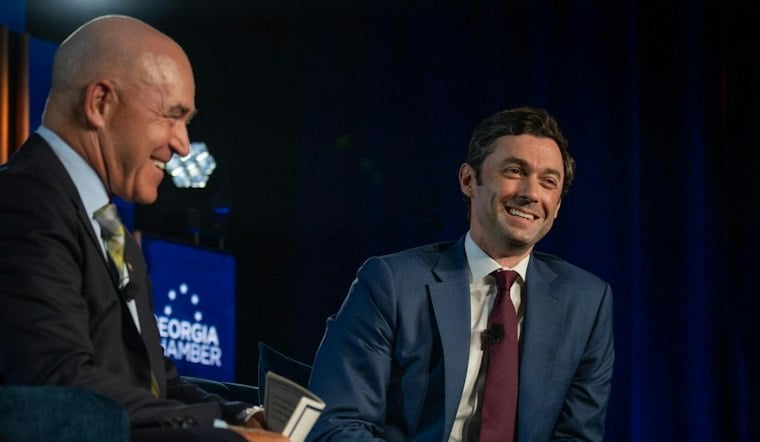
Georgia's closely watched U.S. Senate race hit a telling split-screen moment Tuesday morning: incumbent Sen. Jon Ossoff appeared live on Atlanta radio as polls opened across the metro area, while Republican challenger Rep. Mike Collins's campaign did not take up the same invitation. Ossoff is fighting to hold onto the seat he won five years ago, facing Collins in one of the most closely watched midterm contests in the country.
Ossoff joined WABE's Morning Edition as voting got underway, according to WABE, which reported that precincts were buzzing with voters and election workers across metro Atlanta as he spoke. On air, Ossoff framed the stakes beyond his own candidacy, telling the station that he's also fighting to uphold the tenets of democracy. WABE said it had also extended an Election Day interview invitation to Collins, but his campaign did not accept it.
A Rematch Months in the Making
Tuesday's contrast traces back to an Atlanta Press Club general election senatorial debate on Oct. 13, where both Ossoff and Collins shared a stage ahead of the vote. Ossoff, a U.S. senator since flipping the seat blue in a 2021 runoff, and Collins, who has represented Georgia's 10th Congressional District since 2023, have been locked in a tight campaign built on sharply different diagnoses of the state's economic pressures. Per the same WABE reporting on that debate, Collins blamed higher living costs on “Biden-omics” and high taxes, while Ossoff pointed to tariffs, saying diesel prices were up 70% and ground beef and coffee up 30% since President Trump took office. The two also clashed over healthcare costs, with Ossoff attributing the rise to recent Medicaid cuts and Collins pointing instead to the Affordable Care Act.
Record Early Voting Set the Stage
The Election Day split follows a historic early-voting stretch in Georgia. More than 2.8 million Georgians cast ballots before three weeks of early voting ended Oct. 30, including a midterm record of 2.7 million who voted in person, according to the Atlanta Journal-Constitution. That figure represented 34% of Georgia's 8.2 million registered voters and marked a 13% jump over 2022 midterm turnout, the paper reported, attributing the surge to a younger, more diverse electorate and stronger turnout in left-leaning areas. The AJC was careful to note that the early-voting numbers can't show how those Georgians voted or predict Tuesday's outcome.
Turnout kept climbing once polls opened Tuesday. By 10 a.m., Georgia Secretary of State Brad Raffensperger said more than 300,000 Georgians had already voted that day, with his office projecting more than 1 million votes by the end of the day, according to WTOC. The same report noted Ossoff also sat for a one-on-one interview with Atlanta News First Tuesday morning, using the appearance to urge Georgians to get out and vote.
Whether Collins's campaign plans to address the media directly before polls close remains unclear, as does the reasoning behind its decision not to accept WABE's invitation. For now, the race's closing hours are defined by one candidate speaking directly to voters over the airwaves and another who, per available reporting, has not.




