

























































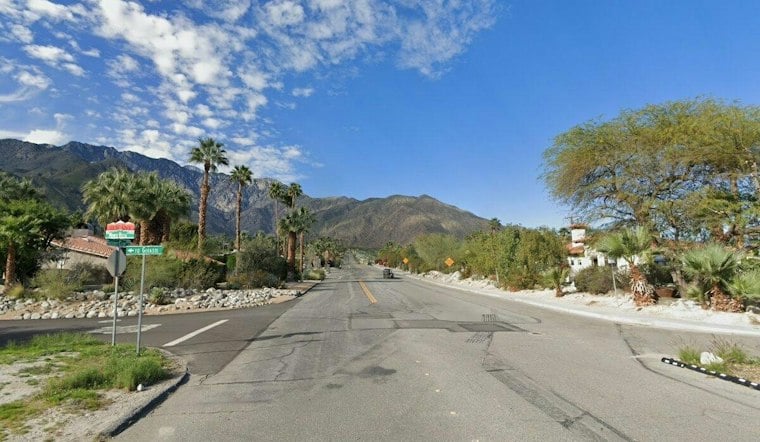
Palm Springs has finished narrowing Racquet Club Road from four lanes down to two, but the project's completion hasn't settled a question that dogged it for more than a year: will slower traffic on the corridor also slow down the fire engines and ambulances that rely on it. The city says the redesign was meant to improve traffic and pedestrian safety along the roughly two-mile stretch, but a city-commissioned study warned the changes could add precious seconds to emergency response times in an area already served by the slowest fire station in Palm Springs.
The City of Palm Springs has completed its Racquet Club Road reconfiguration project, according to Patch. The finished corridor runs from North Palm Canyon Drive to Farrell Drive and Via Escuela, with one travel lane in each direction, new bike lanes, and a dedicated two-way center turn lane, per The Palm Springs Post. The reconfiguration follows the same four-lanes-to-two narrowing described in a report from NBC Palm Springs.
A Study That Flagged Seconds That Matter
Before construction began, traffic engineering firm Kimley-Horn modeled how the new configuration would affect travel times, and the results were not uniformly reassuring. Under 2024 traffic conditions, the firm estimated peak-hour travel times could rise anywhere from 5 to 53 seconds depending on which segment of the corridor was being measured, the same Palm Springs Post report notes. The worst of those numbers, 53 seconds, came from a scenario modeling a fire engine traveling eastbound across the entire two-mile stretch during peak morning hours.
A separate fire-response study went further, projecting that the reconfiguration could increase emergency response times by between 2.7 and 63 seconds in the area served by Fire Station No. 3, with the upper figure representing a worst-case scenario projected out to 2040. The same report notes that Fire Station 3 currently has the longest average response times of the city's five fire stations, making any added delay land on an area that was already slowest to respond. Notably, the traffic model did not account for fire-truck-specific maneuvers, such as using the center turn lane or parking lanes, or for emergency-vehicle signal preemption, limitations that leave open how closely the modeled numbers reflect what a fire engine can actually do on the road.
Council Approved the Project Anyway
Despite those projected delays, the Palm Springs City Council voted to approve construction documents and authorize staff to solicit bids for the project, the Post reported. City Manager Scott Stiles said at the time that the city would explore mitigation options including traffic-signal pre-emption technology for emergency vehicles and improved truck-route signage, according to the same outlet. NBC Palm Springs reports separately that city officials discussed technology to help firefighters navigate traffic, though published project records do not confirm whether that technology was ultimately installed.
The vote came after an extended public engagement process. Between September 2024 and September 2025, the city held four in-person and online community meetings and collected more than 200 comments, 125 of which focused on traffic-calming concerns, per the Post's reporting. A conflict exists in the record on what the project actually cost: NBC Palm Springs' reporting puts the figure at $2.7 million, while the Palm Springs Post reported an estimated construction cost of $3.45 million. The supplied record does not clarify whether the two figures refer to different cost scopes.
Contributors Push for a Formal Review
On The Roggin Report, contributors Don Vickers and Tammy Black discussed emergency access concerns tied to the redesign. Black emphasized that access for firefighters and paramedics is critical, particularly during medical emergencies, and suggested comparing emergency response data from before and after the redesign to see what, if anything, changed. Vickers, for his part, said the narrower roadway appears to have slowed traffic and reduced vehicles' ability to maneuver around obstructions, pointing specifically to cars parked or stopped in the bike lane as one such obstruction.
Both Vickers and Black said the city should review results after roughly six months to a year, comparing emergency calls and response times to assess the project's effect on public safety. Vickers added that the city needs to evaluate whether the project meets its safety goals while still accounting for emergency response needs. No post-completion emergency-call or response-time data has been made public, so whether the redesign has actually changed how quickly crews reach calls along the corridor remains unknown for now.





