

























































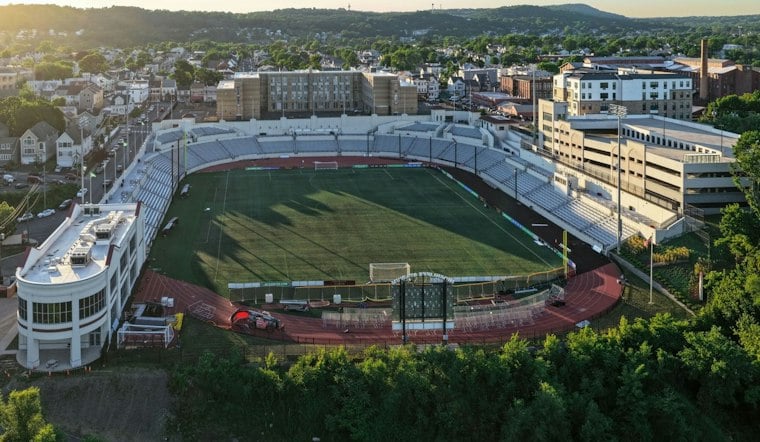
Overlooking the Great Falls of the Passaic River in Paterson, Hinchliffe Stadium opened on July 8, 1932, and within a year was hosting some of the greatest ballplayers ever to pick up a bat. By the time it shut its gates in the 1990s, the stadium had decayed so badly that demolition seemed like the likely ending. Instead, after decades of fights over its fate, Hinchliffe reopened in 2023 as a modern venue still carrying the weight of its Negro Leagues past.
Construction on the stadium began in 1931, and local architect John Shaw designed the venue, according to the Society for American Baseball Research. The Olmsted Brothers contributed to its landscape setting, and the finished stadium featured towers and Art Deco details, with a bronze relief by Gaetano Federici commemorating sprinter Eleanor Egg built into the structure, per reporting from News12 New Jersey. The venue opened with a pageant marking George Washington's birth bicentennial and a formal dedication featuring a track-and-field competition, the outlet reports.
Hinchliffe quickly became a showcase for Black professional baseball. On September 5, 1933, the New York Black Yankees faced the Pittsburgh Crawfords at the stadium, a Crawfords roster that included future National Baseball Hall of Famers Josh Gibson, Oscar Charleston, James “Cool Papa” Bell and Judy Johnson, according to News12. That same year, the Philadelphia Stars defeated the New York Black Yankees at Hinchliffe in a game promoted as “the Colored Championship of the Nation,” according to SABR. The Negro Leagues Baseball Museum notes that the Black Yankees called Hinchliffe home from 1933 to 1938.
A Launchpad for Larry Doby
Hinchliffe's baseball legacy is tied closely to Larry Doby, who attended Eastside High School and played football at the stadium before beginning his professional baseball career with the Newark Eagles in 1942, per News12. Doby joined Cleveland in 1947, becoming the first Black player in the American League, months after Jackie Robinson broke Major League Baseball's modern color barrier with the Brooklyn Dodgers, the outlet reports. SABR adds that Doby's Major League debut came in July 1947.
The stadium wasn't only for baseball. SABR reports that a Hinchliffe boxing card in 1946 was the first telecast of a New Jersey sports event. Beyond sports, Andscape describes Hinchliffe as an entertainment hub in Paterson during the 1930s and ’40s, hosting motorcycle and midget-car racing, rodeos, comedy shows, circuses and concerts. News12 reports the venue also hosted war-bond events during World War II, appearances by Abbott and Costello in the 1940s, and a Sly and the Family Stone concert in the 1970s.
Closer to home, Hinchliffe served Paterson's students and workers for generations. Thousands of silk and dye workers gathered there during labor disputes in 1933 and 1934, and the stadium hosted the Eastside-Central high school football rivalry beginning by Thanksgiving 1932, a rivalry that continued as Thanksgiving games between Eastside and the school later known as John F. Kennedy High School, according to News12. Graduations, track meets and other school activities filled the stadium's calendar for decades, and Andscape notes that Paterson youth and high school students ran their track meets there each spring and summer. Jimmy Richardson graduated at Hinchliffe in 1970, per News12.
Decline, Closure and a Fight to Save It
By the 1990s, Hinchliffe faced significant deterioration, and the Paterson school district weighed whether to repair or demolish it, News12 reports. Demolition was threatened in 1994, the same year an engineering evaluation examined the stadium's condition; that evaluation was revised in 1995, according to the outlet. Accounts of the closure date vary: a National Register nomination places it in 1996, while New Jersey environmental officials place it at the end of the 1996-97 school year, per News12. Andscape, meanwhile, reports that the stadium fell into disrepair and was closed in 1997 due to neglect. After the closure, Eastside and Kennedy's football teams played elsewhere, including in Wayne, News12 reports.
The stadium's prominence as an endangered landmark grew during this period. Preservation New Jersey listed Hinchliffe among the state's endangered historic sites in 1997, and the nonprofit Friends of Hinchliffe Stadium formally organized in 2002, according to News12. That group got the property listed on the National Register of Historic Places in 2004, according to the National Trust for Historic Preservation, and the 2004 nomination indicated that much of the stadium's original concrete could be rehabilitated, per News12.
National recognition followed. SABR reports that Hinchliffe became a National Historic Landmark in 2014, while the National Trust for Historic Preservation says that designation came in 2014. The National Trust says it named the stadium to its 2010 list of America's 11 Most Endangered Historic Places.
From Crumbling Concrete to a $100 Million Rebuild
Congress eventually expanded the boundaries of Paterson Great Falls National Historical Park to include Hinchliffe Stadium, though the National Park Service received no ownership stake in the property, News12 reports. Under 16 USC 410lll, the governing statute places real limits on that inclusion: non-Federal property within the roughly 6 acres cannot be added to the park without the owner's written consent, the government cannot acquire land or interests there by condemnation, and the inclusion creates no buffer zones outside the park's boundaries, according to the U.S. Code.
SABR notes the stadium's revival effort began in 2009, though the National Trust for Historic Preservation describes redevelopment construction starting in 2021 and the stadium reopening in 2023 as part of a roughly $100 million mixed-use project. News12 places the reopening specifically in May 2023. Restoration crews repaired deteriorated concrete and modernized athletic facilities while preserving significant original features, the outlet reports, and the Trust adds that the entire exterior of the stadium was preserved, including the exterior walls and all sections of seating. The original baseball diamond used by the Negro Leagues was even stitched into the new artificial turf, according to the Trust.
The rebuilt complex is about more than the field itself. The redevelopment combined stadium rehabilitation with affordable senior housing, a museum, parking and proposed commercial and community facilities, News12 reports, adding affordable senior apartments and a parking garage to the surrounding blocks. The National Trust specifies that the project includes 75 units of affordable housing for seniors and a 315-space parking deck. The Charles J. Muth Museum now interprets the stadium's Negro Leagues history and its broader role in the community, according to News12.
Back in Action
Hinchliffe today hosts school sports, professional soccer and women's football, News12 reports, and the Eastside-Kennedy Thanksgiving football rivalry returned to the stadium in 2023 after decades away. With facilities still unfinished and hopes for tourism, the building's second act remains a work in progress.





