

























































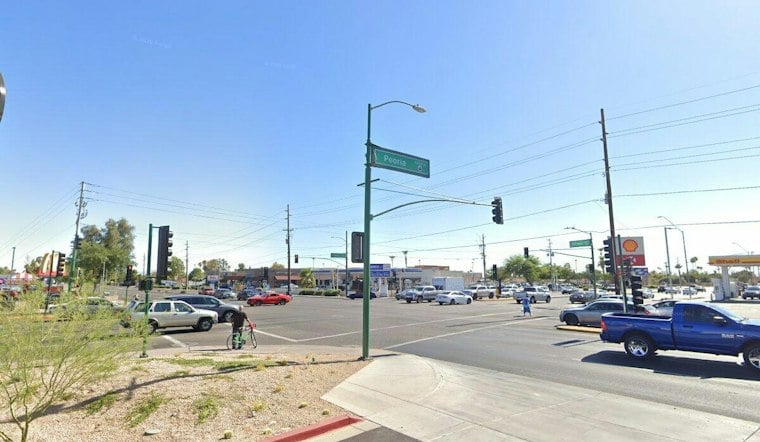
For nearly three decades, the man who died after being struck by a car near 35th and Peoria avenues in Phoenix on July 11, 1998, had no name. Police and hospital staff could not identify him, and the people who knew him on the streets only ever called him “Box Mike.” Now, after years of painstaking genetic detective work, he has one: Michael Kotyk, a Philadelphia native and World War II Navy veteran.
The identification was announced by the DNA Doe Project, as reported by AZ Family, which told Kotyk's story. The victim was described at the time of his death as a white man, 5 feet 9 inches tall and about 190 pounds, with gray hair, a beard, a mustache, blue eyes, and most of his teeth missing. He had been living on the streets of Phoenix before the crash killed him.
Phoenix police eventually reopened the cold case and brought it to the DNA Doe Project, a California-based nonprofit that works to identify unknown human remains, including homicide and accident victims. A DNA profile for Box Mike was generated in 2021, kicking off a search for genetic relatives that would stretch on for years.
A Trail That Led Back to Lviv
The genetic matches researchers found were frustratingly distant — the closest shared less than 1% of their DNA with Box Mike, according to the DNA Doe Project. That thin thread of DNA eventually led investigators to discover that he had Ukrainian and Polish heritage, with roots stemming from a small area near Lviv, Ukraine.
Tracing that lineage proved brutal. Researchers worked for five years before making a major breakthrough in June, digging through records of immigrants from the Lviv region and their descendants in an effort to build out a family tree that could point to Box Mike's real identity.
The effort nearly collapsed when war reached the very archives researchers depended on. A DNA Doe Project co-team leader said Ukrainian archives were hit by drone strikes during Russia's 2022 invasion, and Matthew Waterfield said the team feared the destruction of undigitized files could eliminate their chance to identify Box Mike for good.
Piecing Together a Vanished Life
Eventually, researchers traced a Ukrainian woman who immigrated to the United States in 1913 and had a son named Michael Kotyk. Waterfield said Michael remained a mystery even after researchers had accounted for the woman's other children, until the pieces of his own life began falling into place.
Records showed Kotyk attended South Philadelphia High School and enlisted in the U.S. Navy in 1944 to serve in World War II. After that, his trail goes cold for years; he appeared to disappear after 1950. A 1970 newspaper article referred to him as a transient after he was convicted of vagrancy in Salt Lake City, offering one of the only known glimpses of what happened to him in the decades before he ended up on the streets of Phoenix.
With a likely match in hand, the DNA Doe Project team presented Kotyk as a possible identity to Phoenix police and the Maricopa County Attorney's Office. A fingerprint comparison by the FBI later confirmed that the hit-and-run victim was in fact Kotyk, closing the identification more than 28 years after his death.
One of Dozens of Cold Cases Cracked
Kotyk's case is far from the DNA Doe Project's only breakthrough in the Phoenix area. The organization is fueled by 60 volunteer genealogists who use tools like Family Tree DNA and GEDmatch to help law enforcement identify John and Jane Does, according to FOX 10 Phoenix.
In 2023, the group identified a woman known as the Broadway St. Phoenix Jane Doe as Amelia Munoz Loera, a 41-year-old from Mexico who was struck by a car and left to die near South 15th Street and East Broadway on Nov. 21, 2004, as reported by AZ Family. That case had been sent to the DNA Doe Project by retired Phoenix Police Detective Stuart Somershoe, and a DNA test taken by Loera's niece ultimately led to the match. Somershoe noted that case was the sixth identification the DNA Doe Project had made with Phoenix police alone, and genetic genealogist Cairenn Binder said the organization had identified more than 100 Jane and John Does over the preceding five years.
Other cases trace similarly long, difficult paths. An unidentified man who died at St. Joseph's Hospital in Phoenix on Aug. 17, 2004, after being found unconscious on a sidewalk near Third Avenue and Madison Street was eventually identified through DNA, according to azcentral. In another case cited by FOX 10 Phoenix, the remains of Ginger Lynn Bibb, found in April 2004, went unidentified for nearly 16 years until the DNA Doe Project found a link between families.
The scale of the challenge remains disputed even among investigators. Somershoe has said Arizona has more than 2,000 unidentified bodies, one of the highest totals in the nation, while a separate account attributed to him put the state's total at almost 2,000 and the nationwide estimate at 40,000 unidentified bodies. Either way, Michael Kotyk's case shows how a thin genetic thread, patient volunteers, and a stroke of luck can still give a name back to a man the world had long since forgotten.





