

























































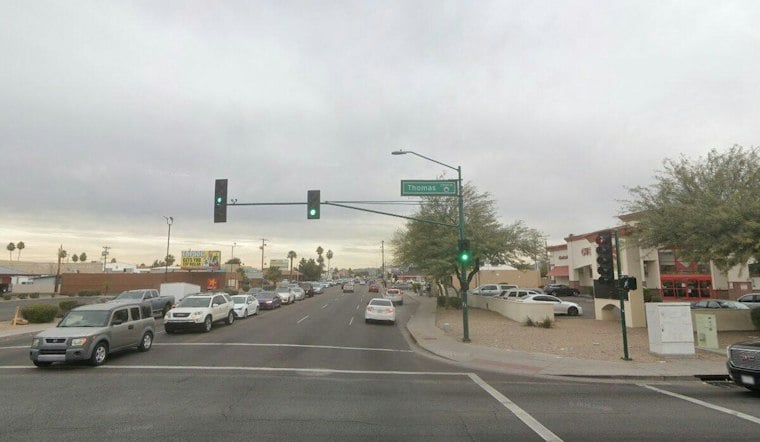
A Phoenix man is recovering after firefighters pulled him from a backyard sinkhole deep enough to swallow part of a pickup truck. Emergency crews responded to a home near 24th Street and Thomas Road, where the man had fallen into a hole that left him too hurt to climb back out on his own.
According to ABC15 Arizona, Phoenix Fire Department personnel were called to the scene around 3 p.m. after reports that a man had fallen into a hole. Fire officials told the outlet the man suffered a chest injury that left him unable to climb out, and a rescue team member helped bring him up from the hole before he was taken to the hospital in stable condition.
The hole did not just claim the man. Fire officials said a pickup truck also partially fell into the sinkhole, and emergency crews had to stabilize the vehicle to keep it from sliding farther in while they worked to free him, per the same ABC15 account. A separate report from 12news.com described the sinkhole as roughly six feet deep.
A Rare but Not Unheard-Of Hazard
Backyard sinkholes are uncommon but not unprecedented, even outside Arizona. Just days earlier, on October 27, a 25-year-old man and his dog fell into a hole approximately seven feet deep behind a home in Lexington Park, Maryland, according to The BayNet. In that case, crews confirmed the hole's depth after initial estimates put it at six feet, and the man was reported alert and oriented when help arrived; rescuers also pulled the dog out safely, and the incident ended with one signed refusal of further medical care.
What caused the Phoenix hole to open up has not been detailed in reporting on the incident. Land subsidence, the gradual sinking of ground tied to groundwater withdrawal, is a documented issue in parts of Arizona, though it is not something that affects the whole state evenly.
Arizona's Broader Ground-Sinking Problem
The Arizona Geological Survey notes that subsidence is concentrated in certain groundwater basins in south-central and southern Arizona rather than occurring statewide, and it traces the phenomenon to decades of groundwater withdrawal exceeding natural recharge, which can collapse pore spaces underground. The survey has linked the problem to 167 miles of mapped earth fissures across the state and says Arizona's Department of Water Resources has detected more than 3,400 square miles of land subsidence overall.
There is some encouraging context in that data: subsidence rates in the Phoenix and Tucson Active Management Areas have dropped between 25% and 90% compared with the 1990s, the survey found. Still, the scale of the state's documented ground movement underscores why incidents like the one near 24th Street and Thomas Road draw attention, even without confirmation of what triggered this particular hole.




