

























































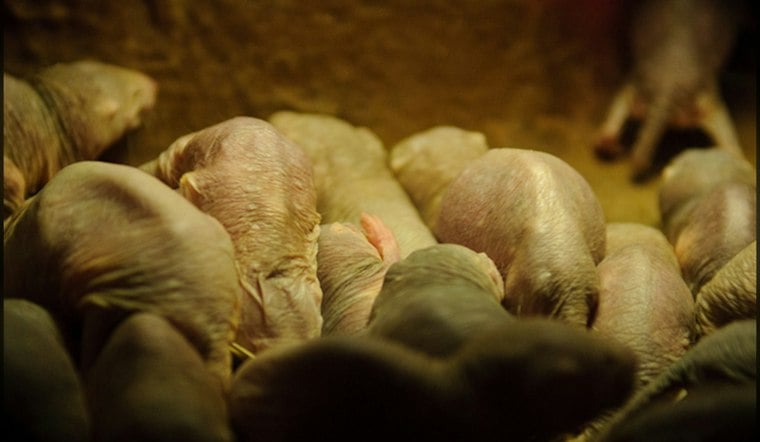
Two dozen naked mole rats have moved into a brand-new habitat at Phoenix Zoo's main plaza, and the wrinkly, buck-toothed rodents are already organized into a strict social order. The animals are split into two separate colonies, each with its own reigning queen, according to zoo President and CEO Bert Castro.
As reported by Arizona's Family, Castro said the zoo has welcomed its share of unusual residents over the years, but this may be its first announced nudist colony. He also said the animals' appearance and social structure exemplify the extraordinary animal kingdom, and that the zoo plans to let guests meet the naked mole rats up close and learn about their adaptations.
Naked mole rats are native to East Africa, and the broader rodent is documented specifically in Ethiopia, Kenya, Djibouti and Somalia, according to the Smithsonian's National Zoo and Conservation Biology Institute. Despite the name, they are not true moles. They are, in fact, more closely related to porcupines, chinchillas and guinea pigs than to moles or rats, according to the San Diego Zoo.
Life Underground, Governed by a Queen
The animals spend nearly their entire lives underground, per the Arizona's Family report, living in eusocial societies where members take on different roles to maintain their shared home. That matches how the National Zoo describes wild colonies, which average 70 individuals but can grow as large as 295, with only one female in each colony breeding while the rest of the workers handle other duties.
Those workers dig through hard-packed soil using powerful, ever-growing incisors, the National Zoo notes, a detail that lines up with the Phoenix Zoo's own description of naked mole rats using their front teeth to carve out complex tunnel systems. The San Diego Zoo adds that the animals are not entirely hairless: they carry roughly 100 fine hairs on their bodies that function like whiskers, plus hairs between their toes that help sweep soil while they tunnel. Underground, their tunnel systems stay a toasty 86 degrees Fahrenheit, according to the same source.
How Long Do They Live?
Longevity estimates for the species vary by source. The Phoenix Zoo exhibit materials describe naked mole rats as capable of living over 30 years, and the National Zoo similarly states that some individuals in human care have reached as long as 30 years, adding that the species' maximum longevity remains unknown. Smithsonian Magazine, however, reports that some naked mole rats live up to 37 years, a figure tied to ongoing scientific interest in why the rodents age so slowly.
That interest has produced some intriguing research. A study covered by Smithsonian Magazine found that some naked mole rats appear to specialize in particular jobs, with some individuals moving around a lot and spending much of their time in the colony's garbage chamber. Separate research cited by the same outlet points to a protein called cGAS that may help the animals repair their DNA, which scientists believe could help delay the aging process.
Splitting Colonies Is a Zoo Tradition
Phoenix Zoo's decision to house its new arrivals as two distinct colonies echoes a pattern seen at other institutions. A 2006 report from Deseret News noted that zoos often transfer naked mole rats to other facilities once a colony grows too large and needs to be split, which is how the Knoxville Zoo ended up opening its Naturally Naked Mole-Rats exhibit that March, built from a group of 16 animals from the Brevard Zoo and another 39 from the Rio Grande Zoo.
More recently, researchers studying a colony at the Salk Institute split 20 naked mole rats off in 2021 to start a separate family known as the Amici colony, according to NPR. That same outlet reported a peaceful transfer of power within the original group this year, when Queen Teré ceded the throne to her daughter, Arwen, without violence — a reminder that even among rodents famous for rigid hierarchy, succession doesn't always require a fight.





