

























































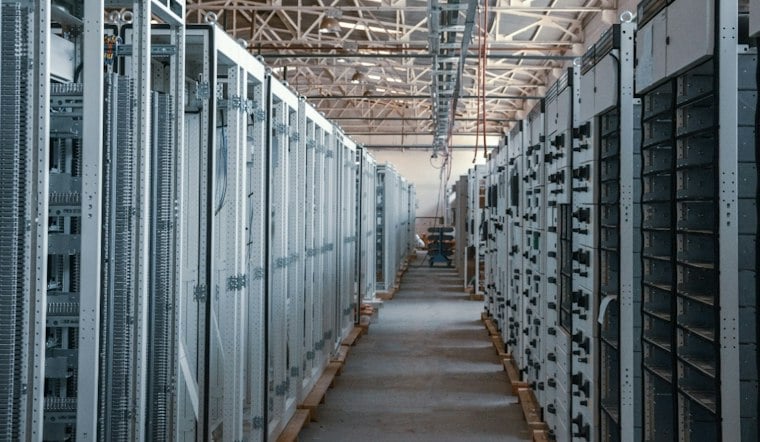
A developer wants to fill part of the shuttered McKinley Mill on Port Angeles' waterfront with rows of computing equipment, pitching three container-like pods as the first phase of a data center that could eventually grow to nine. Rob Janicki, who founded Candelaria Industries, says the computing operation is the only thing that makes the deal pencil out economically — but the Lower Elwha Klallam Tribe says it opposes putting any data center on the site, period.
Janicki first approached the city about the former mill in May 2026 and went public with his redevelopment ideas in October, according to The Seattle Times. His pitch calls for three pods measuring roughly 13 by 53 feet, each holding about 1,400 CPUs, tucked inside an existing 21,000-square-foot concrete building rather than any new earth-moving construction. According to Peninsula Daily News, those three pods would initially draw 9.9 megawatts of power, with Janicki saying the site would ultimately be capped at nine modules even though the building could technically hold around 25.
Power, Cooling and a Lease Still in Search of a Tenant
Janicki has described a closed-loop water-glycol cooling system with rooftop radiators and fans, telling the outlet that just 20 percent of the pods' power draw would go toward keeping the equipment cool. The Seattle Times reports the site already has a substation that could allow tenants to draw as much as 70 megawatts, and that Candelaria would request enough power to serve nearly 8,000 Northwest homes for a year to start. Janicki has said he would lease the computing containers to a tenant that has not yet been determined, and that without the data center, there would be no economic reason to buy the property at all.
Exactly where that purchase stands is murky. Peninsula Daily News reported in September that Candelaria had already purchased the McKinley Mill site over the summer, and an October account said Janicki hoped to complete the purchase by the end of 2026. The Seattle Times likewise reports Janicki entered an agreement to buy the property from McKinley Paper Co. this year.
Tribe Says No Deal, Regardless of Design
The Lower Elwha Klallam Tribe's opposition is not about the details of cooling systems or megawatt counts — it is categorical. Per the Seattle Times, tribal member Tia Skerbeck said the tribe opposes a data center at the site under any circumstances. The tribe wants industrial sites in the area restored to their natural state and cultural resources protected, a concern rooted in the area's history: the Klallam village of č̕ixʷícən, or Tse-whit-zen, was unearthed near the mill during a dry-dock project in the early 2000s, and ancestors were buried at sites later disrupted by the region's industrial development.
Janicki has said he supports the tribe's separate goal of restoring the nearby Ediz Hook lagoon, a tidal salt marsh that serves as a nursery for juvenile salmon migrating from the Elwha and other rivers to the ocean and is home to dozens of fish and wildlife species, despite having been used by mills for decades to dump waste. He has hired an environmental consultant to begin that restoration process. The Seattle Times reports Janicki sought a business partnership with the tribe and that any permits for the project could require tribal consultation under state and federal law. The state has also designated cleanup sites along the Port Angeles shoreline stretching from the Rayonier Mill eastward to the Ediz Hook lagoon, reflecting decades of toxic industrial pollution in the area.
A Moratorium Buys Port Angeles Time
Port Angeles holds the regulatory cards here — the city owns a portion of the mill site, supplies its water and electricity, and ultimately determines much of what can happen there. More than 100 residents attended an October city council meeting where people raised concerns about wildlife, water, waterfront access, power bills and pollution, according to the Seattle Times. In response, the city council approved a six-month moratorium on accepting, processing and approving data-center applications on Sept. 2, a move Peninsula Daily News reports followed input from city staffer Latrisha Suggs after resident concerns surfaced. The council expects to approve formal data-center regulations in early 2027, and Janicki has said each project at the site would be permitted individually.
The mill's labor history looms large in the debate. The mill employed hundreds of workers across decades before its most recent owners shuttered it. The Association of Western Pulp and Paper Workers, which represents current and former mill workers in Port Angeles, has said it wants a seat at the table and expects further communication about preserving or creating union jobs. Union spokesperson Josh Estes said, per the Seattle Times, that the union hopes to partner in a successful transition of the site for future generations, and the group has said it would oppose any proposal that disregards the existing workforce or fails to prioritize quality union jobs. Janicki and the city have expressed interest in meeting with the union, though no such meeting had been scheduled as of the Seattle Times report.
Bigger Dreams, and a Statewide Backdrop
Beyond the computing pods, Janicki has floated a long list of other possibilities for the waterfront site: a deep-water port and aquaculture operation, converting fish waste into fertilizer, generating tidal and wave power, and even restarting a plant that once produced electricity and steam from wood, according to the Seattle Times. He has said the data center is what would finance restoration and those other desired uses of the property.
The Port Angeles debate mirrors a wider reckoning playing out across Washington. The state's Utilities and Transportation Commission is drafting guidelines for how investor-owned utilities set rates and contracts for large power users like AI data centers, and cities and counties including Seattle, Spokane, Renton, Burien, Federal Way, Marysville, Moses Lake, and Skagit and Snohomish counties have all passed their own temporary moratoriums, as reported by The Spokesman-Review.
Port Angeles is not alone in weighing whether a shuttered paper mill's second act should be a data center. In Maine, a developer filed permit applications this month to convert the former International Paper mill in Jay into a similar facility, reusing existing mill buildings for computing equipment and installing two diesel standby generators for backup power, according to the Bangor Daily News.



