

























































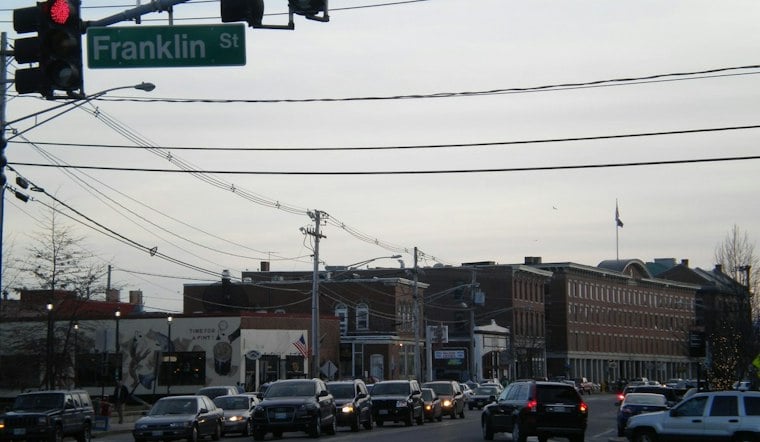
Portland City Councilors are set to vote Monday night on a long-debated plan to redesign Franklin Street, one of the city's busiest corridors connecting downtown to Interstate 295. The proposal would tear out much of the grassy median that currently splits four lanes of traffic, replacing it with four new intersections, continuous sidewalks and raised, buffered bike lanes. Supporters say the overhaul could also open space for park expansion and new housing along a street whose construction in the 1960s divided neighborhoods.
Franklin Street's troubled history is central to why this vote matters. According to Maine Public, the arterial was built in the 1960s during a period of so-called urban renewal, and its construction divided neighborhoods from the rest of the city and displaced immigrant communities. Today, the station reports, Franklin Street remains a source of frustration for some drivers, pedestrians and bicyclists alike — a wide, car-centric corridor in a city increasingly oriented toward walkability.
This isn't the first time city leaders have tried to fix it. The city council attempted to begin a Franklin Street redesign twice before, in 2009 and again in 2015, but both efforts fizzled out due to a lack of funding or support from municipal officials, the same report notes. Monday's vote represents the furthest the project has advanced in nearly two decades of stalled attempts.
What the New Design Would Change
The draft plan on the table would remove much of the wide, grassy median that now divides four lanes of traffic, replacing it with four new intersections, continuous sidewalks and raised, buffered bicycle lanes, per the station's report. Advocates say that freeing up that land would allow for the expansion of Lincoln and Boyd Street parks and potentially the development of new housing — though exactly how much housing remains an open question.
Estimates of the project's housing potential have shifted over time. A September report from the Portland Press Herald said the draft could create roughly 3.5 acres of new land for future development, or up to about 700 new homes, according to city staff. That figure is lower than an earlier projection reported by WMTW on February 27, 2024, when supporters said the project could allow the city space to add about 1,000 housing units and restore land to Lincoln Park. The dossier does not explain the discrepancy between the two estimates.
More than 100 Portland residents turned out for a public presentation and feedback session on the draft in September, the Press Herald reported, with turnout reflecting varied opinions on the proposal. Under the design discussed at that session, the street would retain two travel lanes in each direction between Marginal Way and Congress Street, then reduce to one lane in each direction between Congress and Commercial streets, adding on-street parking in that stretch instead.
Safety Numbers Behind the Push
The push to redesign Franklin Street is also grounded in safety data. From I-295's Exit 7 to Commercial Street, the corridor saw 187 total crashes between 2021 and 2023, including 8 involving pedestrians and 5 involving bicyclists, according to the Reimagining Franklin Street project site. The same source states that two pedestrian fatalities have occurred on Franklin Street since 2023, at Congress Street and Marginal Way.
A MaineDOT analysis cited by the project site found that seven of the ten signalized locations on Franklin Street show a high or very high probability of crashes resulting in fatal or serious injuries. The same transportation data shows traffic volumes in the afternoon peak period drop by more than 70% between Marginal Way and Commercial Street, and notes the corridor currently has no bicycle facilities and very limited transit service.
Cost Estimates Still in Flux
If councilors approve the plan Monday, city staff will work with the Maine Department of Transportation on detailed designs, a phase municipal staff say is already funded through a $2.5 million federal grant. The broader project's total price tag, however, remains unsettled. A January 2025 Press Herald report projected the Franklin Street overhaul would cost $26 million, while Portland's planning director gave ballpark estimates in the $30 million to $40 million range during the September 2026 public session, according to the same outlet. The dossier does not reconcile those differing figures, and no verified construction start date or final budget has been established.



