

























































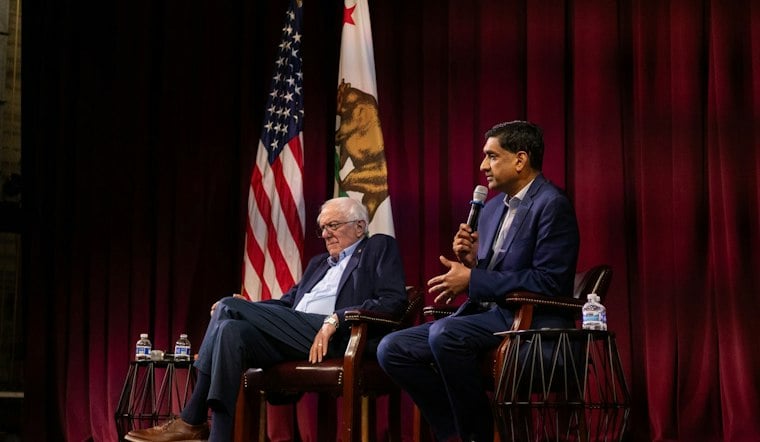
Rep. Ro Khanna wants every American to get a $1,700 check, and he's giving Congress a deadline: the first week of January. The California Democrat is framing the payout as compensation for what the Iran war has done to household budgets, from gas pumps to grocery bills, and he says lawmakers who just won midterm victories now have a chance to actually deliver.
Khanna made the pitch Monday, arguing the checks should go to every American to offset higher gas, food and electricity prices tied to war-related disruptions in oil transport routes, according to The Hill. “The first week in January, the House and Senate must pass a refund check to Americans,” Khanna wrote, adding, “Let's put it on Trump's desk.” He's framed the moment as a test of whether Democrats can turn their midterm wins into action, telling reporters Democrats were given an opportunity through those victories.
The push builds on legislation Khanna introduced back on September 17, 2026, called the Illegal War Refund Act. According to a press release from Khanna's office, the bill would require the federal government to calculate the war's economic impact on taxpayers, cut the Defense Department budget by that same amount, and return the money directly to tax filers and their dependents. Congress.gov lists the measure, H.R. 10498, as having four cosponsors and as referred to the House Ways and Means Committee and, in addition, the House Appropriations Committee as of its introduction.
Why Khanna Says Americans Deserve Money Back
Khanna has argued that American taxpayers shouldn't shoulder the war's economic costs while wealthy and powerful people profit, and that ordinary taxpayers deserve their money back. The dollar figure he's now campaigning on, $1,700, is central to how he's selling the idea publicly, even as the underlying bill ties any refund amount to a calculated economic-impact figure rather than a flat number.
The price tag behind that argument has been climbing. The Hill reported that the cost of the war topped $47 billion in October, and that gas sat at $3.81 per gallon as of Monday afternoon, with diesel running more than $2 a gallon above where it was a year earlier.
Economists Put a Number on the Pain
Those pump prices track a broader estimate from Mark Zandi of Moody's Analytics, who told Fortune that the war has cost the average U.S. household the equivalent of almost $2,000 — including $1,100 in higher energy prices, $540 in higher interest rates and $360 in military costs. Zandi said the energy portion alone was growing by $50 a week at the fuel prices in place when he spoke. Fortune also reported the national average for gasoline hit $4.33 a gallon on a recent Friday, 45% above its prewar level.
The disruption has rippled beyond the gas pump. The World Trade Organization Secretariat found that the Persian Gulf conflict severely disrupted global trade, with urea prices spiking from around $400 per metric ton to more than $850 in April before settling back to $453 in June. The WTO also reported that diammonium phosphate prices climbed from roughly $580 to around $770 per metric ton after the conflict began, and warned that export restrictions following the Strait of Hormuz closure could affect up to 15% of world fertilizer exports.
Democrats Weigh Funding Fights Over the War
Khanna's refund push lands alongside a separate, broader Democratic effort to pressure the administration over the war itself. Senate Democrats say they have some Republican support to end the conflict, the station reported, and have discussed using funding restrictions as leverage to stop it.
The idea of state or federal relief checks tied to high gas prices isn't new. Back in 2022, nearly 23 million California residents were in line for inflation-relief checks of up to $1,050 after Gov. Gavin Newsom announced a $17 billion relief package, according to The Washington Post. That package, part of the state's 2022-2023 budget, also proposed suspending the state sales tax on diesel fuel and providing rent and utility assistance.
Whether Khanna's current proposal moves anywhere near that scale remains to be seen. For now, it sits with the committees that received it in September, while Khanna presses his January deadline in public, hoping to turn a campaign-season talking point into a check Americans can actually cash.



