

























































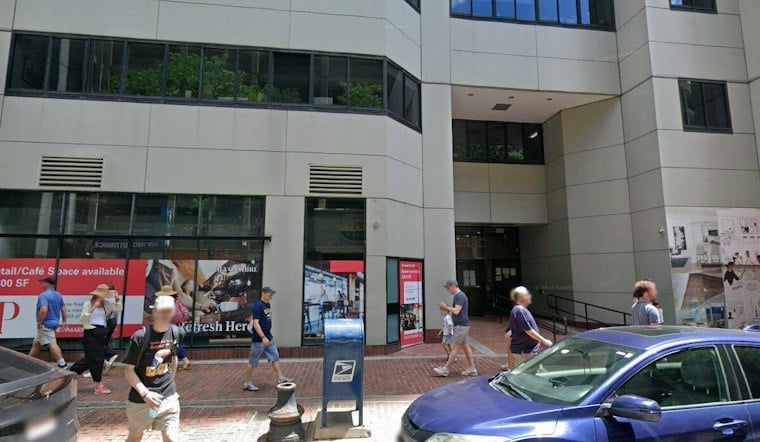
Ruben Companies has filed plans to turn seven office floors at 250 Washington St. into 98 apartments, a change that would make its mostly residential Downtown Crossing tower fully residential if the city approves the work.
The owner took the proposal to Boston's Planning Department, Universal Hub reported. Nothing in the filing establishes approval, a construction start, or a move-in date. For now it is a proposal sitting with planners, not a finished conversion.
What the Filing Actually Proposes
The building is a 42-story tower across from Pi Alley, with a driveway running through to Devonshire Street. Ruben already owns it. The new homes would replace office space on seven floors rather than rebuild the tower from the sidewalk up.
Most of the apartments would be one-bedrooms. The filing also lists 20 two-bedroom units and nine studios. It does not break out a separate one-bedroom total, so the precise split stops there.
Seventeen of the 98 units would be income-restricted and rented to households earning no more than 60% of Boston-area median income. Separately, Ruben says it will make three market-rate apartments available to people holding Section 8 or similar vouchers. Those three are not an extra set of income-restricted homes. They are market-rate units the company is offering to voucher holders.
Bikes in the Basement, No Cars on the Plan
The apartments come with indoor storage for 44 bicycles and no proposed parking. Forty-four racks for 98 homes is not a bike for every resident. It is the transportation plan on paper.
The address sits near all four subway lines at Downtown Crossing, which is the practical answer to a garage that is not in the filing. Car-free conversions are not new in this part of the city. A May 2025 Boston.com report on two already approved projects, 110 rentals at 9 Arch St. and 45 at 123 N. Washington St., said both included zero parking. Those buildings also carried affordable set-asides: 22 units at Arch Street and seven at North Washington Street.
The Tax Break Ruben Plans to Seek
Ruben plans to seek city tax breaks through Boston's office-to-residential pilot. Planning to seek is not the same as applying, qualifying, or receiving the break, and the filing does not show that any abatement has been granted for 250 Washington St.
The city's own description of the program is specific. Boston.gov says the incentive is a 75% tax abatement for 29 years, aimed at turning vacant office space into housing. That is the deal on offer. It is not a receipt for this tower.
The vacancy picture that helped sell the program is older and should stay dated. In May 2025, Boston.com described downtown office vacancy at about 20%, with a possible rise toward 30%, against residential vacancy of about 4%. Those figures are not a current reading of 250 Washington St., and they do not explain why Ruben chose these seven floors.
A Pipeline Counted Several Different Ways
Citywide conversion totals have grown in the published reports, but the counts do not use one definition. Treating them as a single running tally would mix applications, projects, proposed homes, and units already under way.
Boston.com's May 2025 account said the city had received 15 applications proposing 762 housing units across 20 buildings and more than 600,000 square feet of office space. By January 2026, The Boston Globe reported 22 applications covering 1.25 million square feet and 1,517 units. In June, the Boston Business Journal described 26 projects totaling nearly 1,800 apartments since the program began in 2023.
Later counts from The Robinette Team shift the frame again. An August 2026 count it cited put the program at 29 proposed projects and 2,331 units, of which 431 had started or finished construction. A September 2026 program presentation was reported as 28 applications proposing 2,420 homes. Proposed is the operative word. A filing, including Ruben's, is not a building permit and not a lease-up.
Larger Conversions Already Further Along
Ninety-eight apartments would be a noticeable addition on Washington Street. They would not be the biggest conversion in the downtown pipeline.
The BPDA board has approved turning the 11-story office building at 31 St. James Ave., rebranded as 140 Providence St., into 476 apartments, including 95 income-restricted units, Banker & Tradesman reported. That project was described as the largest approved under the city's office-to-residential conversion incentive program.
A different Washington Street proposal was, at the time it was reported, even larger on paper than Ruben's. In January, the Globe said Synergy Investments had proposed converting the 11-story Old South Building at 294 Washington St. into 255 apartments, then the city's largest office-to-residential conversion proposal. That description belonged to January. It is not an update on whether 294 Washington has since been approved.
Ruben's next concrete step is the one already taken: a Planning Department filing for seven floors, 98 apartments, 17 income-restricted units, three voucher-accessible market-rate apartments, 44 bike spaces, and no parking, with a tax break still something the company plans to seek.





