

























































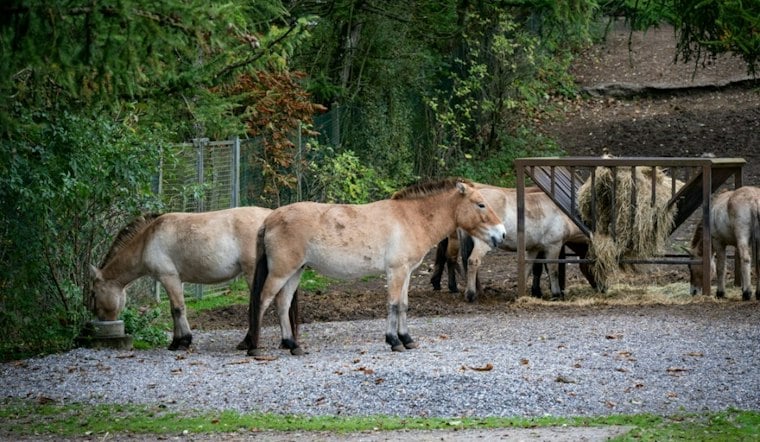
The Saint Louis Zoo has a new resident making history: Aylin, a Przewalski's horse foal born in July, is the first of her kind ever born at the zoo. She lives with her parents, Nika and Ziggy, at WildCare Park's Kent Family Conservation and Animal Science Center in Spanish Lake.
Aylin's arrival marks a milestone for the zoo, according to FOX 2, which reported that she is “the first Przewalski's horse foal born in Saint Louis Zoo history.” Her parents, Nika and Ziggy, were the zoo's first two Przewalski's horses and arrived in St. Louis in February 2025, per the same report. The foal now calls the Kent Family Conservation and Animal Science Center home, a non-public section of WildCare Park that includes five barns across 61 acres dedicated to breeding endangered and critically endangered hoofed mammals, according to Saint Louis Zoo.
A Species Pulled Back From Extinction
Przewalski's horses are considered the world's last truly wild horse species, and the breed's story is one of near-total collapse followed by a slow comeback. The species was declared extinct in the wild in the late 1960s but was brought back from the brink through coordinated breeding efforts, the station's report notes. Today, wild Przewalski's horses exist only at reintroduction sites in Mongolia, China, and Kazakhstan.
Population figures vary depending on the source and scope. FOX 2 reports that scientists estimate the wild population at 2,500 to 3,000 animals, while a separate 2025 report from Spectrum News put the overall population, including free-ranging groups, at about 2,000 after more than 50 years of breeding and reintroduction work. On the question of founders, FOX 2 reports that every Przewalski's horse alive today descends from a captive population of about 12 breeding animals, though National Geographic has reported that fewer than 200 remained in the world by 1969, all in zoos, descended from 13 horses captured before 1948.
Reintroduction Efforts Stretch Across Continents
The push to return captive-bred Przewalski's horses to the wild began in the early 1990s, when conservationists started introducing animals to wild areas in China and Mongolia, according to National Geographic. More recently, a multinational project launched a plan to introduce 40 horses over five years to Kazakhstan's Altyn Dala, with organizers hoping to have 40 to 45 horses living independently in the wild by 2029, the outlet reports. National Geographic also notes that more than 1,000 Przewalski's horses now live in China and Mongolia, while a separate account from biodb.com states that China's population alone had grown to more than 900 as of August 2025. That same source reports that 30 Przewalski's horses were reintroduced to Kalamaili Nature Reserve in Xinjiang, northwest China, this past April.
WildCare Park's Growing Roster of Rare Births
Aylin's birth adds to a pattern already taking shape at WildCare Park, where more than 25 endangered or critically endangered species have been born since 2024, according to the Saint Louis Zoo. The park's first-ever birth came in April 2024, when Roxie, a Grevy's zebra, arrived, as previously reported by the St. Louis Post-Dispatch.
WildCare Park itself is scheduled to open in 2027 on 425 acres near the confluence of the Mississippi and Missouri Rivers, per the Saint Louis Zoo. Zoo officials have not announced a specific opening date, FOX 2 reports, meaning Aylin and her parents will likely spend time growing up behind the scenes before the public ever gets a glimpse. A 2025 Spectrum News report similarly noted that visitors would have to wait until the park's 2027 opening to see the zoo's Przewalski's horses in person.
For now, Aylin remains tucked away at the Kent Family Conservation and Animal Science Center with Nika and Ziggy, part of a species whose survival has depended on decades of coordinated work by zoos and conservationists worldwide. Conservationists credit zoos, including the Saint Louis Zoo, with contributing to the species' comeback, a reminder that a single foal born in a Missouri barn connects to a much larger story of a horse that nearly disappeared entirely.





