

























































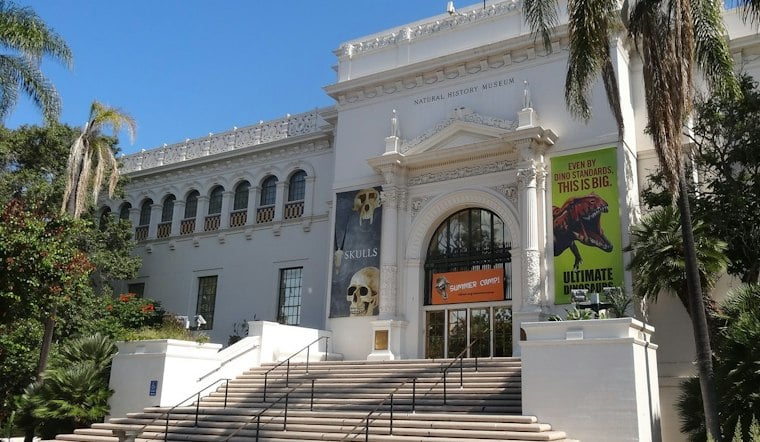
For four decades, specimen No. 28852 sat quietly in a drawer at the San Diego Natural History Museum, labeled as an obscure shrimp-like crustacean called Tesnusocaris goldichi. Now scientists say that label was wrong — the fossil is actually a 324-million-year-old insect, one of the oldest ever confirmed, and its discovery is reshaping what researchers thought they knew about the earliest chapters of insect evolution.
Scientists have reclassified the specimen as Chosha praecursor, according to the San Diego Union-Tribune, which reports the fossil is now considered among the earliest uncontested insects ever discovered. A study published in Nature states that the phylogenetic reconstruction recovers C. praecursor as a hexapod, strongly favoring its placement as an early-diverging insect, dating it to the Carboniferous period, roughly 324 million years ago, in the Tesnus Formation of Texas.
The fossil's journey to that drawer began in 1985, when a field team led by curator Frederick Schram brought it back from a private property in Brewster County, Texas, as reported by the Union-Tribune. The specimen was classified as a crustacean in 1991, and that identification stuck — until a Cambridge University doctoral researcher happened to notice it decades later.
A Cambridge Researcher Spots What Others Missed
Erik Tihelka inspected the fossil after seeing its images in a textbook, per the Union-Tribune's reporting, and began reexamining features that didn't quite fit the crustacean label. According to KPBS, the fossil spent the majority of its four decades at the museum safely nestled in its drawer before that closer look began to unravel its true identity.
What Tihelka and his collaborators found was striking. The fossil carries insect apomorphies including an ovipositor and a terminal filament, according to the Nature study, alongside six legs attached to its thorax and an egg-laying organ and tail-like filament, as described in the original reporting. But it also differs from crown-group insects in a key way: it has multisegmented abdominal legs modified like paddles, extending from its abdomen in extra pairs not seen in modern insects. The New York Times reported in September that the creature had 24 legs in total, counting those paddle-like appendages alongside its six thoracic legs.
Filling In a 60-Million-Year Mystery
The find matters because it lands near the edge of what researchers call the hexapod gap — a stretch of roughly 60 million years in the fossil record when early insects seemingly disappear from evidence entirely. Sources differ on exactly where that gap ends: Scientific American describes the missing interval as running from 385 million to 325 million years ago, while KPBS puts the end point at 322 million years ago. Either way, Chosha praecursor sits right at that boundary, which the Nature authors say means these stem-group fossils represent the earliest uncontested insects and partly reconcile the incongruence between molecular clock estimates and the fossil record.
Researchers have reportedly suggested the creature may have used its paddle-like legs to glide through water, and the Nature paper notes that the unusual abdominal gill-like appendages of Chosha suggest a semiaquatic mode of life in at least some stem-insects. KPBS reports that researchers see the combination of the fossil's terrestrial and aquatic adaptations as potentially indicating it is an evolutionary bridge between life in water and life on land — though that remains an interpretation rather than a settled conclusion.
On Display Just Down the Hall From Where It Sat
Chosha praecursor is now on public view at the museum, displayed in a glass case as part of the Amazement in the Basement exhibit on the lower level, according to KPBS. Museum paleontologist Tom Deméré told the outlet that the find is a reminder of what else might be hiding in the collection. “It's possible that there are fossils in here that are new to science but they haven't been studied yet,” Deméré said, adding that researchers using the museum's holdings can bring new life to specimens and make fresh discoveries in the process.
The specimen's long detour through a storage drawer — originally cataloged under a crustacean name that bore no resemblance to its true identity — underscores how a single second look, prompted by a photo in a textbook, can upend decades of assumptions. As the New York Post put it in its own account of the discovery, a fossil stuffed in a drawer has changed what scientists thought they knew about life on Earth.





