

























































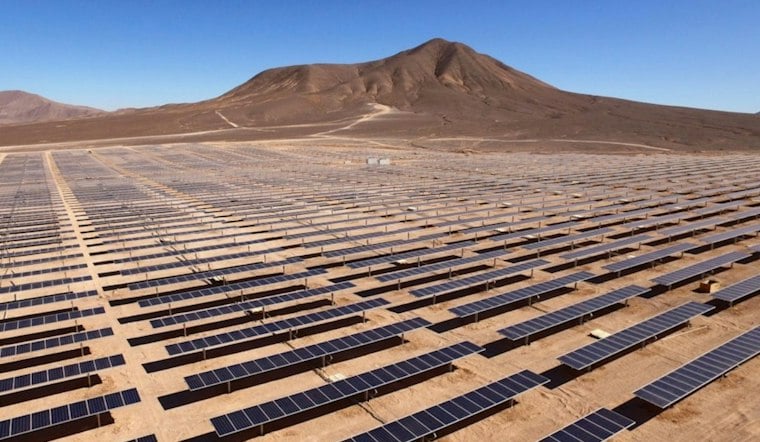
Avantus just padded its bank account by roughly $230 million, pushing total commitments under its corporate credit facility to $1.28 billion as the San Diego-based solar and storage developer races to build out a 24-gigawatt pipeline across California and the Desert Southwest.
The company announced the expanded facility on Wednesday, according to a report from finance.yahoo.com, building on the $1.05 billion facility Avantus closed in August 2026. Five new lenders — Helaba, MUFG, NordLB, Santander and Standard Chartered — joined the lending consortium as lead arrangers, while SMBC continues to serve as administrative agent, collateral agent and lead arranger for the deal.
Avantus describes itself as a developer, owner, and operator of utility-scale solar and energy storage projects, a model that leans on owning and operating clean energy infrastructure rather than simply developing projects for sale to someone else. That strategy demands steady access to capital for development, construction, and long-term ownership, which is where the expanded credit line comes in. As reported by Pulse 2.0, the broader lender group also includes ING Capital, HSBC, KKR, Truist Securities, Bank Hapoalim, CIBC, KeyBanc Capital Markets, Mizuho, National Bank of Canada Capital Markets, and Natixis Corporate & Investment Banking.
A Pipeline Built Around Pairing Solar With Storage
Avantus says its development pipeline now totals approximately 24 gigawatts of system capacity, including 13 gigawatts of solar generation integrated with 44 gigawatt-hours of energy storage, concentrated in California and the Desert Southwest. The company frames those projects as a way to meet growing electricity demand while increasing renewable power availability during the hours when solar generation is limited — the evening ramp when the sun goes down but demand doesn't. Energy storage, the station's report notes, plays that balancing role between renewable generation and electricity demand around the clock.
Avantus estimates its planned solar and storage pipeline could provide dispatchable power to more than 10 million Americans, though the figure is the company's own projection rather than an independently verified calculation. The pairing of solar with batteries has become increasingly common nationwide: as of September 2026, 16% of new solar projects deployed that year were co-located with battery storage, representing about 41 gigawatts, with the U.S. Energy Information Administration projecting the share could reach 19% by year's end, according to Utility Dive. That marks a dramatic shift from 2017, when only around 2% of new solar capacity, or 5 gigawatts, was co-located with storage, before jumping to 25% of projects by 2023.
Backers, Legal Counsel, and the Executive Behind the Deal
Avantus is backed by strategic investments from KKR and EIG, with KKR Capital Markets and EIG Capital Markets serving as placement agents for the credit facility transaction. Kirkland & Ellis acted as legal counsel to Avantus, while Milbank represented the lenders in the deal.
Omar Karar said Avantus is proud to renew and broaden relationships with leading project finance banks, a statement he framed as reflecting confidence in the company's execution and its trajectory as an independent power producer. The expanded lender group, Pulse 2.0 reported, gives Avantus additional banking relationships and financing capacity as it works through its California and Desert Southwest pipeline.
How It Stacks Up Elsewhere in the Industry
Avantus isn't alone in lining up fresh capital for solar-plus-storage work. Independent power producer Pivot Energy closed a $500 million corporate credit facility with Nuveen Energy Infrastructure Capital to finance its own solar and battery storage project development, according to Renewables Now.
The scale of California's storage buildout underscores why deals like this one matter. Battery storage capacity in the state grew from less than 700 megawatts at the start of 2019 to more than 23,000 megawatts by mid-2026, per the California Energy Commission. With Avantus's pipeline concentrated in California and the Desert Southwest, the company's expanded war chest positions it to keep adding to that growth curve as utilities and grid operators lean harder on batteries to keep the lights on after sunset.





