

























































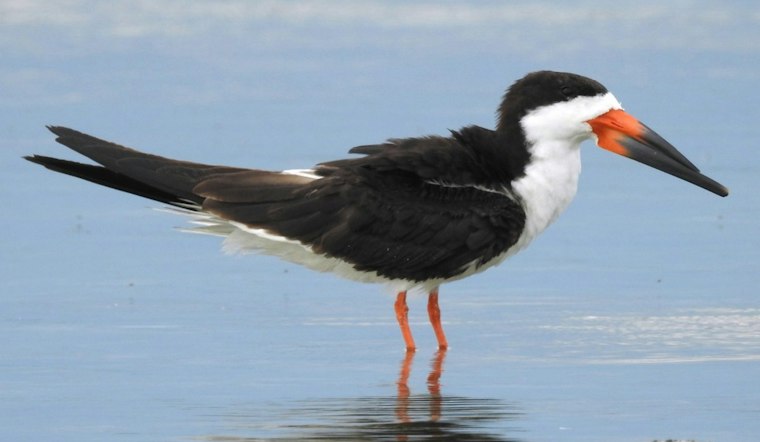
A black skimmer chick has hatched and grown strong enough to fly on the Sanibel Causeway, marking the first confirmed successful nesting there in more than three decades. The milestone comes even as coyotes tore through other shorebird colonies across the island this season, a split outcome that has conservationists celebrating one win while bracing for steep losses elsewhere.
A Three-Decade Wait Ends
The Sanibel-Captiva Conservation Foundation confirmed the hatch in June, reporting that “the first black skimmer chick has hatched at the Causeway since the early 1990s.” By mid-July, the same organization said the chick had reached flight-capable age, noting in its update that the young bird was thriving. SCCF also reported that a few dozen more skimmer chicks had hatched on the Causeway since the initial milestone, with about a half-dozen adults still incubating nests at the time of that report.
The numbers built steadily through the season. By June 19, WGCU reported 81 least tern nests and 15 black skimmer nests on the Causeway that season. According to the Sanibel-Captiva Islander, those totals eventually climbed to 18 black skimmer nests on the Causeway, which produced 29 fledged chicks, while the Causeway's least tern count reached 85 nests for the year.
Partners Guarded The Colony Through Nesting Season
SCCF did not pull this off alone. The organization said it worked closely with the Florida Department of Transportation, the Florida Fish and Wildlife Conservation Commission, and Lee County to protect the colony and its nests, a partnership reflected in the Islander's reporting that Lee County and FWC worked with SCCF to shield the nesting area. The Causeway nesting area was closed to the public from April through July or August, per the Islander, giving the birds room to incubate without disturbance.
Staff and volunteers also stood watch during Independence Day fireworks, and the fallout was better than feared: SCCF reported that the fireworks did not negatively impact the nesting colonies that year. The protective effort paid off for a species that had struggled to gain a foothold there since the early 1990s, with Samantha Hinsz of SCCF noting, per the Islander, that black skimmers lay up to three eggs per nest.
Four Years Running For Least Terns
The skimmers' success came alongside a now-familiar pattern for least terns, which SCCF said returned to nest on the Sanibel Causeway for the fourth consecutive year following a 30-year absence. Least terns nest together in colonies on the Causeway, and the Islander reported Sanibel recorded 73 least tern nests islandwide in 2026, with the Causeway alone accounting for 85 of the season's least tern nests. The island also logged 15 snowy plover nests in 2026, according to the Islander.
Those figures stand in contrast to 2025, a banner year by a different measure. SCCF reported that season produced more least tern nests and chicks on the Causeway than at any point since at least the 1990s, with more than 200 nests fledging more than 150 chicks, according to the Sanibel-Captiva Islander. At that season's peak, 142 least tern nests were being incubated with 114 chicks in the colony, the Islander reported. About 30 black skimmers joined the tern colony in mid-June 2025, and while seven nests were documented that year, no chicks were ever confirmed — making this year's 18 nests and 29 fledged chicks a clear turnaround.
Coyotes Take A Heavy Toll Elsewhere
The Causeway's good fortune didn't extend across the rest of Sanibel. SCCF reported that repeated coyote depredation reduced nesting success at several colonies and pushed least terns and black skimmers to shift to other locations. The foundation's July update described least terns taking a heavy hit from coyote predation, leaving one colony down to a single active nest with a few chicks and another with just one nest that had hatched at least one chick.
Per the Islander, coyotes caused 66 nest losses on Sanibel in 2026, a stark reversal from 2025, when the island recorded zero coyote-caused nest losses. Washouts added two more nest losses in 2026, compared with none the previous year. Hinsz told the Islander that the season brought high nesting numbers for least terns and snowy plovers but significant coyote predation affecting many nests, and that the Causeway itself had gone without coyote predation for the prior two years before this season's losses.
Snowy Plovers And Wilson's Plovers See Mixed Results
Snowy plovers, which nest islandwide on Sanibel, fledged seven chicks from 15 nests this season, Hinsz said, down from seven chicks fledged out of seven nests in 2025. Many of this season's snowy plover nests were predated, Hinsz said, prompting birds to attempt nesting a second or third time. SCCF's July update added that only four snowy plover chicks had fledged by that point in the season, with one active nest and a brood of two chicks still remaining.
Wilson's plovers delivered a split verdict depending on location. SCCF reported that Sanibel's first Wilson's plover nest in five years was unsuccessful, likely due to predation, while North Captiva and Bunche Beach each recorded multiple Wilson's plover broods that successfully fledged chicks. Sanibel's three nesting shorebird species — least terns, snowy plovers and Wilson's plovers — nest in colonies scattered across the island, leaving each population exposed to different predator pressures depending on where it settles.
Why Protecting Nests Remains So Difficult
SCCF has acknowledged it has limited ways to directly help shorebird nests survive predators. Structures placed over nests to shield eggs carry their own risk, since they can scare off adult birds and cause nest abandonment altogether. Crows, meanwhile, use visual clues to identify nests, complicating efforts to camouflage them. Hinsz noted that SCCF has no protection measures specifically in place for snowy plovers or least terns, leaving habitat closures, fencing and public education as the foundation's primary tools against threats like coyotes and washouts.



