

























































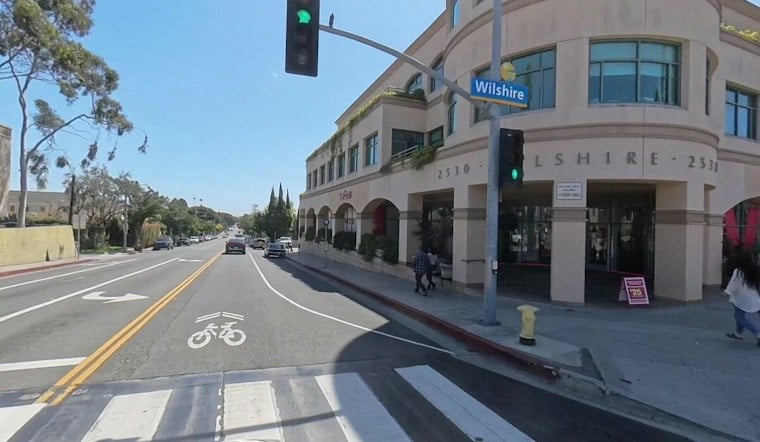
The City of Santa Monica is asking a judge to drop it as a defendant in a personal-injury lawsuit filed by a man who lost part of his leg when a drunk driver plowed into a bus bench near Wilshire Boulevard and 26th Street in 2023. Gelvy Velasquez Ortiz, who was seated at the bus stop when the crash happened, suffered fractures to his right leg and pelvis in addition to losing part of his left leg.
City attorneys filed court papers with Santa Monica Superior Court Judge David W. Swift arguing that driver John Edward Alevizos was the sole cause of Ortiz's injuries, according to MyNewsLA. The outlet reports that Alevizos was driving home from the Gaslight Bar on Wilshire Boulevard on June 2, 2023, when he closed his eyes, accelerated and failed to brake before his car jumped the curb and struck Ortiz. Alevizos had a blood-alcohol level of 0.22, nearly three times the legal limit, and later pleaded no contest to felony drunken driving causing great bodily injury.
Ortiz filed his lawsuit in June 2024, naming both the city and Lorcan O'Herlihy Architects, the designer of the bus stop, as defendants. His complaint alleges the stop was in a dangerous condition that endangered pedestrians generally, and that the city should have installed barriers or bollards to protect Ortiz and other passengers. The lawsuit also claims at least 14 vehicle collisions occurred near the intersection and bus stop in the five years before Ortiz was hurt, per the same account.
City Says Barriers Would Create New Hazards
Santa Monica's attorneys counter that the bus stop was not in an inappropriate location and did nothing to increase or intensify the danger created by Alevizos' conduct. In their filing, as MyNewsLA reports, the city describes the location bluntly: “the bus stop sits where it must sit — near the street.” Attorneys also argue the stop posed no more than a trivial risk when the adjacent property was used with due care, writing that “nothing about it increased or intensified the danger from Alevizos' reckless conduct.”
The city's defense leans heavily on the idea that physical barriers would create their own problems. Attorneys argue that street barriers could impair passengers' ability to board and exit through the bus's front and rear doors, and that barriers could obstruct passengers using wheelchairs, walkers and strollers. The city says it weighed passenger safety and bus-stop placement against the need to let drivers see waiting riders, and that it considered access for elderly and disabled passengers in positioning the stop.
Dueling Numbers on the Stop's Safety Record
The two sides offer conflicting figures on how safe the stretch of Wilshire has actually been. The city's filing states that more than 100 million cars passed the bus stop without an accident over a decade, while a separate part of the same filing puts the figure at vehicles passing the stop at least 120 million times without an accident or complaint in the ten years before the crash. Neither figure is reconciled in the reporting, and MyNewsLA presents both without resolving the discrepancy.
The stretch of Wilshire Boulevard where the crash happened has drawn broader safety scrutiny outside the courtroom. A safety analysis conducted by Toole Design found that pedestrians were involved in 60 percent of the fatal and severe-injury crashes identified along the corridor. The firm's work led to a first phase of safety improvements implemented in summer 2023, which included curb extensions with paint and bollards, right-turn-only restrictions at 14 unsignalized intersections, flashing beacons and red bus-stop zones.
Separately, the City of Santa Monica has described Wilshire Boulevard as a top priority of its Vision Zero initiative, with the city citing an analysis of more than 11 years of collision data. The dossier evidence does not establish whether any specific safety feature was present at this particular bus stop at the time of Ortiz's crash, and that detail remains unresolved in the available record.
What the Law Requires
Under California Government Code §835, a public entity can be held liable for injury caused by a dangerous condition of its property if a plaintiff establishes that the property was in a dangerous condition at the time of the injury and that the condition proximately caused the harm, according to California Legislative Information. The statutory excerpt available does not spell out the full legal test the court will apply, and it remains unclear how Judge Swift will weigh the city's trivial-risk argument against Ortiz's claims about the stop's history of nearby collisions.
A hearing on the city's request is scheduled for February 5, 2027. Until then, the dispute leaves open whether a bus stop built into a location the city calls unavoidable — near the street, where buses must load and unload riders — should have been fortified against drivers like Alevizos, whose blood-alcohol level that night was more than double the legal threshold.



