

























































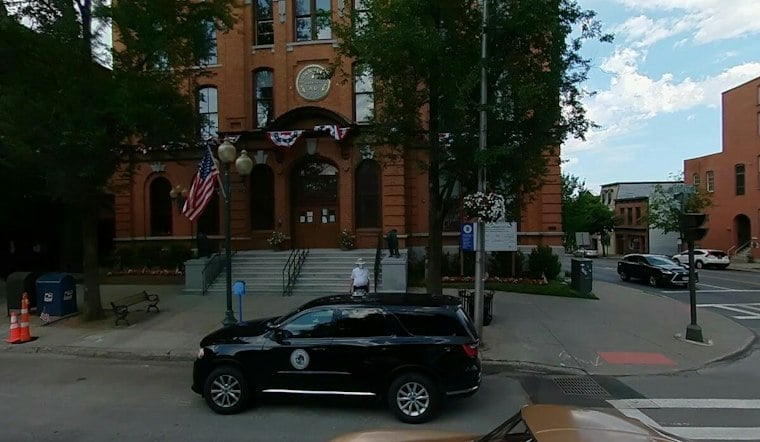
A Saratoga Springs City Court judge found four people guilty this week of violating the city's no-camping ordinance after they staged red tent protests outside City Hall, rejecting their argument that the ban violated their First Amendment rights. Judge Jeffrey Wait ordered Alexus Brown and Samantha Romero to pay $100 each, while Angela (Dio) Kaufman and Jacob Feinland were ordered to pay $150 fines covering two separate sets of charges.
The case, which marked the first no-camping ordinance violation to go to trial, was decided Wednesday in Saratoga Springs City Court, according to The Daily Gazette. Wait said the case involved no First Amendment violations and found that police had given defendants proper warnings before issuing citations, adding that officers were respectful and cited people only for violating the camping prohibition itself. The ordinance, adopted by the City Council in a 3-2 vote in July 2025, was upheld against a constitutional challenge, as the Times Union reported, with Wait rejecting defense attorneys' argument that the ban itself was unconstitutional.
Red Tents and a Standoff Outside City Hall
The charges trace back to August 15, 2025, when police learned a demonstration against the camping ban was likely and then observed matching red tents being erected in a line on the public sidewalk outside City Hall throughout the day. Officers warned protesters around 6 p.m. to leave or face appearance tickets, and when the tents remained, police issued four appearance tickets around 7:15 p.m. to people accused of violating the ordinance. Bystanders chanted “housing not handcuffs” as the tickets were issued, and the tents stayed up for roughly nine hours before being taken down around midnight.
Kaufman and Feinland faced a second round of charges after another set of tents went up on October 25, 2025. Police reported that two tents were placed on the sidewalk outside City Hall around 3:30 p.m. that day, though they came down in less than an hour. Three Saratoga Springs police officers testified that they saw no one sleeping and no camping materials beyond the tents themselves, and police further testified that the protesters did not violate demonstration laws. The seed reporting also notes that the protests involved no violence, disorderly conduct or reported criminal activity.
Dueling Arguments in Court
Defendants pleaded not guilty in December 2025 to violating the city ban. Their attorney, Mark Mischler, argued the ordinance was invalid, unlawful and unconstitutional, and separately contended it had been enforced improperly and not according to its own wording. Mischler told the court the protest amounted to expressive conduct challenging the city's decision, and defense counsel argued the tents represented a lawful demonstration rather than camping.
James Potter, special counsel for the city attorney's office, countered that the defendants violated the ordinance regardless of their intent. Francine Vero separately dropped other city no-camping charges on the condition that defendants worked with RISE Housing and Support Services. Mischler had suggested a conditional discharge with payment to an organization addressing homelessness in place of fines, but Wait ordered the monetary penalties instead.
What the Ordinance Actually Says
Saratoga Springs' Chapter 95A ordinance prohibits sleeping, lying or sitting on or in city property and placing camping materials there, according to the City of Saratoga Springs' ordinance text. City property is defined broadly to include public sidewalks, street medians, public parking garages and lots, public gazebos and public easements. The ordinance also requires a warning before anyone can be cited — a person cannot be ticketed unless they continue the prohibited conduct after first being warned by police or code enforcement.
Penalties under the ordinance top out at $100 for a first conviction and up to $250 for a second or subsequent conviction, matching the civil penalty structure the city laid out when it passed the ban in 2025. The ordinance text also includes exceptions allowing someone to sit or lie down due to a medical or other emergency, or to sit on a curb during a demonstration or other specified public event.
Activists Vow More Pushback
Feinland said the camping ban was unconstitutional and harmed unhoused community members, while Kaufman said the issue continued to warrant scrutiny and pushback, adding that activists would explore further action. Kaufman separately told the Times Union that at least 34 tickets had been written under the camping ban in the preceding year. The Times Union also noted that Pittsfield, Massachusetts, revoked a similar encampment ban after advocacy-group pushback, though no comparable reversal has occurred in Saratoga Springs.
Wednesday's trial wasn't the first time the camping ban landed activists in court. Five people were charged in connection with an earlier round of protests, with four of them appearing before Wait in City Court in October 2025, according to WAMC. Protesters have consistently argued the ordinance penalizes poverty and targets unhoused people arbitrarily, a claim the city has not accepted.
Shelter Capacity Remains a Backdrop
The legal fight has unfolded against a backdrop of strained shelter capacity in Saratoga Springs. As of May 2025, RISE Housing and Support Services operated the city's only 24/7, low-barrier shelter, running it on what it called a temporary basis since 2022, WAMC reported at the time. The organization warned that spring that the shelter might close that June without a firm city funding commitment, a scenario it said could leave roughly 35 people without a housing solution. RISE has separately said its Adelphi Street Shelter provided services for three and a half years before an announced November 1 closure, though the organization's posted notice does not specify the year of that closure.





