

























































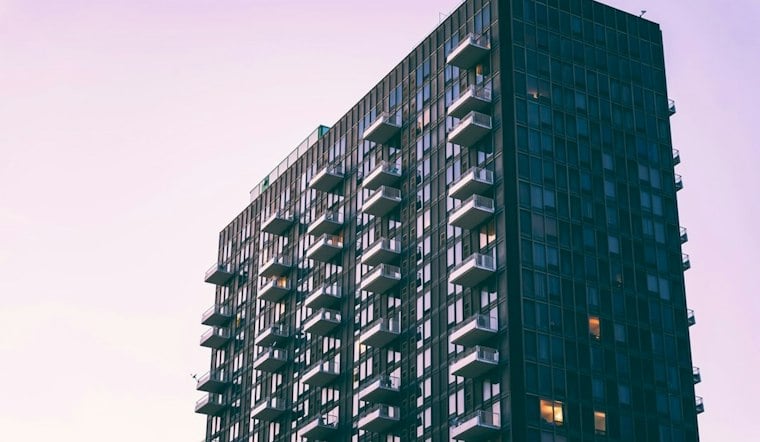
A St. Louis city board has approved incentive changes clearing a path forward for a long-stalled apartment development on Delmar Boulevard, now valued at $72.88 million. The revised deal maintains both tax abatements and industrial revenue bonds for the project, while aiming to simplify its future financing.
As reported by the St. Louis Business Journal, rising interest rates had halted the development, known as The Bridge, according to the outlet's article preview. The project has a long and winding history on the stretch of Delmar known as the Delmar Divide, where earlier plans called for 199 market-rate apartments alongside 1,200 square feet of ground-floor retail, according to a report from Kingsway Development.
That earlier report described the Land Clearance for Redevelopment Authority voting to approve a 90% property-tax abatement for 10 years for The Bridge, at the time described as a $62.7 million apartment complex at 4800-4830 Delmar. The same report also mentioned state Brownfield tax credits and New Markets Tax Credits alongside the abatement.
A Project That Has Stalled Before
The Bridge's price tag has climbed since those earlier estimates. NextSTL put the project's estimated cost at $62.7 million back in 2023, and that same report suggested rising interest rates and materials costs had likely stalled the development even then, per NextSTL's reporting.
The project's timeline has slipped before. A listing on the development forum urbanSTL noted that the Bridge special-purpose entity was slated to start construction by mid-2022, though it remains unclear whether that target was ever met or what has happened with construction since. The site at Delmar and Euclid has drawn development interest for years; a 2020 report from the St. Louis Post-Dispatch described an earlier proposal for a $43 million, 156-unit apartment building at that same corner of Delmar Boulevard and Euclid Avenue.
How Other Delmar-Area Deals Have Moved Forward
The incentive structure behind The Bridge mirrors tools used elsewhere in the city to unstick stalled development. In October 2024, the St. Louis LCRA Board approved the remaining $171 million in bonds, along with a construction sales-tax exemption, for AHM Group's proposed $232 million Downtown West development near CityPark, according to St. Louis Public Radio. That project was planned to include more than 450 apartment units along with tens of thousands of square feet of offices and retail across 12 acres, the station reported.
Downtown West's incentive package included three separate taxable industrial revenue bond issues and real-property tax abatements for each parcel, St. Louis Public Radio's reporting noted. At the time, AHM Group said it was positioning the project to move forward as financing markets improved, with a goal of breaking ground in 2025. “We're positioning ourselves to be ready to move forward with the projects heading into 2025,” the company said, according to the station's report.
The Legal Mechanics Behind the Incentives
Industrial revenue bonds like those tied to The Bridge operate under a specific state framework. Missouri law requires that a municipality proposing an industrial-development project first approve the project plan by a majority vote of its governing body, according to the Missouri Revisor of Statutes.
Those bonds can also be paired with property-tax relief. The Missouri Department of Economic Development says it may be possible, with approval of the city or county issuer, to exempt or abate most real or personal property tax on new real-estate improvements and new machinery financed through a Chapter 100 bond — though the city or county must own the assets financed by the bonds, according to the agency's guidance.
For now, the exact scope of the revised Bridge deal, including its current apartment count and retail footprint, has not been detailed beyond the incentive changes themselves. What is confirmed is that city officials have signed off on a restructured package intended to keep the long-delayed Delmar Boulevard project moving after years of financial headwinds.



