

























































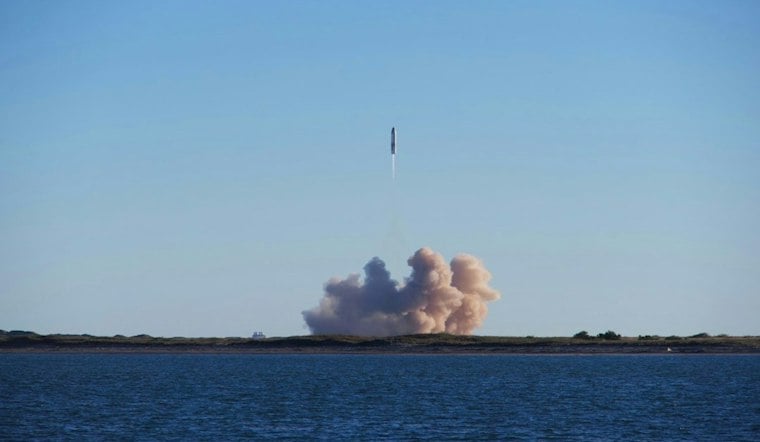
SpaceX's Starship Flight 15 lifted off from Starbase in South Texas Friday at 4:47 p.m. local time, soaring toward orbit on the company's 15th uncrewed test of the giant rocket. The mission notched a win by deploying satellites and reaching orbit, but SpaceX scrapped its bid to catch the returning Super Heavy booster, instead guiding it to a splashdown in the Gulf of Mexico.
The booster recovery maneuver was called off about six and a half minutes after launch, according to Space.com, which reported that SpaceX brought the booster down for a controlled splashdown rather than attempting to snag it with the launch tower's mechanical arms. As 6abc reported ahead of the launch, SpaceX had hoped to catch both the booster and the Starship upper stage on their returns, though the company had made clear the two vehicles would not be caught simultaneously.
Why the catch was scrubbed remains murky. NBC News reported that the maneuver was aborted shortly after launch and that the reason was not immediately clear, while Scientific American offered a different account, attributing the diversion to trouble with some of the booster's engines. Those two versions have not been reconciled, and no source has confirmed a definitive cause.
Upper Stage Reaches Orbit, Deploys Satellites
Despite the aborted booster catch, Starship's upper stage reached orbit about 27 minutes after launch, per the same NBC News account. The vehicle then deployed 26 Starlink V3 satellites into orbit roughly 40 minutes into the flight, with all of them making it safely into orbit, according to Ars Technica.
The double-catch SpaceX had been chasing — snagging both the booster and the ship on return — did not happen on this flight. The New York Times reported that SpaceX will have to wait until its next test flight to attempt recovering all parts of the rocket in a single mission. SpaceX could still attempt to return Starship's upper stage to Starbase the following day, Nov. 14, though Ars Technica noted that any landing attempt — expected around 3:15 p.m. local time — was contingent on the vehicle passing health checks after reaching orbit.
A Pattern of Partial Successes
Flight 15's mixed outcome echoes the previous test. Scientific American noted that Flight 14 also reached orbit and deployed operational Starlink satellites, but that mission ended early because of an engine issue on Starship, forcing the vehicle down in the Pacific Ocean. SpaceX has successfully returned the Super Heavy booster to its launchpad three times before, with the last such tower catch coming in March 2025, according to NBC News.
The stakes behind these repeated attempts are tied to SpaceX's broader ambitions for Starship, the largest rocket ever built. If the vehicle can be repeatedly flown and reused, the Times reported, it would revolutionize the space industry by enabling launches of bigger, heavier payloads at lower costs. Part of that effort hinges on the heat-shield tiles covering Starship's exterior, which Ars Technica reported must be light and resilient enough to withstand rapid reuse with minimal refurbishment between flights.
Elon Musk has set an ambitious timeline for what comes next: NBC News reported that he expects Starship to reach a weekly launch cadence by the first half of 2027. For now, Flight 15 adds another data point to that goal — an orbital success paired with an unresolved booster recovery that SpaceX will have to sort out before its next attempt.





