

























































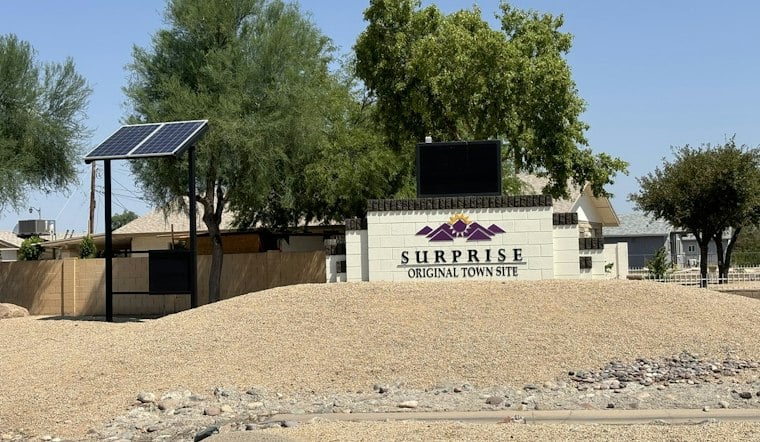
Surprise officials say the fast-growing West Valley city has enough water lined up to support nearly 22,000 new homes over the next 14 years, even as Arizona braces for another round of Colorado River cuts. But a proposed drought management plan could put the brakes on that growth, allowing the city to temporarily halt new development if water supplies become threatened.
According to ABC15 Arizona, the city says it currently uses about 40 percent of its water portfolio, with capacity remaining to accommodate thousands of additional homes over the next decade. City projections cited by the outlet indicate Surprise has more than twice the annual water supply needed to meet anticipated demand in 2027, and thousands of homes are already planned or under construction in the northwest part of the city.
Surprise Water Department Director Michael Boule has previously described the city's approach to its supply in similar terms. In an earlier statement to ABC15, Boule said the city was using 40 percent of its water portfolio, with 60 percent not currently being used for growth or potential reductions, and he noted the Surprise service area currently delivers about 11,000 acre-feet of water annually. Several groundwater wells and water supply facilities are under construction to expand capacity and improve system reliability, per that same report.
A Drought Plan With Teeth
The drought management plan under discussion would give Surprise the option to temporarily freeze new development if water supplies become insufficient, and it outlines potential restrictions on outdoor water use during severe drought conditions. Those restrictions could include tighter rules for lawn watering, vehicle washing, and landscaping, with the severity of any limits depending on how bad a shortage becomes. The goal, according to the plan, would be to preserve water for essential uses.
Surprise's current drought framework isn't new. The City Council approved an updated drought preparedness and resiliency plan at a December 7 meeting, replacing a version first adopted in 2008, Signals AZ reported. That earlier update laid out Stage 1 measures such as conservation messaging, efficiency checks on irrigation systems, and guidelines for new sod installation.
Arizona is anticipating a significant hit to its Colorado River allocation. Per the city's figures as reported by ABC15, Surprise anticipates a 15 percent reduction in its own Colorado River allocation, while the state faces roughly 760,000 acre-feet in reductions next year. Boule has said that municipal and industrial subcontracts, unlike agricultural allocations, have never been shortened.
How the Cuts Add Up Statewide
The scale of those reductions tracks with broader state-level planning. A federal two-year plan calls for Arizona, California, and Nevada to collectively cut Colorado River use by 1.25 million acre-feet in 2027 and 2028, with Arizona facing the largest reduction of the three Lower Basin states at 760,000 acre-feet of its allocation, according to azcentral.com. A separate azcentral.com report noted that if the Interior Department accepted the Lower Basin proposal, Arizona was expected to forgo that same 760,000 acre-feet annually out of its 2.8 million acre-foot allocation.
Most of those cuts are expected to land on the Central Arizona Project, which delivers Colorado River water into central Arizona, per KJZZ. Arizona Water Resources Director Tom Buschatzke said the state is well positioned to handle the coming reductions, telling KJZZ in an earlier report, “we are pretty well prepared to deal with that level of reductions.”
Other Valley Cities Face Their Own Reckoning
Surprise isn't alone in adjusting to a shrinking river. Phoenix planned to enter Stage 2 of its own drought plan in January, asking residents and businesses to voluntarily cut water use by 5 percent and directing city departments to use 10 percent less, according to the same KJZZ report. Phoenix draws about 60 percent of its water from the Salt and Verde river system, a little less than 40 percent from the Colorado River, and a small amount from groundwater.
Smaller towns face steeper exposure. Cave Creek, a town of about 5,000 residents, relies on the Colorado River for more than 90 percent of its water supply, KJZZ reported in a separate article. Phoenix, Peoria, and Surprise offered to help Cave Creek as it confronted the prospect of sharp cuts to its water supplies.
Stretching Supply Through Reuse
Back in Surprise, city officials point to wastewater treatment and aquifer recharge as tools for stretching available resources, per ABC15's reporting. The South Water Reclamation Facility treats and reuses wastewater collected from homes and businesses, and Boule has said the city uses that effluent water to recharge its aquifer, allowing treated wastewater to replenish underground supplies.
Boule has said the city's first responsibility is ensuring existing customers have reliable access to water, and that Surprise could sustain its current water customers even if Colorado River supplies fell to zero. He identified the long-term health of the Colorado River as the greatest threat to the city's water security, while saying its diversified water portfolio provides protection against potential shortages.
The stakes extend beyond city hall. Selwyn Justice, a farmer with Justice Brothers Ranch, said water shortages can carry broader economic consequences as water becomes more expensive and resources get redistributed, a concern that echoes across a region where growth and drought planning are increasingly intertwined.





