

























































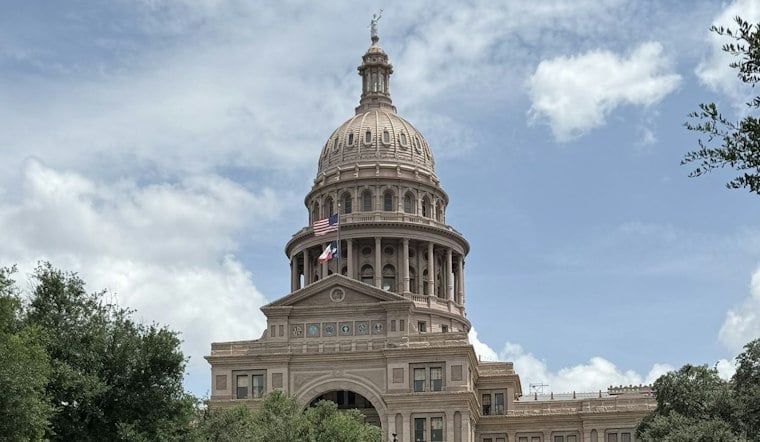
A newly filed Texas Senate bill would require every public school district and charter school in the state to report each year on how — or whether — they teach Holocaust Remembrance Week, with new teacher training aimed at districts found to be falling short. State Sen. José Menéndez, a Democrat who has represented his district since 2015, is behind the proposal, which arrives as Texas lawmakers begin stacking up bills for the next legislative session.
What Senate Bill 134 Would Actually Require
Menéndez introduced Senate Bill 134 as part of a broader filing push, dropping 61 bills on Nov. 9, the first day lawmakers could file legislation for the next session, according to JNS, which first reported on the bill for the Baltimore Jewish Times. The legislation would require public school districts and charter schools to submit annual reports detailing their Holocaust Remembrance Week activities, lessons and instructional materials. Those reports would then be compiled by the Texas Education Agency and shared with regional education service centers and the Texas Holocaust, Genocide and Antisemitism Advisory Commission.
The bill's central enforcement mechanism is a new teacher-training program aimed at school districts that had low participation in Holocaust Remembrance Week instruction, per the same reporting. But the bill as described does not identify which districts would be covered or set a specific threshold for what counts as low participation, leaving that determination unresolved for now.
A Pilot Program for Future Teachers
Beyond the annual reporting requirement, SB 134 would create a four-year pilot program at certain public colleges and universities designed to prepare future teachers to teach about the Holocaust. Under the bill's timeline, the Texas Higher Education Coordinating Board would be tasked with selecting the participating institutions by May 1, 2028. The broader bill carries a proposed effective date of Sept. 1, 2027, with the school reporting requirements kicking in for the 2027-28 academic year.
The legislation also envisions a grant program, though one explicitly dependent on securing funding. Those grants would support lesson plans, educator training, digital resources and bilingual curricula, and could also help pay for student trips to Holocaust museums, with priority given to campuses in both urban and rural districts.
How Texas Compares to Other States
Texas would be joining a patchwork of state-level efforts if the bill advances. At least 17 states already require Holocaust education as part of their secondary-school curriculum, according to the United States Holocaust Memorial Museum as cited by the Education Commission of the States. Colorado's 2020 H.B. 1336 required districts and charter schools to fold Holocaust and genocide studies standards into an existing course, and the state went further in 2023, making the subject a condition of high school graduation for school years beginning on or after July 1 of that year.
Other states have leaned on training and collaboration rather than mandates. Washington's 2019 S.B. 5612 encouraged secondary schools to teach the Holocaust and required the state's office of public instruction to work with an expert nonprofit to develop best practices and support teachers. Wisconsin lawmakers pushed similar legislation in 2021 that would have required instruction on the Holocaust and other genocides at least once in grades five through eight and again in grades nine through twelve. The Education Commission of the States noted that at least nine such bills were introduced across eight states in 2021 alone, reflecting a broader legislative trend that predates Texas's current proposal.
Why Advocates Say the Gaps Matter
The push for better Holocaust education has been fueled in part by troubling survey data. A national survey cited by the Education Commission of the States found that 63% of adults aged 18 to 39 did not know that six million Jews were killed in the Holocaust, underscoring the knowledge gap that bills like SB 134 are meant to address.
In Texas specifically, the Texas Holocaust, Genocide and Antisemitism Advisory Commission has said it is trying to reach rural communities in particular — places, the commission noted, where there isn't a Holocaust museum nearby or where educators may need more training, according to Spectrum News. Holocaust Museum Houston already offers educators across the state a free, detailed curriculum built around Holocaust Remembrance Week, a resource that could factor into how districts respond if SB 134's reporting requirements take effect.
Texas isn't alone in weighing financial incentives to support the work, either. Pennsylvania lawmakers have introduced a proposal for a Holocaust and Anti-Hate Education Grant Program, to be administered by the state's Commission on Crime and Delinquency, with individual grants ranging from $500 to $10,000, according to MyChesCo. Whether Texas's own grant program moves forward will depend on whether lawmakers ultimately allocate the funding SB 134 would require.




