

























































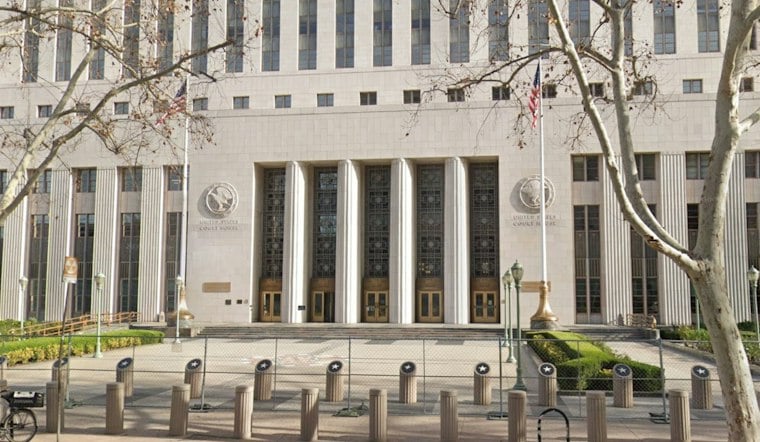
A La Puente man, a Temple City man and a Lake Elsinore woman are facing a nine-count federal indictment over an alleged scheme to smuggle counterfeit goods and other contraband from China through the Ports of Los Angeles and Long Beach. The three were expected to appear for arraignment Friday afternoon in downtown Los Angeles.
Zhe Wang, 40, also known as Chris Wang, of La Puente; Eric Ly, 38, of Temple City; and Mildred Estrada, 41, of Lake Elsinore, are each charged with one count of conspiracy, four counts of smuggling and four counts of breaking customs seals, according to MyNewsLA.com. Wang is a lawful permanent resident from China, while Ly and Estrada are U.S. citizens, according to the U.S. Attorney's Office. A Justice Department statement describes the case as involving tens of millions of dollars' worth of counterfeit and other contraband shipped from China to the ports, per the Department of Justice, Central District of California.
How the Alleged Scheme Worked
Prosecutors allege the defendants and others arranged to ship counterfeit goods from China through the two ports from July 2024 through July 2025. Per the indictment, Wang received instructions from customers in China about which cargo containers to divert, while Ly used shipping-industry contacts to find drivers willing to move containers from the ports to co-conspirators' warehouses.
The outlet's report details how containers selected for U.S. Customs and Border Protection inspection were allegedly taken to warehouses before that inspection could happen, where the cargo was removed. Wang and Ly allegedly operated the warehouses where the smuggled goods were stored and concealed, prosecutors allege, and Ly and Wang are accused of paying Estrada and others substantially above-normal trucking fees to transport the containers.
Seals Allegedly Broken and Replaced
Co-conspirators allegedly broke the containers' security seals, removed the contraband, and replaced the seals with counterfeits, per the indictment. Containers that still held their remaining cargo were then sent on to CBP-authorized inspection locations, according to the same account.
If convicted, the defendants would each face up to 20 years in federal prison for every smuggling count, up to 10 years for every count of breaking a customs seal, and up to five years on the conspiracy count. Homeland Security Investigations and the Environmental Protection Agency's Criminal Investigation Division are investigating the case, the report notes. The charges remain allegations, and the defendants have not been found guilty of any crime.
A Pattern Seen Before at the Same Ports
This is not the first time investigators have alleged a similar scheme at the twin ports. A separate case brought in January 2025 charged nine people with federal crimes over an alleged plot to smuggle at least $200 million in counterfeit and illicit goods from China through the same facilities, as reported by the Los Angeles Times. In that case, prosecutors alleged logistics company executives, warehouse owners and truck drivers moved containers to City of Industry warehouses, unloaded the contraband and replaced it with filler cargo before customs inspection — a method that echoes what prosecutors now allege in the Wang, Ly and Estrada case, though the two cases are not shown to be connected.
That earlier scheme was said to have run from at least August 2023 to June 2024, and investigators seized more than $130 million worth of contraband, including counterfeit consumer goods, illegal chemicals, and unapproved food and drugs, the Times reported. A U.S. Customs and Border Protection spokesperson described those charges as involving the largest trade fraud on record at the Los Angeles-Long Beach port complex. Officials said truck drivers in that alleged scheme earned about $10,000 per illegal shipment, compared with the roughly $200 to $300 they would normally be paid to move a single container.
The Los Angeles and Long Beach ports handle about 30% of the country's international seaborne cargo, making them a frequent target for smuggling schemes, the Times reported. In 2022, U.S. Customs and Border Protection announced the ports had seized a record $1 billion worth of counterfeit products in a single year, underscoring the scale of the problem authorities continue to confront at the twin port complex.




