

























































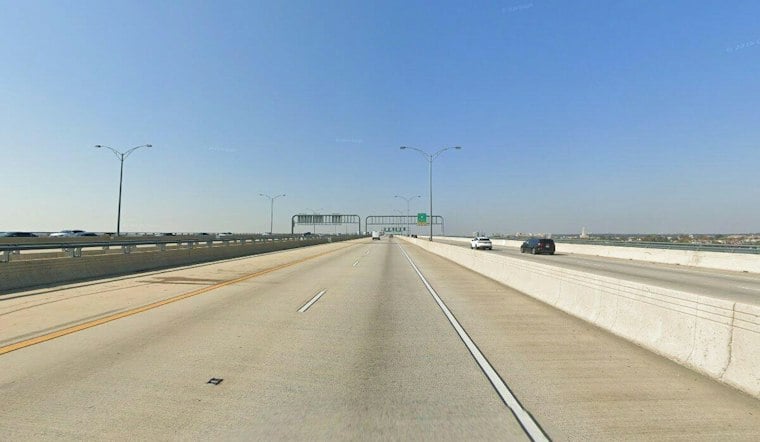
Virginia has put a price and a ramp list back in front of regional planners for express lanes on the last stretch of I-495 in the state that still does not have them. The revived submission prices the work at $2.5 billion and inventories 19 ramp projects on the Virginia side, one day before the Transportation Planning Board decides whether that package can even become the basis for a new air-quality analysis.
The Alexandria Brief reported that the Virginia Department of Transportation is advancing a study to potentially extend express lanes along 11 miles of the southern section of I-95/I-495. That southern section is the last portion of I-495 in Virginia without express lanes.
What the Virginia Submission Lists
The Brief said the revived submission lists 19 ramp projects on the Virginia side of the corridor, running between the Springfield Interchange and Route 1. The mix is 10 new ramps, eight rebuilt ramps and one closed ramp. Four of those projects are flyovers west of South Van Dorn Street.
Those are Virginia-side access changes, not the full cross-Potomac footprint. A separate account of the revised design puts the proposed project on an 11-mile run from just east of the Springfield Interchange in Fairfax County to just east of Maryland Route 210. The ramp inventory and the bridge crossing are related pieces of the same Southside proposal, but they are not the same list.
The $2.5 billion figure is the cost Virginia's revived submission puts on the project. It is not a construction contract, and it does not by itself put the lanes into the region's funded plan.
Lanes, a Transit Strip and Waiting Tow Trucks
FFXnow reported in September that VDOT's revised design proposed four non-toll lanes and two Express Lanes in each direction, along with an 18-foot-wide right-of-way down the middle for future Metro service. The transit reservation is space held in the cross-section, not a funded rail project with a start date.
The same revised plan called for stationing tow trucks near the Woodrow Wilson Bridge on a permanent basis to deal with breakdowns or accidents, because shoulder space would be reduced. That is an operating answer to a narrower bridge: a truck already nearby, rather than a shoulder wide enough to clear a stall without closing a lane.
The design therefore tries to do several things at once on a constrained crossing. It adds tolled capacity beside free lanes, keeps a strip for a Metro line that does not yet exist there, and plans around crashes and breakdowns instead of assuming the shoulder can absorb them.
Left Out of Visualize 2050
This is not the project's first pass through the regional plan. At its October 2025 meeting, the Transportation Planning Board voted to leave the I-495 Southside Express Lanes project out of Visualize 2050, the region's long-range transportation plan. Staff had already prepared two versions for public review, one with the project and one without.
On December 17, 2025, the board approved Visualize 2050, the related transportation improvement program and the air quality conformity report, according to a Metropolitan Washington Council of Governments progress report. That approval followed the vote that left the express lanes out. The adopted plan is not a pending draft still waiting on this project.
The Brief reported that projects must be included in Visualize 2050 to receive federal funding and approvals. A study, a ramp list and a $2.5 billion submission can move the conversation. They do not substitute for plan inclusion.
What Wednesday's Vote Would Actually Do
On Wednesday, the Transportation Planning Board is scheduled to vote on whether to accept Virginia's submission as the basis for a new air quality analysis. Proposed Resolution R5-2027 would approve VDOT's project submission for use in the air quality conformity analysis and approve the scope of work for that analysis.
The same proposed resolution would set a schedule allowing the board to vote on plan inclusion no earlier than March 17, 2027. That is the earliest date described for a vote on adding the I-495 Southside Express Lanes to Visualize 2050. It is a floor, not a decision that the lanes will be added that day.
Accepting a submission for modeling is a narrower act than amending the long-range plan. Conformity analysis tests whether a defined project, under a defined scope of work, fits the air-quality rules attached to the regional plan. It does not award a construction contract, open a lane or settle the shoulder and transit questions already embedded in the design.
More Miles, and a Sharper Crash Argument
Critics have already treated the revised design as a compromise that still adds traffic and risk. Greater Greater Washington reported a Rocky Mountain Institute estimate that the additional lanes should add 186 million new annual vehicle miles of travel to the regional road network.
The article's author estimated that removing shoulders would likely double congestion-causing crashes, to around two per week. The piece also reported that more than a quarter of all crashes on the bridge in the preceding 31 months caused an injury or fatality. If that observed rate continued, the author estimated, incidents in the local lanes could rise by about 12 per year, with 2 to 4 of those likely to be serious or fatal.
Those figures are estimates attached to a critical reading of the plan, not a VDOT finding and not a crash total the region has adopted as a forecast. They do line up with the design choice FFXnow described: less shoulder, and tow trucks stationed at the bridge because breakdowns and accidents would have less room to sit.
Wednesday's vote, if it follows the question now in front of the board, only decides whether Virginia's submission becomes the basis for a new air-quality analysis. Under the schedule in proposed Resolution R5-2027, a vote on actually adding the lanes to Visualize 2050 could not come before March 17, 2027.





