

























































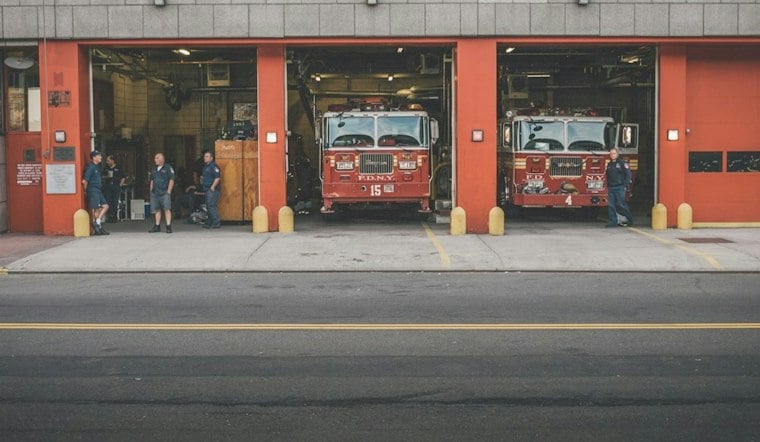
Tracy’s City Council voted unanimously to put up $600,000 toward a federal firefighter grant, but a disagreement over who pays the rest of the bill is now threatening the whole deal. At stake is a $2.9 million FEMA SAFER grant that requires the South San Joaquin County Fire Authority to come up with a $1.8 million match over three years, and Fire Chief Randall Bradley has warned that reopening the negotiated split could blow up the agreement entirely.
The grant and the fight over its matching funds were detailed in a report from Tracy Press, which covers the fire authority’s service area spanning both the city of Tracy and the Tracy Rural Fire District. Bradley told the council that if the city can’t find its share of roughly $900,000 over three years, Tracy stands to lose about $3 million in public-safety funding altogether. He argued the city should not walk away from a $3 million grant over a $900,000 contribution spread across three years.
The fire authority operates seven stations and one administration building across a 170-square-mile jurisdiction, according to the South San Joaquin County Fire Authority. Four of those stations sit within Tracy’s city limits, while three more — Stations 93, 94 and 95 — belong to the rural district, located on Durham Ferry Road, Schulte and Hansen Roads, and Tracy Hills Drive respectively. The authority says it responds to calls as a single jurisdiction, sending whichever unit is closest regardless of which member agency owns it.
A Tangled Cost-Split Formula
The fire authority normally splits costs 67.5% to Tracy city limits and 32.5% to the rural district, but for this grant match, the authority recommended an even split of about $906,000 apiece. The Tracy Rural Fire District board voted on October 19 to pay 50% of the required match, even though Bradley said the district had only committed to 37.5% beforehand. Bradley now plans to ask the rural board to approve raising its match share to $1.2 million, even as the Tracy council hesitated to allocate the full amount the authority requested.
That hesitation is tied to where the money would actually go. Council members Steve Abercrombie and Dotty Nygard pushed back on the proposed interim staffing plan, which calls for distributing nine new firefighters across the authority’s service area while a permanent Station 98 is still being planned. Under that plan, one position would be assigned across the rural district and one flexible position would float across the whole service area, with a fourth firefighter added to Truck 91 at Station 91 on 11th Street.
Council Members Question Where Firefighters Would Go
Abercrombie asked directly whether the authority would even receive the grant before Station 98 is built, and he said he objected to keeping a 50-50 match split if two of the three new positions end up serving rural stations. He instead favored assigning one firefighter position to Station 95, one to Station 94 and one to Truck 91. Nygard argued that waiting until Station 98 opens could prove more cost-effective than hiring nine firefighters ahead of time, and council member Dan Arriola said he was inclined to agree with both Abercrombie and Nygard.
Bradley pushed back on reshaping the deal, warning that changing the match formula could prompt the rural district to reject the negotiated agreement outright, and that amending the agreement risked the district rejecting both it and the grant itself. He said the interim staffing was meant to supplement staffing needs while Station 98 remains absent, and that the compensatory fix for not having that station yet would be boosting staffing at other stations. According to Bradley, the authority could still receive the grant and get firefighters on duty immediately under the interim approach. He also noted that rural district stations already serve city-limit growth areas including Tracy Hills and Ellis.
Why Station 98 Matters So Much
Station 98 would be owned by the Tracy Rural Fire District and is likely to be sited on Valpico Road between Corral Hollow Road and Lammers Road. It’s intended to cover southwestern Tracy, the Tracy Hills and Ellis developments, the Cordes Ranch industrial area, and rural land south of town. The original plan for the station called for hiring nine firefighters, three for each of three shifts. The Tracy Hills development alone includes 6,000 approved homes about five miles outside town, a growth driver that has put pressure on the area’s fire coverage.
Bradley pointed to two recent fires as evidence of the stakes. He described the June 2026 Medline fire on Promontory Parkway, which destroyed a 1 million-square-foot building, as the largest structure fire in the U.S. that year, per his own account. He also cited the Corral Fire, which burned more than 14,000 acres southwest of Tracy near Tracy Hills in June 2024.
Other California Cities Have Hit Similar Snags
Tracy isn’t the only California city wrestling with SAFER grant strings. In Redding, the city was awarded around $5 million through the same FEMA program to add firefighters to engine crews, but it only collected about $2.9 million after missing its staffing goal of four firefighters per engine, according to KRCR. Redding’s council voted to seek a FEMA hardship waiver to lower that staffing requirement, with city staff expected to report back on December 1 on what was submitted, after staff said the grant period had expired before the city logged enough eligible expenses to claim the rest of the money.
A similar staffing-condition snag surfaced in Belmont, North Carolina, where a SAFER award was structured to fund 75% of firefighter salaries in each of the first two years and 35% in the third, according to Citizen Portal. That city’s fire department said an outside firm had mis-tagged positions in its grant application, complicating its own match obligations. Both cases underscore how SAFER grants can come with staffing strings that end up shaping local budget fights long after the award is announced.
For now, Tracy’s council has locked in its $600,000 contribution, but the broader standoff over staffing placement and the rural district’s match share remains unresolved. Bradley’s message to the council was blunt: the city risks losing a $3 million grant over a comparatively small three-year contribution, while council members continue to weigh whether the interim staffing plan serves the right stations before Station 98 is ever built.




