

























































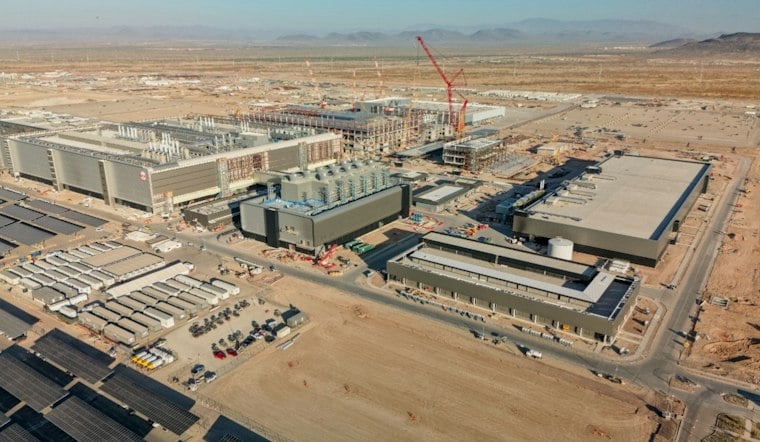
TSMC's sprawling north Phoenix chip campus could eventually draw as much electricity as roughly 300,000 homes, according to new documents filed with Arizona's state utility regulator. The filings put a staggering number on a project that's already reshaping how the state's biggest utility plans to keep the lights on.
The estimate comes from an application Arizona Public Service filed asking the Arizona Corporation Commission to approve an energy contract with TSMC, as reported by KJZZ. The application estimates TSMC would use about 1.9 gigawatts of energy at full buildout, a dramatic jump from earlier projections. The Arizona Technology Council had previously said TSMC's first construction phase was expected to require about 200 megawatts, which APS said was equivalent to powering nearly 30,000 Arizona homes — a fraction of the full-buildout figure now on the table.
If approved, the contract would make TSMC the first company to receive power through APS's so-called subscription model, a framework built for the utility's most power-hungry customers. APS says it's shoring up renewable energy resources and building natural gas power infrastructure specifically to support TSMC's growing energy needs, per the same KJZZ report.
A New Gas Plant Tied to the Chipmaker's Rates
Central to the filing is a proposed natural gas facility APS calls the Desert Sun Power Plant, which the utility wants to build roughly 13 miles west of Gila Bend. According to APS, the site would be capable of adding around 1,280 megawatts to Arizona's energy portfolio, though Utility Dive has reported the facility as a 1,238-megawatt combined-cycle plant slated to come online in 2032 to serve large-customer subscription load — a discrepancy the available filings don't explain. APS has said construction on the project is planned to begin in 2028, if regulators sign off, and the utility expects the buildout to require two new switchyards and two transmission lines.
APS maintains that TSMC's contracted rates would cover the costs of building the plant, and that the facility would add generation to the grid that benefits more than just the chipmaker. Whether the Corporation Commission approves the contract, and on what terms, remains to be seen — the filings reviewed so far don't spell out the rate structure, contract length, or how costs would shift if TSMC's actual demand ends up above or below the projections.
Part of a Bigger Power Squeeze
The TSMC filing lands amid a broader scramble across Arizona's grid. Utilities have said nearly 100 existing data centers in the state are already driving a short-term power crunch, the station's report noted in October. APS has estimated that data center customers made up about 7% of its peak load this year, up from roughly 5% the year before.
Since 2023, APS has sought bids for 8 gigawatts of additional energy capacity to have ready by 2031, and the utility's director, Mike Eugenis, has said 4.5 gigawatts of that total is earmarked purely for data centers. The research firm Cleanview has estimated that 95 data center projects are planned statewide, which combined would triple current data center energy use in Arizona.
Those numbers track with APS's own long-range forecasts. The utility projects peak demand will grow about 3.4% annually over the next 15 years, driven by industry and data centers, according to Utility Dive. APS forecasts peak demand will exceed 14.5 gigawatts by 2041, nearly 60% higher than its current record peak of about 9.2 gigawatts.
Who Foots the Bill
The scale of the buildout has already drawn scrutiny over who pays for it. A 12News investigation was headlined as finding that APS customers paid $587 million tied to data-center-sector growth, though APS has denied that claim. That dispute sits alongside the open questions in TSMC's own filing — including exactly how the subscription contract's costs would be structured if the chipmaker's real-world demand diverges from the 1.9-gigawatt estimate.





