

























































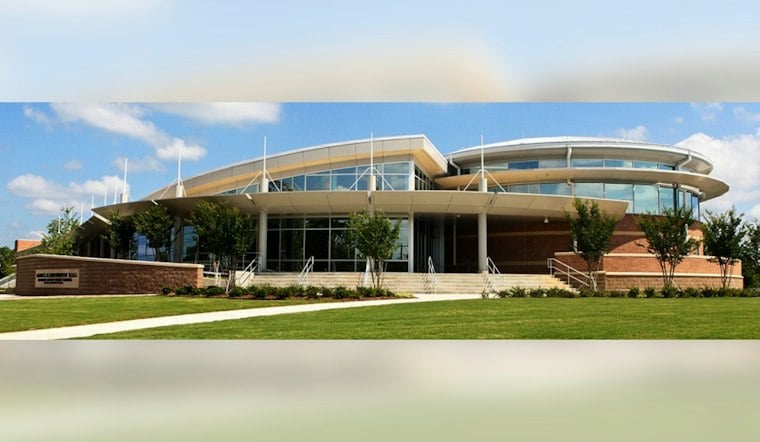
Tuskegee University cut the ribbon Thursday on its new $14 million Carver Genomics Center, capping more than five years of development on a facility leaders say is designed to confront cancer disparities that have hit Macon County especially hard. University President Dr. Mark A. Brown told attendees that cervical, breast and prostate cancer morbidity rates in Macon County are in some cases 70 percent higher than rates elsewhere in Alabama, a state he said already has higher cancer morbidity rates than most of the country.
The ribbon-cutting, held in Macon County, marks the latest milestone for a project that WSFA reports was in the works for more than five years. According to the station, the Carver Genomics Center is intended to address health disparities and improve representation in clinical trials and medical development, while also giving Tuskegee students hands-on access to direct cancer research and opportunities across healthcare fields.
A Long-Planned Annex Takes Shape
Tuskegee had previously described the project as a $14 million annex to the Carver Research Center, according to Tuskegee University, with the explicit goal of ensuring broader representation in research development and clinical trials. The university's own account of the groundbreaking noted that construction would be completed by Bailey-Harris Construction of Auburn, Alabama, and that the building's construction cost was partially supported by a National Institutes of Health grant, numbered C06OD032083.
Financing for the center came together without the university taking on debt, per facts shared at the opening ceremonies, with federal and local tax credits secured through area credit unions helping cover costs. The university's earlier announcement specified that Hope Enterprise Corporation had committed $7 million in New Markets Tax Credits to the project. At the opening, Rotary District 6880 presented Tuskegee with a $125,000 check in Macon County as part of the festivities.
Five Years of Research Ahead
The center actually launched in 2024, with its first phase focused on building the infrastructure needed to support modern genomic science, the university said in a more recent announcement. That update describes the project now transitioning from planning and capacity building into five years of full research operations, supported by nearly $10 million from the National Institutes of Health. Research efforts will focus on three cancer-related projects, per the same university account, continuing work that Tuskegee says will target health inequities affecting Macon County and the surrounding region.
University leaders framed the center's mission in personal terms at the ribbon-cutting. Dr. Thierno Thiam, Tuskegee's provost and senior vice president for academic affairs, said the center represents access, discovery, and the potential for students from Tuskegee to lead scientific innovation.
Community Trust Built Into the Model
Central to the center's approach is its relationship with the people it studies. Researchers have built a model that prioritizes informed consent, transparency and ongoing dialogue while working closely with residents in Macon and Bullock counties, according to the university's announcement. That emphasis echoes broader concerns in the field: a study published in the Journal of Genetic Counseling has noted that a lack of diversity among genomic research participants can result in disparities in the benefits of genetic testing, and that community engagement strategies have been used elsewhere in Alabama to recruit more diverse populations into similar research.
The university also pointed to continued physical expansion supporting the center's work. In August 2025, Tuskegee broke ground on a new 8,000-square-foot research annex intended to support the center's growing research portfolio, according to the university's announcement. Combined with this week's ribbon-cutting, the additions signal that Tuskegee intends the Carver Genomics Center to remain a long-term fixture of its research mission rather than a one-time capital project.



