

























































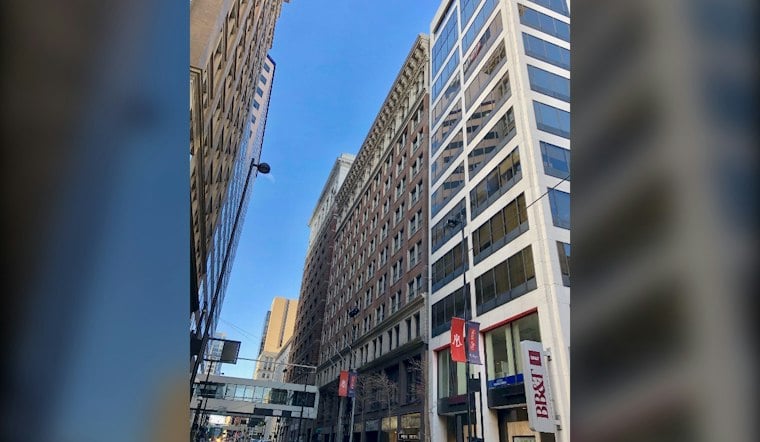
Two historic high-rises that have sat empty in downtown Cincinnati for years are getting a combined $5.1 million from the state of Ohio, money meant to fund cleanup and interior demolition as developers push toward long-delayed conversion plans. One building is headed for apartments. The other is supposed to become the region's first Kimpton hotel, a project that has been announced since 2017 and still hasn't broken ground.
Pogue Annex Eyed for 122 Apartments
The H&S Pogue Service Building, a 12-story red-brick annex near Race and Third streets that once served the H. & S. Pogue department store, has sat vacant since 2005, according to Centre Daily Times. Located at 310 Race St., the building is planned to become a 122-unit apartment building with ground-floor commercial space, per the same report, with ABC Reality Advisors and Saul Urban LLC aiming to convert it into affordable housing. A separate report from ThinkTV lists the same address with a different plan version calling for 106 apartments, a portion of which could be set aside at 60 percent of area median income; the evidence does not clarify whether the differing counts reflect separate stages of planning.
Rich Palmer, a spokesperson for Cincinnati's Office of Strategic Growth, said the state funding closes critical financing gaps and reduces the city resources needed for development, the outlet reported. The Pogue project's share of the new money is earmarked for hazardous materials abatement and interior demolition, work that typically has to happen before a vacant tower can be gutted and rebuilt inside.
Traction Building Hotel Still Stuck Since 2017
The second building, the Traction Building near Walnut and East Fifth streets, was built in 1903 and has been targeted for conversion by Nashville-based Parkes Development. Centre Daily Times lists the address as 423 Walnut St., while Local 12 identifies it as 432 Walnut St. The conversion plan was first announced in 2017, and Cincinnati issued a warning to the developer that it would likely begin enforcing repair orders and rescind a tax abatement if the project did not start soon, Local 12 reported.
Room counts for the planned hotel also vary across the available reporting. Centre Daily Times describes a 151-unit Kimpton hotel, Local 12 reports 152 rooms, and Parkes Development's own announcement describes a proposed 153-room Kimpton Hotel for the Walnut Street site. The portion of the new state funding tied to the Traction Building is intended for asbestos abatement, selective interior demolition and infrastructure improvements, according to Centre Daily Times, whose reporting draws on an earlier Cincinnati Enquirer account describing the Traction plans as having moved slowly.
Parkes Development has separately secured a construction loan for the redevelopment, though the company declined to name the lending bank or disclose the loan amount, Local 12 reported in a related story.
Part of a Bigger Downtown Office Pipeline
The two projects sit inside a broader wave of office-to-residential activity downtown. The Port of Greater Cincinnati's own figures put the city's office vacancy rate at roughly 20 percent, with more than 9 percent of Cincinnati's office space currently being converted or planned for conversion and about 3.2 million square feet of space in the conversion pipeline, according to The Port of Greater Cincinnati. A CBRE report cited by the Port ranked Cincinnati second nationally for office-to-residential conversions, trailing only Cleveland, while a 2024 RentCafe report placed the city fifth in the nation for completed 2023 conversions and 11th for planned apartment conversions, with more than 2,300 units in that pipeline.
Not every analysis lands on the same figures. ThinkTV, citing 2023 CBRE data, reported that 7 percent of Cincinnati's office inventory was planned for conversion or already in progress across 11 projects totaling 2.4 million square feet. Nationally, Brookings has cautioned that office-to-residential conversions in large U.S. cities have been slow to materialize, citing market uncertainty and zoning constraints.
Since 2000, more than 1,300 residential units have been created from office conversions in downtown Cincinnati, with nearly 500 more expected to come online by the end of 2024, per the Port's figures. More recent additions include Urban Sites' Atlas Building project at 530 Walnut Street, which Cincinnati City Council approved for $2.9 million in Downtown/Over-the-Rhine East TIF funding on top of $5 million in Ohio Historic Rehabilitation Tax Credits, according to WVXU. That $22.8 million project is slated to bring 67 housing units and more than 12,000 square feet of commercial space, with roughly half the units affordable at 60 and 80 percent of area median income. Elsewhere downtown, Ashley Commercial Group has already opened 19 on the Park, a 52-unit community built from an $11 million office conversion that was reported nearly full, according to the Cincinnati Business Courier, which separately tallied 10 downtown office-conversion projects representing more than $500 million in investment citywide.




