

























































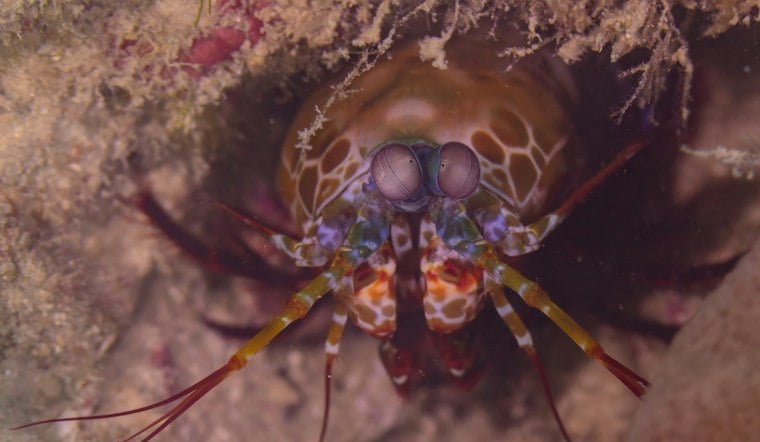
Mantis shrimp can see colors that no human eye will ever register, and a University of Hawaiʻi at Mānoa researcher just helped explain how. A new study found that these reef-dwelling crustaceans rely on at least 12 distinct types of light receptors and 17 rhodopsin proteins working together to detect a dramatically wider slice of the light spectrum than most animals, humans included.
The research, published in Science Advances in October, was co-authored by Megan Porter, a professor in the UH Mānoa School of Life Sciences, according to the University of Hawaiʻi News. The study dug into how mantis shrimp eyes detect light and what happens biologically when they do, as later reported locally by Kauai Now. Researchers found that special proteins and natural pigments work together to help mantis shrimp sense a wider range of light, including far-red wavelengths that sit entirely outside human visual range.
Seventeen Proteins, A Dozen Ways to See
At the center of the findings are the 17 rhodopsins the team studied, proteins that enable mantis shrimp to detect a broader range of light than most other animals. Per the study detailed on Science.org, those 17 rhodopsins are involved in color sensing and rely on functionally diverse signaling through what scientists call Gq/Gi coupling. The same research identified at least 12 photoreceptor classes in mantis shrimp eyes, each tuned to specific wavelength ranges spanning 300 to 700 nanometers.
Three of those rhodopsins stood out for absorbing light beyond 600 nanometers, a feat the study's authors described as representing exquisite far-red-sensitive animal rhodopsins. That far-red sensitivity does not come from the rhodopsins alone. The same research found that carotenoid filters combine with multiple individually tuned rhodopsins to extend the animals' broad vision all the way into the far-red spectrum.
Mapping the Molecules
The researchers studied 17 opsins: 15 long-wavelength-sensitive opsins and two middle-wavelength-sensitive opsins. The two middle-wavelength rhodopsins absorbed light maximally at 455 and 459 nanometers, while twelve of the long-wavelength rhodopsins clustered with absorbance maxima near 540 nanometers. Several of the blue and red rhodopsins also showed photoreversibility, meaning they shift their light absorption in opposite directions depending on how retinal binds within the protein.
The anatomy behind all this chemistry sits in the mantis shrimp's midband, a strip of six specialized rows within the eye. According to the study, rows 1 through 4 handle color discrimination, while rows 5 and 6 are responsible for the animal's separate ability to detect polarized light.
What It Means for Understanding Vision
Porter framed the broader significance of the work in terms of what it reveals about animal perception generally. “Animals have all sorts of sensory abilities that we don’t think of and oftentimes can’t imagine, and understanding that really opens up our own world,” she said, according to Kauai Now's reporting. She added that understanding how rhodopsins respond to different wavelengths and work together can explain the underlying mechanisms behind mantis shrimp vision.
The university's own account of the findings echoes that framing, noting the study helps scientists understand how eyes can detect different types of light and turn that information into signals. The photograph used in reporting on the study's co-author was credited to Michael Bok, who photographed Porter for coverage of her work.
Beyond Biology, Toward New Sensors
Mantis shrimp vision has already proven useful outside the lab. The University of Hawaiʻi News reports that mantis shrimp eye research has previously inspired small sensors capable of detecting color as well as the direction or vibration of light waves. The new study's authors suggest the findings could inspire scientists to develop new ways to detect light using technology, though no specific device or commercial product has been tied to this research.
Hawaii News Now similarly reported that the findings could inspire new technologies for detecting light, including possible broadband sensors and potentially medical applications, though those uses remain prospective rather than realized. Separately, researchers writing in Optica suggested that the bistable nature of these light receptors may help mantis shrimp adjust to rapid underwater shifts in how much light is available and what spectrum it falls in.
How It Compares to Human Sight
The comparison to human vision varies depending on the source. Optica reports that mantis shrimp have at least 12 types of photoreceptor cells compared with four in humans, while a separate account from Eco Magazine states that humans have three types of color-sensitive cells. Either way, the gap between mantis shrimp and human perception is stark, and Optica notes some mantis shrimp species can even detect circularly polarized light, a capability with no human equivalent.
This is not the first time mantis shrimp vision has drawn scientific attention. Earlier research found that the rock mantis shrimp carries six photoreceptors dedicated specifically to ultraviolet light, each tuned to a different wavelength.





