

























































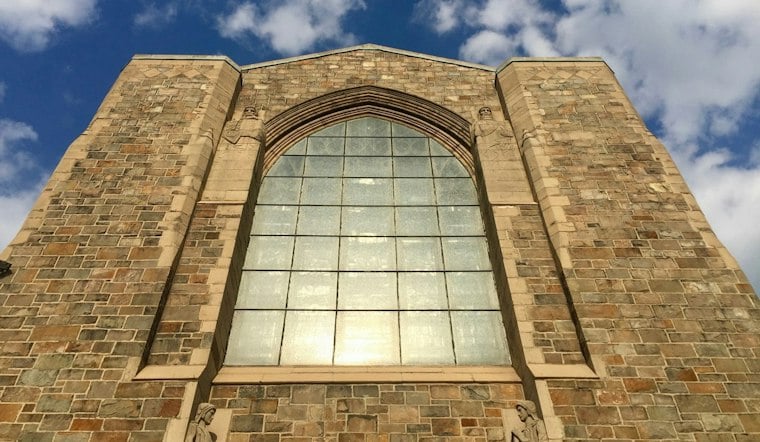
The landmark University Circle church known for generations as the Holy Oil Can has a buyer lined up, and he's not a stranger to the neighborhood's tech scene. Jonathan William Piper of Waite Hill, a software company executive, computer scientist and inventor holding 11 U.S. patents, is set to purchase the long-vacant church property, though the deal has not yet closed and its financial terms remain under wraps.
The congregation’s departure is recent: on March 1, 2026, the church held a final service, formally deconsecrated the building and released it for “any honorable use”; the congregation was disbanded the next day. Its roots reach back to 1831, and the building was commissioned after the 1919 merger of two Methodist congregations. The final-service program documents the closure, while Cleveland Historical’s account traces the church’s origins and the building’s design.
According to Cleveland Magazine, a certificate of disclosure issued this week by the City of Cleveland's Building Department as part of the sale transaction documentation named Piper as the buyer. Terms of the pending sale, which hasn't yet closed, weren't publicly revealed, the outlet reported. The seller is the East Ohio Conference of the United Methodist Church, based in North Canton, which put the property on the market in April 2025 asking $1.5 million.
Piper is the chief scientific officer and vice president of business development at MIM Software, a GE Healthcare company headquartered on Science Park Drive in Beachwood with additional offices in Europe and China. MIM Software was assigned 11 U.S. patents developed and submitted for medical imaging by Piper over 15 years, two of which were co-developed with Jerimy Brockway, per the same report.
A Landmark With a Nickname Rooted in Its Shape
Built in 1928, the church was declared a Cleveland Landmark by Cleveland City Council in 2013. Its building measures 54,081 square feet on 1.64 acres, according to Cleveland Magazine's reporting. The property sits at an address the City of Cleveland's own designated-landmarks listing gives as 1919 East 107th Street, though a Case Western Reserve University Encyclopedia of Cleveland History entry lists the building's address as 1907 E. 107th St. — a discrepancy that remains unresolved in the available records.
Landmark status carries practical limits for a future owner: Cleveland requires review of exterior changes to designated landmarks, with a Certificate of Appropriateness required before work begins. That does not by itself rule out a new use, but it means proposed exterior alterations would go through a city review process. The city’s landmark rules describe those requirements, which could shape renovation plans for the church.
The church earned its distinctive nickname from its shape, and for decades its 200-foot spire dominated the skyline. The structure was University Circle's tallest building for 56 years, Cleveland Magazine notes, until the Cleveland Clinic's Walker Center, originally built as the Ohio Industrial Commission rehab center at 10524 Euclid Ave., eclipsed it in 1984 with a height of 208 feet across 16 floors.
How the Skyline Has Kept Climbing Since
The Walker Center's reign didn't last forever either. One University Circle, a 20-story tower at 10730 Euclid Ave. standing 234 feet tall, surpassed it sometime after 2018. Today the tallest nearby structure is the 24-story Artisan Apartments at 10700 Chester Ave., which rises 267 feet — and it will soon have company, with the 262-foot East Stokes tower under construction next door as part of the Circle Square development, per Cleveland Magazine.
Other former houses of worship in the area have already found new life. The 1931-built First Church of Christ, Scientist at 2200 Overlook Rd., with its 155-foot-tall bell tower, now operates as the EY-Nottingham Spirk Innovation Hub, the magazine reported — a precedent that underscores how University Circle's historic religious architecture has increasingly transitioned into institutional and commercial use.
A nearby adaptive-reuse example took years of planning and renovation: design firm Nottingham Spirk bought the former First Church of Christ, Scientist in 2003 and converted it into its Innovation Center, which opened in 2005. The company says historical tax credits helped with the project. That history shows one path for a former church in the area, but it does not establish what Piper intends for the Holy Oil Can. Nottingham Spirk’s account of the conversion describes the timing and role of the tax credits.
Open Questions Remain Around the Deal
Hanna Commercial Real Estate is the listing agency for the property. Bob Biggar said Hanna had no comment on potential transactions and would respond if permitted, according to the outlet's reporting. Separately, Cleveland Magazine's Neotrans column noted it had not received replies from Piper or MIM Software marketing director Jim Janek, and said the article would be updated if responses are received.
What Piper intends to do with the building once the sale closes has not been disclosed, and neither the final sale price nor other terms of the transaction have been made public. The certificate of disclosure confirmed only his identity as the buyer, leaving the future of one of University Circle's most recognizable landmarks, for now, an open question.





