

























































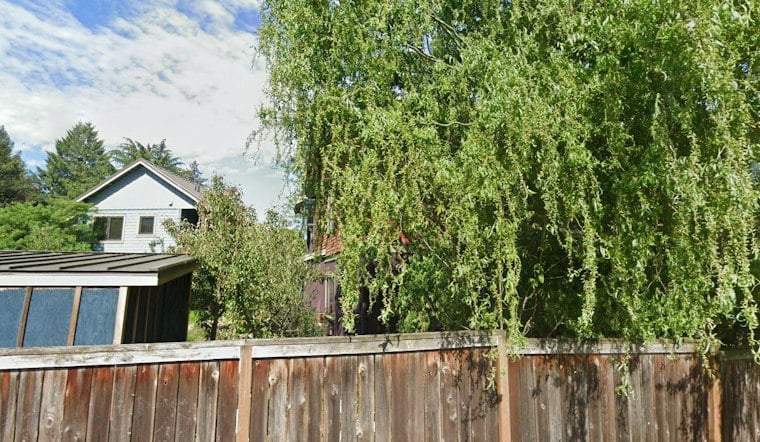
University Park neighbors spent Wednesday night at a vigil for a redwood and the house beside it, both more than a century old and both now lined up to come down. A Bureau of Development Services notice says the tree is scheduled for removal, and the University Park Neighborhood Association says Greenwood Homes LLC is expected to build new housing in their place.
The fight is local and immediate, but it lands in a city that has spent a decade writing rules about which trees stay. KPTV reported that association members held the vigil on Nov. 11 and still hope to work with the builder and the City of Portland. By publication, the station said it had not heard back from either.
A Candlelight Ask, Not a Finished Case
John Garofalo, who has lived in the area for more than 30 years, told neighbors the tree's beauty, the wildlife it supports and what it gives the block are worth defending. He also described University Park as a livable place tied to culture, family and ancestry. KOIN reported that he estimated the redwood at 126 years old. That figure is his estimate, not a city measurement.
Madeline Masters put the incentive more bluntly: there is a strong reason, she said, to destroy the very things that draw people to the city. Steph Mohr, a board member of the University Park Neighborhood Association, said neighbors want to keep the same kind of loss from repeating in other neighborhoods.
The association's stated aim is collaboration, not a locked confrontation. Members hope to sit down with the home builder and the city. As of KPTV's report, that conversation had not started in public. The developer and the city had not answered the station.
Six Houses, On Paper
KOIN reports that plans call for six new single-family homes to replace the North Portland house and tree. That number comes from the station's reporting, not from a statement by Greenwood Homes or the city in the material available here. The association's account is broader: new housing where the tree and house stand now.
KPTV, citing the city website, reported that Greenwood Homes LLC has several permits pending or under review for plots in the area. Pending and under review are not the same thing as a finished approval, and those listings were described as covering several plots, not pinned in the reporting to a single issued demolition permit.
What is on the record is narrower and harder to soften. A Bureau of Development Services notice says the tree is scheduled to be removed. The exact day, the stated reason and the underlying permit documents were not part of the published accounts. Neighbors are organizing against a scheduled removal whose paperwork they can see only in outline.
Canopy Goals, and a Code Under Rewrite
The redwood is one tree. Portland's own numbers describe a city still short of the shade it says it wants. Portland Monthly reports that canopy covers 32 percent of the city's land area. The Urban Forest Plan aims to raise that to 35 percent by 2045 and 45 percent by 2065. A century-old conifer does not move those percentages by itself. Cutting one, while the official target points up, is the kind of subtraction neighbors notice.
The rules meant to manage that tradeoff are Title 11, the formal tree code the city passed in 2015 for trees on public and private property inside city limits. In 2025 Portland eliminated most tree-removal permit fees and opened a revision of the code. Draft amendments are expected for public comment in spring 2027. Whatever happens on this North Portland lot will be decided under the code as it stands, not under amendments that have not been released.
The city's tree-removal FAQ says Title 11 lets homeowners remove problem trees — dead, dying, diseased, dangerous, a nuisance species, or next to a building — and replant a replacement. That language does not establish whether any of those categories fits this redwood. Nothing in the neighborhood accounts describes the tree as dead, diseased or a hazard. The notice says it is scheduled to come out. The reason is not in the reporting.
Shade is not only a planning slogan. Portland Monthly tied the canopy debate to Multnomah County's 72 heat deaths in 2021, all but three of them attributed to June's heat dome. That is context for why a large tree gets a vigil, not a claim that this redwood would have changed that summer.
Portland Has Argued This Before
University Park is not the first block to treat a tree removal as a neighborhood event. In 2015, neighbors in Eastmoreland tried to save three large sequoias slated to come down for construction, The Oregonian reported. That same year, near Southeast 41st Avenue and Clinton Street, neighbors protested a removal and one of them climbed a remaining tree.
Development and a big tree are not always opposites. In Cully, Noelle Studer-Spevak and Eli Spevak helped build Cully Grove, a 16-unit cohousing community where they live, and a deodar cedar still stands at a corner of the property, Portland Monthly reported. The project went up. The tree stayed. That is a design choice, not a rule that binds Greenwood Homes.
The other edge of the code is also on the books. The city paid Sarah and Joel Bond $272,400 after a falling tree crushed their Southwest Portland home. Two years earlier, the city had denied their permit to cut that tree down. Preservation has a cost when the city says no and the tree later fails. Removal has a cost when the thing being removed is the reason people say they live on the block.
What Is Still Open
For this lot, the next documented steps are administrative, not ceremonial. The tree is on a removal schedule. Greenwood Homes has area permits still pending or under review. KOIN's account of six single-family homes is the most specific picture of what could replace the house and redwood, and it has not been confirmed in a statement from the builder or the city.
The association wants a conversation before the chainsaws. Mohr's point was about the next neighborhood as much as this one. Spring 2027 is when Portland expects the public to see draft tree-code amendments. Wednesday's vigil will not rewrite Title 11. It does put a named redwood, a house older than a century, and a housing plan on the same block, in front of a city that says it wants more canopy and has not yet answered the neighbors asking it to prove that on this corner.





