

























































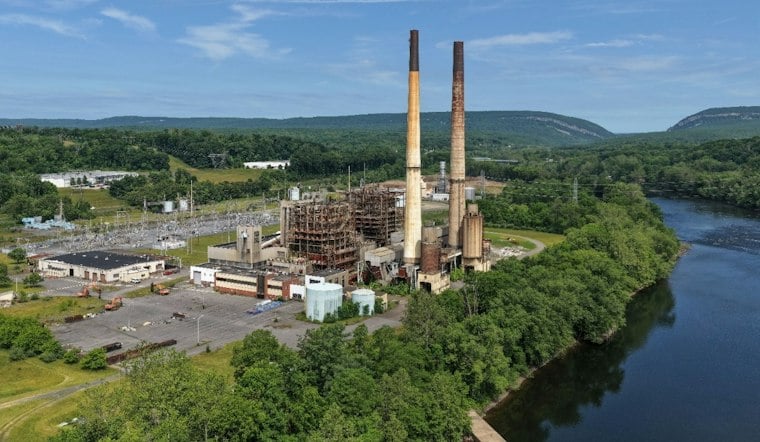
Two sharply different blueprints for a massive data center campus along the Delaware River came before Lehigh Valley regional planners this week, and they walked away with more questions than answers. The proposals, which would rise near the former Portland Generating Station coal-fired power plant in Upper Mount Bethel Township, both carry a listed maximum electrical demand of 2,100 megawatts — even though the two designs look nothing alike on paper.
The Lehigh Valley Planning Commission's Comprehensive Planning Committee added the Slate Belt Technology Campus proposals to its meeting agenda, giving the project its first formal regional review. Developer Slate Belt Holdings, a partnership between Talen Energy and Lou Pektor's River Pointe Logistics Group, is seeking to build on the same stretch of land where the township previously approved a 12-building River Pointe logistics project — an approval for just under 6 million square feet of warehouse space that, according to WFMZ.com, stalled before ever coming to fruition.
This time, the developer isn't offering one plan but two. Design 1 calls for 29 data center pads — 23 on the west side of River Road and six on the east side — with a 3.3 million-square-foot campus footprint that would employ roughly 1,200 people. Design 2 is a far leaner alternative: six buildings, five on the west side and one on the east, ranging from 171,425 to just over 395,000 square feet apiece, totaling a 1.4 million-square-foot footprint and an estimated 600 jobs.
Same Power Demand, Very Different Footprints
That contrast — a nearly 2.4 times larger building footprint in Design 1 compared to Design 2, yet an identical maximum electrical draw — is exactly what caught the attention of LVPC commissioners and members of the public at the meeting. Both designs are being reviewed by the LVPC separately, and a spokesperson for Slate Belt Holdings told the commission that the two versions represent separate, alternate approaches to developing the same site, explaining that power demand would stay the same because different technology would be deployed inside the buildings depending on which design moves forward. The spokesperson declined to elaborate further on the specific technology involved.
Jill Seitz, the LVPC's chief community and regional planner, said the applicant should spell out how the two alternate designs relate to one another, particularly when it comes to shared infrastructure and improvements that were previously approved for the site under the earlier logistics proposal. The regional review flagged the shift from a logistics center to a data center use as a substantial change from what was previously proposed for the property.
Earlier reporting on the project has reflected some of that same uncertainty in the numbers. lehighvalleylive.com reported in October that either version of the roughly 900-acre campus would generate 2.1 gigawatts of electrical load including computing power and ancillary equipment, while the Morning Call reported the plans targeted 2 gigawatts of electrical capacity. The two outlets also diverged on building totals: lehighvalleylive.com put Design 1's footprint at 3.3 million square feet and Design 2's at 1.4 million square feet, while the Morning Call reported 3.5 million square feet for the 29-building design and nearly 1.5 million square feet for the six-building version.
A Coal Plant Site Reimagined
The proposed campus would combine 752 acres on the west side of River Road with 152 acres on the east side at the site of the former coal-burning plant, according to lehighvalleylive.com's October report. The plans describe closed-loop cooling for the data centers, with any water removed from that system trucked away to a facility approved by the Pennsylvania Department of Environmental Protection. The Morning Call separately reported that FirstEnergy has an agreement with Slate Belt Holdings to provide half of the campus's desired electrical load, and that an end user for the facility had not yet been designated as of October.
The LVPC's review found that shifting the site from logistics warehousing to data center use could actually reduce previously anticipated freight traffic and water consumption while opening up new economic opportunities for the region. At the same time, the commission identified campus scale, electrical demand, supporting infrastructure, and proximity to sensitive natural, scenic and recreational resources as significant regional planning considerations moving forward. Because the LVPC serves only in an advisory capacity, it will ultimately be Upper Mount Bethel Township that decides the project's fate.
What's Next for the Township
The Upper Mount Bethel Township Planning Commission has scheduled consideration of both proposals for its meeting Wednesday. Separately, township supervisors voted to advertise a hearing for Nov. 23 on a new data-center zoning ordinance, according to a separate lehighvalleylive.com report, a sign that local officials are moving to put formal rules in place around a project of this scale.
Upper Mount Bethel's debate is unfolding against a backdrop of rapid data center growth statewide. An October industry inventory counted 79 operating data centers in Pennsylvania, with seven more under construction and 46 planned, according to Engineering News-Record. The Pennsylvania Public Utility Commission has also raised concerns about what all that growth means for the grid: a study released in September found that, based on regional grid operator PJM's load forecast at the time and without additional policy action, the grid would fail to meet PJM's reliability planning standard from 2027 through 2030, according to the Pennsylvania Public Utility Commission.
Elsewhere in the Lehigh Valley, data center development is already moving forward on a much smaller scale. Bethlehem's Planning Commission recently granted land development plan approval and three waiver requests for a proposed 65,590-square-foot, two-story, 120-megawatt data center, per WFMZ.com's coverage of that city's review — a fraction of the size and power demand under discussion in Upper Mount Bethel. Pennsylvania's municipal code recognizes municipalities' role in providing for legitimate land uses, and Upper Mount Bethel's township officials will decide whether, and in what form, the Slate Belt Technology Campus gets built.





