

























































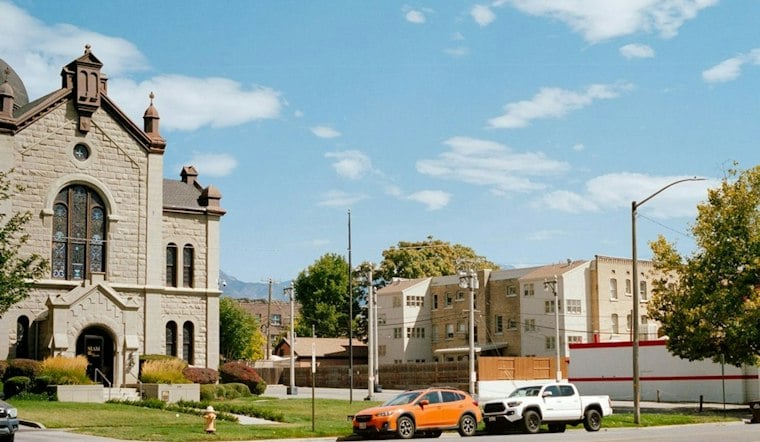
Utah built the infrastructure to resettle more than 1,000 refugees every year for decades, but this year the state welcomed just 152, according to Olivia Whiteley, director of strategy for Reliable Refuge. The gap comes as researchers warn that Utah, despite its youthful population and high fertility rates, is on a collision course with the same demographic slowdown reshaping the rest of the country.
A Researcher's Case for Immigration as Demographic Fix
Whiteley made her case during a roundtable hosted Wednesday by the Sutherland Institute, arguing that domestic and international migration are becoming the driving forces behind Utah's population growth, as reported by Utah News Dispatch. She said nearly 21% of Utah's population growth from 2024 to 2025 was due to international migration, even as demographers project smaller household sizes and an older median age statewide. Robin Fretwell Wilson, a family and health law professor at the University of Illinois Urbana-Champaign, described Utah's demographic imbalance as “wicked in a way that even the culture wars are not,” adding that migration could help solve it.
Nationally, the picture is shifting fast. Net international migration to the United States peaked at 2.7 million in 2024, according to the U.S. Census Bureau, then fell 48% to 1.3 million in 2025 and is expected to decline further to about 321,000 in 2026 — a trend the same report attributes to recent immigration policy changes that have reduced the number of international admissions to the country.
Refugee Capacity Far Outpaces Current Arrivals
Whiteley urged Utah leaders to call for an operational refugee minimum, pointing to the stark gap between the state's long-standing capacity and its current intake. She proposed bipartisan congressional action to codify a refugee floor shaped by state input, which she said would guarantee Utah a baseline number of admissions each year, and noted that Utah has already led the country in codifying the state's administration of the refugee program.
The economic case Whiteley laid out leans on both age composition and tax contributions. She cited an American Immigration Council analysis of a 2023 survey showing that 77% of America's foreign-born population is between 16 and 64 years old, compared with 60% of the U.S.-born population. Immigrants, she said, fund services for American retirees and fill labor gaps with younger workers, with agriculture, construction, STEM fields and transportation increasingly reliant on immigrant labor, and care work in particular depending heavily on immigrant workers as demand grows alongside an aging population.
Tax Contributions and Fiscal Tradeoffs
On the fiscal side, immigrants were estimated to have paid about $652 billion in combined federal, state and local taxes in 2023, including $31.2 billion paid by refugees specifically, the same Utah News Dispatch report states. A 2024 HHS study found refugees and asylees contributed $123.8 billion more in revenue than government expenditures over a 15-year period. That federal-level benefit comes with a documented state and local cost, however: according to a fiscal-impact brief from the U.S. Department of Health and Human Services, ASPE, refugees, asylees and their immediate families were a net benefit to the federal government, estimated at $37.5 billion, but a net fiscal cost to state and local governments, estimated at $21.4 billion.
Where Utah Ranks Among Western States
Separate research from the Kem C. Gardner Policy Institute shows Utah received 85,137 net international migrants from 2020 through 2025, ranking 24th among all states by raw total. But measured as a rate, Utah's net international migration of 24 new migrants per 1,000 residents ranked 13th highest in the nation over that same period. Among Mountain Division states, the institute found Utah had the third-largest number of net international migrants but the highest rate per 1,000 residents in the region. The same research brief notes that the Census Bureau's methodology does not differentiate between authorized and unauthorized migration and does not explicitly estimate unauthorized migrants.
That Gardner Institute data also shows Utah's international migration pattern tracked the national trend closely — slowing sharply during the COVID-19 pandemic in 2020 and 2021, surging from 2022 to 2024, and then dropping steeply in 2025, with net international migration accounting for a sizable share of the state's total net migration across those years.
Long-Term Projections Loom Over the Debate
The backdrop to Whiteley's proposal is a set of long-range federal projections that frame immigration as an increasingly central demographic lever. The Congressional Budget Office projects that the annual number of deaths will exceed the annual number of births starting in 2030, with net immigration expected to become an increasingly important source of population growth as that shift takes hold, according to the CBO's own website as cited by Utah News Dispatch. The CBO also projects that U.S. population growth will slow from an average of 0.3% a year to just 0.1% a year between 2037 and 2056, with the total population projected to stop growing and begin shrinking in 2056. The population served by Social Security, meanwhile, is projected to increase from 349 million people in 2026 to 364 million in 2056 — a gap that officials and researchers warn would affect both the broader economy and the federal budget as fewer births collide with an aging population.





