

























































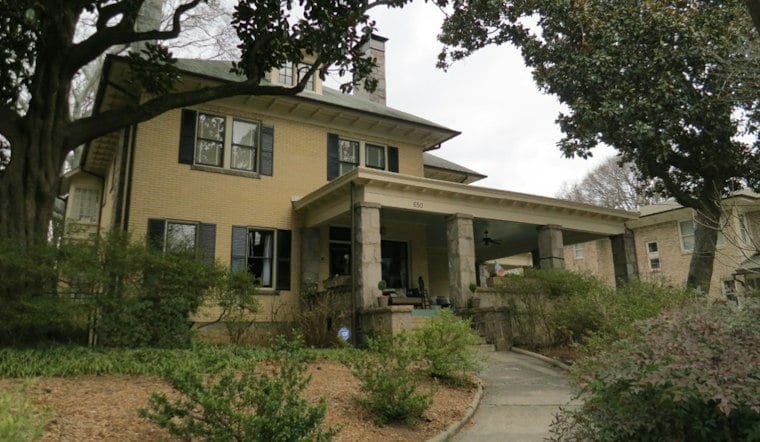
A weathered house on a hill along Ponce de Leon Place in Virginia-Highland is where, in August 1982, an Atlanta police officer walked in and arrested a man named Michael Hardwick — setting off a legal fight that would reach the U.S. Supreme Court and reshape the national conversation on gay rights. Now the 1920s-era home faces a very different threat: its owner has submitted plans to tear it down and build a new house with a pool in its place.
The city has not approved that demolition, according to the Atlanta Journal-Constitution, which first reported on the standoff over the property's future. Local residents are instead pushing for historic landmark designation, hoping to preserve a building most passersby would never guess carried such weight in American legal history.
A Case That Tested Georgia's Sodomy Law
Hardwick's arrest at the house became the basis for Bowers v. Hardwick, a case that challenged Georgia's sodomy statute and reached the nation's highest court. The Supreme Court decided the case in 1986, and the ruling went on to help shape the broader gay rights movement in the years that followed, per the same AJC account. Hardwick's lawyer, Kathy Wilde, represented him through the litigation, and the two were photographed together at Colony Square in Atlanta in September 1986 as the case drew national attention.
The U.S. Supreme Court's own opinion, reproduced by Justia, held that Georgia's statute was constitutional and found no fundamental constitutional right to engage in sodomy. That holding stood until the Court reversed course. The New Georgia Encyclopedia states that Bowers v. Hardwick was explicitly overturned in 2003 by Lawrence v. Texas, while Rough Draft Atlanta reported the decision was overturned in 1998 — accounts that diverge on the date even as both agree the ruling was eventually struck down.
City Council Moves Toward a Landmark Bid
Atlanta's City Council passed a resolution asking the director of the Urban Design Commission to nominate the Virginia-Highland property as a landmark building, the AJC reported, a step that opens the door to formal consideration but falls short of actually designating the home. Councilmember Kelsea Bond introduced the resolution, which passed unanimously and was co-sponsored by Councilmembers Alex Wan and Matt Westmoreland, according to Rough Draft Atlanta's coverage of the vote. The outlet also notes the property is already included in Atlanta's 2023 LGBTQ+ Historic Context Statement, a document cataloging sites tied to the city's LGBTQ history.
The home has drawn attention from Charlie Payne, an advocate and historian.
A Zoning Hearing Looms Thursday
Property owners seeking to demolish a structure like this one may request a variance, and Atlanta's five-member Board of Zoning Adjustment has scheduled a hearing on that request for noon Thursday at Atlanta City Hall, per the AJC. NPU-F had deferred its own vote before the BZA set the new hearing date. Whether the board grants the variance, and what that would mean for the landmark nomination moving through City Council, remains to be seen.
Atlanta's push mirrors a broader, uneven effort to preserve LGBTQ history across the country. The National Park Service published its LGBTQ Heritage Theme Study in 2016, the same year Stonewall was designated a National Historic Monument, according to the National Trust for Historic Preservation. The Stonewall Inn itself was first listed on the National Register of Historic Places back in 1999, which the Trust describes as the first listing of a site known specifically for its LGBTQ history. Since then, sites including Denver's First Unitary Society, Washington's Slowe-Burrill House, and the Lorraine Hansberry Residence in New York have joined the register between 2017 and 2021.
Atlanta's own historic context study, cited by the National Trust alongside a similar effort in Raleigh, reflects a local attempt to document that history.
What Happens Next
For now, the fate of the Virginia-Highland house sits at the intersection of a zoning hearing and a landmark nomination process that has only just begun. The City Council resolution requests that the Urban Design Commission's director formally nominate the property, but it does not itself grant landmark status, and the demolition plans the homeowner submitted remain on the table. Residents hoping to save the house will be watching Thursday's hearing closely, aware that a single zoning decision could determine whether the site where a Supreme Court case began still stands.




