

























































What voters can do
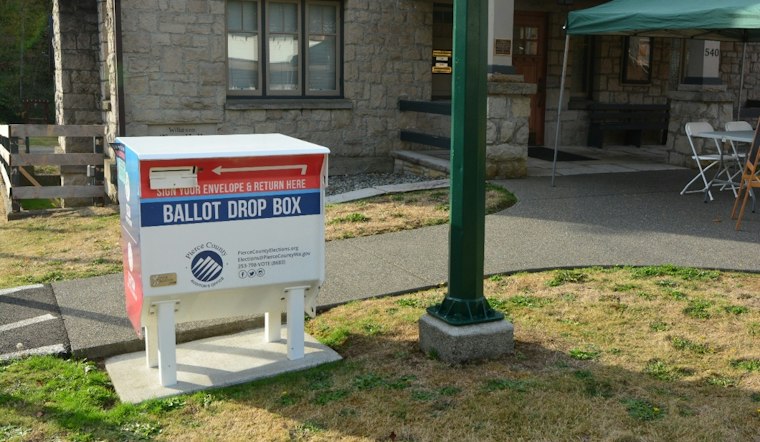
Washington law requires ballots postmarked by Election Day to be counted if they arrive by the deadline for certification. Allard advised voters to use official ballot drop boxes or mail at least a week before Election Day. Voters taking a ballot to a post office can ask for a manual postmark when they drop it off, he said; USPS says the service is free, according to its statement on election mail.
The Postal Service said it authorized special election-mail procedures nationwide from Oct. 24 through Election Day, Nov. 3. In areas covered by RTO, managers are to separate returned ballots, hand-cancel them on the day they are collected and arrange daily transport to local election offices, according to a USPS memorandum.
The Postal Service’s response
USPS reported that 97.98% of ballot mail was delivered on time against its service standard through Oct. 9 and said its network had no major reported disruptions. It also cited its report that 99.6% of ballots were delivered from voters to election officials within three days during the 2024 general election. The agency said it would not implement or enforce the Ballot Mail for Federal Elections rule for this general election, according to its statement.
What the study measured—and what it projects
A University of Washington research brief projects that postal delays could double the share of ballots arriving too late to count. Research lead Scott W. Allard estimated that 20,000 or more people who mailed ballots before Election Day could be affected, according to UW News. Allard also projected that late arrivals could account for 1% to 1.5% of all Washington ballots this cycle. These are forecasts, not a count of ballots already rejected.
The researchers examined voter-level ballot records and county-level rejection figures from the Washington Secretary of State. The late-ballot analysis examined state primary and general elections from 2020 through 2025. UW News reported that, across the period studied, about 11% of primary ballots and nearly 5% of general-election ballots were postmarked by Election Day but arrived afterward.
The report’s 2025 comparison found that late-arrival rejections affected 3.2% of ballots from ZIP codes covered by the Postal Service’s Regional Transportation Optimization program, or RTO, versus 1.4% of ballots from other ZIP codes. Voters in RTO ZIP codes were also nearly three times as likely to have a ballot postmarked by Election Day but delivered too late to count. The statewide county-average late-rejection rate was 1.1% that year, about twice the typical rate in past general elections, according to the UW findings.
How mail handling and rural exposure factor in
RTO, introduced in October 2023, changed collection and processing for mail from ZIP codes more than 50 miles from a regional processing center. In those areas, collection shifted from twice daily to once daily; a ballot may not receive a postmark until it reaches a processing facility, potentially the following day or later. The program began in about two dozen Washington ZIP codes in February 2024 and later expanded. More than 90% of rural Washington voters in the 2024 general election lived in a ZIP code covered by RTO, UW News reported.
A separate ProPublica analysis found that nearly 2,000 ballots arrived late in 11 predominantly rural eastern Washington counties during that cycle’s primary, compared with about 600 in the 2022 midterm primary. In urban Spokane, ProPublica found that late-ballot rejections fell. These comparisons come from ProPublica’s reporting and analysis, not the UW study. ProPublica also reported increases in service-change-related rejections in California, Ohio, North Carolina and Oregon. Separately, NPR cited a national estimate of 43,000 to 55,000 additional ballots potentially rejected because of RTO.
If a ballot has a signature problem
A separate University of Washington Evans School report found that roughly three in five ballots challenged for a signature issue from 2020 to 2024 were cured before certification. For an unsigned ballot declaration, the Washington Secretary of State says voters may cure the problem by signing in person by close of business the day before certification.
The UW brief has not been peer-reviewed, and the researchers plan to submit the findings to an academic journal, according to the university. Allard said the burden of postal delays falls disproportionately on rural voters and people in outlying suburban communities, and argued that voters should not be left solely responsible for addressing the problem.





