

























































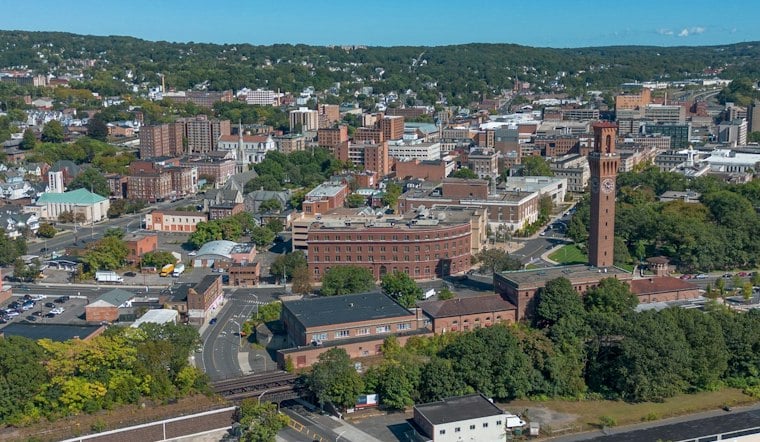
Waterbury officials are chasing $16.5 million in state and federal grants to clean up a 20.5-acre stretch of long-dormant industrial land just west of downtown, the former home of Anaconda American Brass. The money would fund environmental remediation at the Freight Street site, a sprawling former manufacturing campus that has sat largely empty for decades while the city works to make it usable again.
The Waterbury Development Corp. board approved the grant applications on Tuesday, according to Hartford Business Journal. The ask breaks down into three pieces: $10 million from the state's Community Investment Fund 2030 program, $6 million from the state Department of Economic and Community Development's brownfields program, and $500,000 from the U.S. Environmental Protection Agency. None of the three applications has been awarded yet, and the outlet's reporting does not indicate when decisions are expected.
The same WDC board meeting on Tuesday also produced a separate, already-finalized deal: a $2.42 million contract with Trumbull-based Stamford Wrecking Co. for demolition and environmental cleanup work at the city's Anamet site on South Main Street, a different industrial property across town. The city has already spent millions in state and federal funding demolishing buildings at the former Anaconda campus itself, but officials have not estimated what the site's total cleanup bill will ultimately run, saying that figure awaits further study.
A Site Built for Reuse, If the Money Comes Through
Part of the pitch for Freight Street is location. The site sits within walking distance of a Metro-North passenger station and near the interchange of Interstate 84 and Route 8, and any redevelopment there could tie into roads and underground utilities that were rebuilt through an infrastructure improvement initiative completed in 2020. James Nardozzi, the WDC's executive director, said he envisions the cleanup eventually bringing new housing and businesses to the property, with benefits rippling into the broader regional economy.
Nardozzi also pointed to financial incentives that could sweeten the deal for whoever eventually builds there, noting that potential developers can access federal opportunity-zone benefits along with state enterprise-zone tax incentives. The Freight Street property remains the subject of a redevelopment vision.
A Brass City Legacy Left Behind
The site's industrial pedigree runs deep. Freight Street was used for brass manufacturing from the mid-1800s until Anaconda American Brass Co. shut down operations there in 1975, a span that fits into Waterbury's broader history as a global brass-manufacturing hub from the mid-19th through mid-20th century that earned it the nickname the Brass City. Brass manufacturers once employed tens of thousands of workers across the city, turning out everything from ammunition and military hardware to plumbing fixtures, buttons and household goods.
After Anaconda closed, Environmental Waste Resources Inc. ran an industrial-waste processing business on the property for nearly 30 years, and Phoenix Soils later used part of the site to bake contaminants off polluted soils. Waterbury began taking ownership of polluted industrial sites and tapping state and federal resources to prepare them for redevelopment under former Mayor Neil O'Leary, and the city acquired the three properties that make up the Freight Street site between 2020 and 2023.
Why Public Money Is the Only Path Forward
The scale of Waterbury's brownfield backlog is reflected in a 2016 U.S. Environmental Protection Agency estimate that the city had roughly 200 brownfields scattered across its footprint.
The state's own brownfield grant program reflects the scale officials are working with — Connecticut's Brownfield Municipal Grant Program lists grants of up to $6 million, though the actual ceiling depends on the funding round's published notice, per the Connecticut Department of Economic and Community Development. Separate engineering analysis from Tighe & Bond has described nearby Freight Street and West Main Street parcels as carrying more than 150 years of industrial history, including a stretch as a hazardous-waste treatment, storage and disposal facility.
Other Waterbury Brownfields Show the Long Road Ahead
Freight Street is not the only brownfield the city is working through. In a separate, already-reported phase of this same campus, the city previously moved to spend $5.44 million on foundation and subsurface-utility removal at 170 Freight Street, with soil testing planned once the concrete slabs came out. And at the unrelated Anamet site, officials have spent years untangling a 17.4-acre former brass manufacturing campus the city bought for $650,000 in 2017 through a limited liability company set up for the purchase, later putting nearly $3 million in city funds — most of it toward a new roof — into a roughly 200,000-square-foot high-bay building to keep it viable for reuse.
That project has also drawn a tentative buyer: Waterbury officials have negotiated a possible sale of the Anamet property to Cornerstone Realty, operated by the Albert family, under a deal that would bring Waterbury-based plumbing supply company Torrco on as a tenant. The WDC board reviewed that tentative arrangement in late August, though Nardozzi has said the sale remains under negotiation, with a private-sector closing expected sometime in 2027. On the funding side, the WDC and DECD recently agreed to conditions of a $5.3 million cleanup grant for Anamet, part of roughly $11 million in grants expected to support that site's multiyear remediation effort. “The reality is that without the DECD as a partner, we would never have reached the stage we are in,” Nardozzi has said of that project.
Monday's $2.42 million Stamford Wrecking contract, funded by a state grant, covers demolition of the former administrative building, concrete slab removal, remediation of the former power plant and construction of an exterior wall at Anamet, with room for additional contaminated soil removal, petroleum removal and groundwater treatment. Most of that work carries a 140-day completion window, while the groundwater treatment portion is allotted a full year. None of that contract applies to the Freight Street site, which remains a step behind in the cleanup pipeline as its grant applications await a decision.





