

























































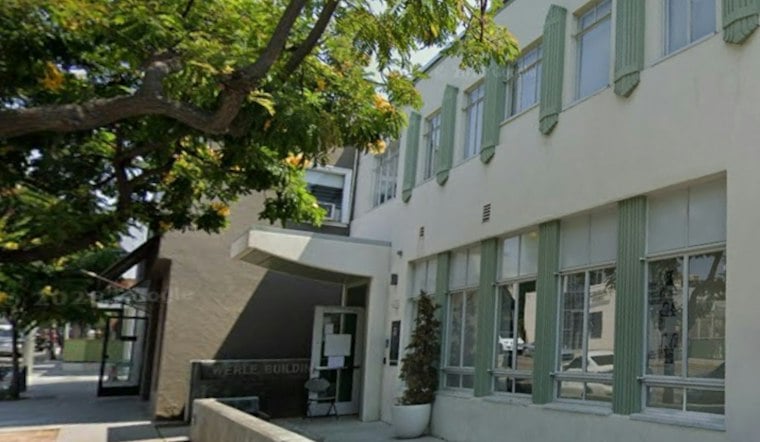
West Hollywood's Log Cabin Recovery Center, a historic Robertson Boulevard building that hosts more than 90 addiction recovery meetings a week, is headed toward a major rebuild after the City Council approved an $18.4 million construction contract at its November 16, 2026, meeting. The contract awards the job to Shawmut Design and Construction, pairing preservation of the roughly 90-year-old structure with a sizable expansion of recovery services on the site.
Before the meeting, WEHO Online reported that the council would consider awarding Shawmut the project at 621 N. Robertson Boulevard at its November 16, 2026, meeting. WEHO TIMES reported that the council approved the contract, whose underlying construction value is $16,141,751, with a 14% contingency of roughly $2.26 million built in, bringing the authorized construction amount to a cap of $18,401,596. Shawmut, formally known as Shawmut Woodworking & Supply Inc., doing business as Shawmut Design and Construction, was selected as the lowest responsive and responsible bidder after competitive bidding, per the staff report cited by the outlet. Three firms submitted proposals: Plant Construction Company bid $16.36 million, and PCL Construction Services bid approximately $17.5 million, both higher than Shawmut's winning figure.
What the Rebuild Actually Covers
The project folds together preservation of the historic building with expanded recovery facilities, accessibility improvements and broader property modernization, the outlet reports. Rehabilitation work includes removing non-historic additions, architectural restoration, replacing building systems and the roof, exterior improvements, new windows and doors, and interior restoration — all of it set to follow the Secretary of the Interior's Standards for the Treatment of Historic Properties. That attention to historic character traces back to 2016, when the City of West Hollywood identified the property as eligible for the National Register of Historic Places in its Commercial Historic Resources Study.
Beyond the historic shell, the plan adds roughly 3,400 square feet of support facilities, including new meeting rooms, office space, restrooms and other operational spaces, per the WEHO TIMES report. The broader site work covers reconstruction of the adjacent public parking lot, landscaping, security improvements, EV charging stations, photovoltaic shade structures and pedestrian accessibility upgrades. The project was developed in coordination with the West Hollywood Recovery Center, historic preservation consultants and design professionals, the outlet notes.
Meetings Keep Running Through Construction
Construction is slated to unfold in two phases, and recovery meetings will continue during the first phase of work on support facilities and site improvements, according to the report. Once the expanded space is ready, West Hollywood Recovery Center operations will relocate there — consolidating services that currently sit in separate locations. The city's own project page notes the expansion includes two additional meeting rooms meant to accommodate and consolidate those services into a single site, and that the center currently hosts more than 4,500 meetings a year at the Log Cabin.
Shawmut would be required to complete the project within 410 working days of receiving formal notice to proceed, the WEHO TIMES report states. Construction work cannot begin, however, until required federal environmental reviews are complete and written authorization is issued. That caveat lands against a backdrop of earlier delay: a report from California Construction News in April 2024 projected construction would begin that October and wrap by December 2025, while a January 2026 account from WEHO TIMES pushed the expected start to spring 2026 following months of permitting-related delays.
Other Contracts Riding Alongside the Big One
The November 16 agenda bundled several smaller agreements tied to the same project. The council authorized an additional $343,033 payment to Lehrer Architects LA Inc. for construction administration services, on top of that firm's existing agreement, which carries a 15% contingency and a total authorized amount of $1,968,952.95 under a contract extending through June 30, 2029. Separate agreements covered $98,351.63 to AESCO Inc. for geotechnical engineering and soils inspection services, $160,572 to Smith-Emery Laboratories Inc. for deputy building inspection services, and $93,336 to Gafcon PM-CM LLC for labor-compliance oversight. Combined, the construction and professional-services authorizations total $19,148,343.72, per the WEHO TIMES report.
The Log Cabin project carries an estimated overall budget of $27.79 million, the outlet reports. Local funding accounts for $22.79 million of that figure, including $5.75 million for property acquisition and $17.04 million covering planning, design, renovation, expansion and construction. Outside grants make up the remaining roughly $5 million, including $3 million from Los Angeles County, $1.15 million in state funding and $850,000 from the U.S. Department of Housing and Urban Development. Separately, West Hollywood's city government page states that more than $10.5 million in funding has been allocated to date, and that Los Angeles County's Board of Supervisors approved $3 million in American Rescue Plan Act funds for the project in August 2024.
A Decades-Old Deal for a Deed-Restricted Property
West Hollywood's history with the Log Cabin site stretches back years before the current contract talk. The city initially authorized a lease with an option to purchase the property in March 2020, then exercised that purchase option in March 2022, formally acquiring it from the City of Beverly Hills the following month. A deed restriction on the property requires it remain dedicated to recovery-related services and public parking, cementing its future use regardless of how the renovation proceeds. City officials have framed the broader project as a way to support social services, upgrade aging infrastructure and maintain a long-term recovery-community facility in West Hollywood.
A CEQAnet record indicates the project was approved and found exempt from the California Environmental Quality Act in June 2024, according to a search-result listing from the California Environmental Quality Act Network. That listing is a truncated snippet rather than the full underlying record, so the complete CEQA documentation remains to be independently reviewed.




