

























































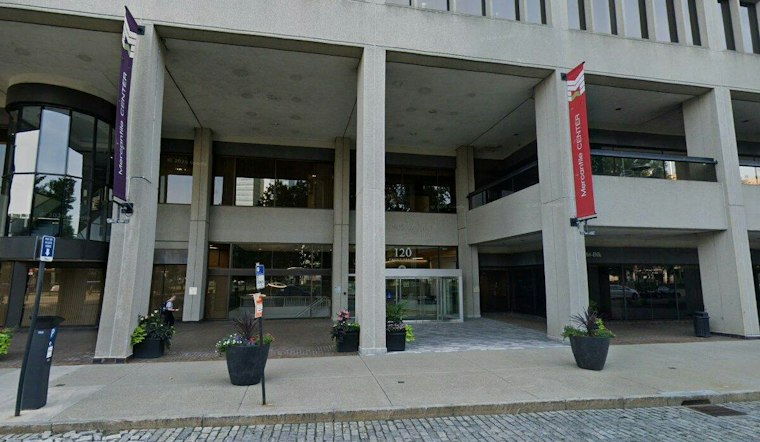
Canines for Disabled Kids scheduled its sixth annual Over the Edge rappel for November 14, a 110-foot descent from the Mercantile Center at 120 Front Street in Worcester. The height is the draw. The organization says the money is for school programs about service dogs, help for people considering one, and scholarships toward training costs for children and teens.
The date, the building and those uses are spelled out on the organization's event page. A companion PledgeIt listing names the Mercantile Center and puts the descent at 110 feet.
The Roof On Front Street
The Front Street address was already on the fundraiser's map. Canines for Disabled Kids scheduled its third annual Over the Edge for November 18, 2023, at 120 Front Street, and limited that year's rappel to 90 slots, according to the organization's 2023 event page. This year's listing calls the November 14 date the sixth annual.
Kristin Hartness has said the Worcester group is the only organization licensed in Central Massachusetts to hold an Over the Edge event. Over the Edge is a North American company that partners with nonprofits to raise money through building rappels. She has said the shared rappel lets participants do things together, and that the event has grown immensely and should keep growing.
Administrative manager Maggie Kilcoyne has said the internal goal was to do better than the previous year's total. The office is not the roof. Canines for Disabled Kids lists 65 James Street, Suite 210, on its homepage. Front Street was the invitation. James Street is the address the organization lists.
Accepted First, Then A Grant
Scholarships run from $250 to $5,000. The scholarship committee decides where a grant lands in that range, the organization's scholarship page says, and Kilcoyne has said the amount varies with a family's circumstances. Five thousand dollars is the published ceiling. Two hundred fifty is the floor.
The sequence is the harder part. A child must already be accepted by an Assistance Dog International member, an International Guide Dog Federation member, or another qualified training program before applying. The scholarship does not open the door to training. It is help after a program has said yes.
The awards go to children under 18 who have gone through the service-animal process. The nonprofit makes them twice a year, in January and June, about 15 to 20 in a calendar year. A participant who raises at least $1,000 can name a scholarship after someone. That $1,000 buys the name, not a set award. The committee still picks the amount.
Applications are not the scarce piece, on the organization's account. Its Incredible Pairings page says scholarship applications for 2026 continue to exceed previous years. Canines for Disabled Kids does not train the dogs. It helps families identify the tasks a service dog would need to handle and connect with a program that fits. Rappel funds, as the event page describes them, also cover school education and help for people only considering a service dog. The acceptance letter governs the grant. It does not govern those other uses.
The Bill Beside The Scholarship
That Incredible Pairings page prices service-dog training at $35,000 to $55,000, and says a family's share can run as high as $24,000. The largest scholarship, $5,000, sits well under that family share. The smallest, $250, barely moves it. The committee is funding a portion of the cost, and the portion has a cap.
Canine Companions uses a different price list. A Purina Pro Club page reports that Canine Companions says training a service dog can cost up to $45,000 and include up to two years of training. The page also reports that 50 percent of dogs in training never graduate, often because of behavioral or health issues, and that Canine Companions had more than 400 people waiting to receive an assistance dog.
The washout rate is one reason selection has become research. The Purina account describes a collaborative two-year study by researchers at the Duke Canine Cognition Center and Canine Companions, aimed at cognitive tests for service-dog candidates. That waitlist is not Worcester's. It is the kind of bottleneck sitting upstream of a rule that will not take a scholarship application until some program has already accepted the child.
Federal guidance uses a specific definition. The ADA service-animal FAQ defines a service animal as a dog individually trained to do work or perform tasks for a person with a disability.
Older Than The Roof
Hartness has multiple sclerosis. She received her first service dog in the early 2000s, and she has said that during that first year her falls dropped from more than twice a week to twice in six months. Rocky is her fourth service dog.
The nonprofit was founded in 1998. Incredible Pairings, a separate fundraiser, has been held for 17 years, its PledgeIt page says. Over the Edge is the newer piece, a sixth annual descent from one Worcester roof, attached to a campaign set to run through December 31.
Donations tied to the rappel fund scholarships for children under 18 who have gone through the service-animal process. The standing award months are January and June, which puts the next round in January. Scholarship applications for 2026 continue to exceed previous years, the organization says. The family share can still reach $24,000. The committee's range still stops at $5,000.





