

























































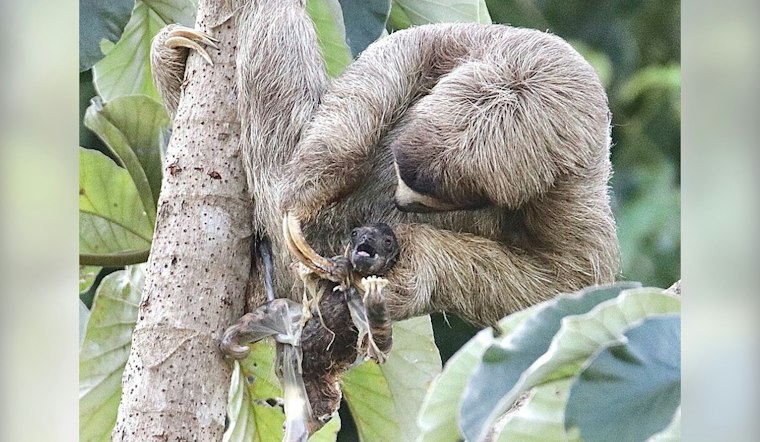
Zoo Atlanta has a new, very sleepy resident. The zoo announced that Nutella, a Hoffmann’s two-toed sloth, gave birth to an infant on October 30, and the baby will stay tucked away behind the scenes until warmer weather returns.
According to a news release from Zoo Atlanta, the infant is expected to be visible with Nutella outdoors once the sloths return to their outdoor habitat this spring. The zoo’s announcement calls the new arrival the third offspring of Nutella and male Cocoa, though a separate Zoo Atlanta page listing new arrivals identifies Waffles, born on October 13, 2025, as the pair’s third offspring — a discrepancy the available materials do not resolve.
Nutella and Cocoa were matched up through the Association of Zoos and Aquariums’ Species Survival Plan, a program designed to maintain healthy, genetically diverse, and self-sustaining animal populations in accredited zoos, per the zoo. Their pairing has now produced multiple offspring over the past couple of years, including Rolo, who FOX 5 Atlanta reported was born on August 9, 2024, and was the first male sloth born at Zoo Atlanta. That outlet noted the zoo’s Sloth Care Team selected Rolo’s name from nearly 2,000 public submissions, and visitors could see him with or near his mother at the Brazilian Outpost section of the Orkin Children’s Zoo.
Born Ready to Cling
Sloth babies arrive more prepared for the world than most newborn mammals. The gestation period runs an uncommonly long 11 to 12 months for an animal of this size, and infants are born fully furred, with their eyes open, teeth already present, and fully developed claws for clinging to their mothers, the zoo’s report explains.
Gina Ferrie, Zoo Atlanta’s Vice President of Collections and Conservation, said sloths offer a window into the natural world that goes beyond their reputation for slow movement. “Sloths have so many behaviors and adaptations that highlight the incredible biodiversity of our natural world,” Ferrie said. “They also give us the opportunity to share a conservation story that helps our Members and guests appreciate the impact of human activities on wildlife.”
That behavior is on full display at the zoo, where sloths are described as almost exclusively arboreal, rarely touching the ground and doing nearly everything — including eating — upside down.
Not Endangered, But Not in the Clear
Hoffmann’s two-toed sloths are not currently classified as endangered. The species is listed as Least Concern given its wide distribution, presumed large population, and presence within a number of protected areas, according to xenarthrans.org.
Still, the species faces mounting pressure in the wild across Central and South America. The same group reports that the sloths are affected by ongoing deforestation, wildfires, hunting, and illegal trade, with some subpopulations — particularly in Colombia, Central America, Bolivia, and Brazil — declining due to severe habitat degradation and fragmentation.
The zoo’s own announcement points to habitat loss tied to illegal logging as a growing threat, and reports that hundreds of sloths are electrocuted each year while using power lines to travel between fragmented patches of forest. Those population pressures are part of why the zoo frames each birth, including Nutella’s latest, as a small contribution to a broader conservation effort.
For now, Atlanta visitors will have to wait. The newest arrival, along with Nutella, isn’t expected to be visible outdoors until spring, when the zoo’s sloths typically return to their outdoor habitat for the warmer months.



